Raising capital is not said to be the boldest idea anymore; it’s totally about how you can execute it. Today, investors rarely fund raw ideas, and they back founders who can demonstrate that their products work, identify their target users, and explain why the market actually exists.
That’s when a build-up mobile prototype comes into play as a strong asset.
So, if you are a startup founder, solo entrepreneur, or early-stage product leader preparing for angel or seed funding, your prototype is no longer optional.
As per industry insights, startups having a functional, high-fidelity mobile app prototypeare more likely to secure early investments, as it helpsin reducing the risks by turning assumptions into something more tangible, making it much easier for the investors to evaluate clarity, user flow, and real-world relevance within minutes of a demo version.
This comprehensive guide is specially designed for the founders who actually want to build a mobile app prototype that attracts investors, not just looks good.
You will have an understanding of what investors want to see and how to present your true ideas clearly without wasting any money.
By the end of this, you will be able to know how to utilise your prototype to strengthen your pitch and get investors on board.
What is a Mobile App Prototype & Why Investors Need One?
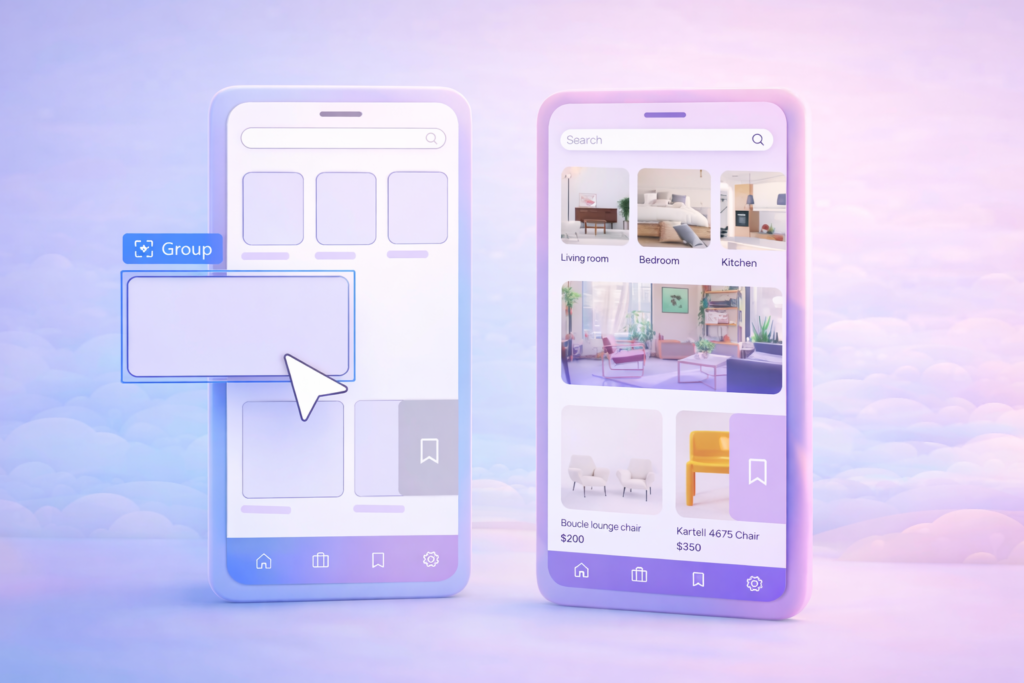
A mobile app prototype is a working model of your app that demonstrates how it looks and functions.
Unlike mockups or wireframes, mobile prototypes allow users to interact with your app, click buttons, and navigate between screens.
Also referred to as an interactive, non-functional, or semi-functional simulation of an app’s interface created before full-scale coding to demonstrate its look and functionality and improve the user experience.
With a global mobile app market projected to grow from approximately $252.9 billion to $626.4 billion by 2030, it clearly indicates the need for validated app ideas, making a prototype an essential component to communicate the product and attract investors at early stages.
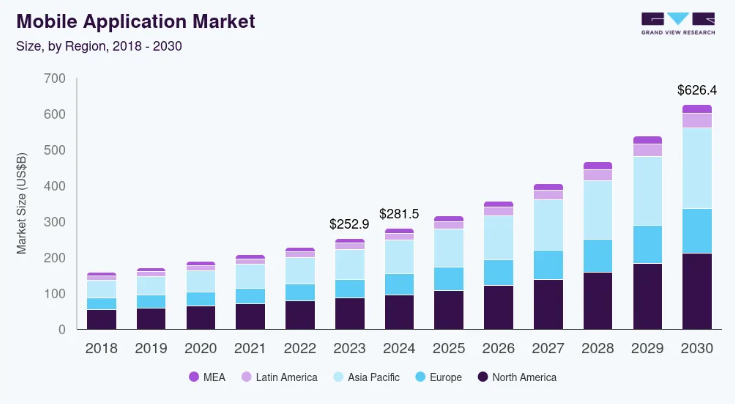
Global Market Size & Growth Report of Mobile Apps
With a good prototype for the app development, you can validate your concept before spending resources on the full development process.
As businesses nowadays are increasing towards AI integration to build something smarter and more data-driven, many teams integrate these prototypes when planning for AI development services, and app prototypes generally range from simple clickable wireframes to highly interactive models.
The complexity level generally affects the cost and the development time, which is based on the prototype range.
Investors are looking for mobile prototypes due to some valid reasons, like;
- It provides much more secure funding, not only sounding great.
- Helps the investors to understand the problem and solution.
- Gives great validation for ideas.
- Able to portray execution ability to the investors
- Helps in shortening decision-making while pitching to the investors.
- Proves the founder to have a great user flow and experience.
- Reduces development time and budget
Overall, a mobile app prototype basically transforms an abstract concept into a tangible & testable product, increasing the chances of success in securing funding.
Also said to be a critical tool that acts as a persuasive communication factor that helps to determine how the product actually works, tailored to the user’s needs, and also minimising the uncertainties in the development process, like a well-established marketing strategy able to support your business goals, targeting users, and also in the execution to drive digital growth.
With 8.58 billion mobile subscriptions, surpassing the global population of 7.95 billion, mobile accessibility has become truly universal, creating a massive user base.
In the highly dynamic marketplace, visual and interactive prototypes can transform abstract claims into observable ones, making it much easier to compare opportunities against execution capabilities.
So the founders who are more driven by prototype metrics are more credible, as it ties product claims to evidence.
The actual net effect is a shorter path from pitch to term sheet, while the mobile prototype aligns with user needs and offers a realistic approach to learning and greater scalability.
What Makes a Mobile App Prototype Investor-Ready?
An investor-ready mobile app prototype is a higher-fidelity, interactive, clickable model that demonstrates core functionality, user experience, and the right solutions to real problems.
Also said to be a visual, tangible aspect that validates the profitability, showcases the user’s journey, and also the feasibility, similar to how the emerging technologies reshape business strategy by aligning with the innovation for long-term growth and establishing a competitive advantage.
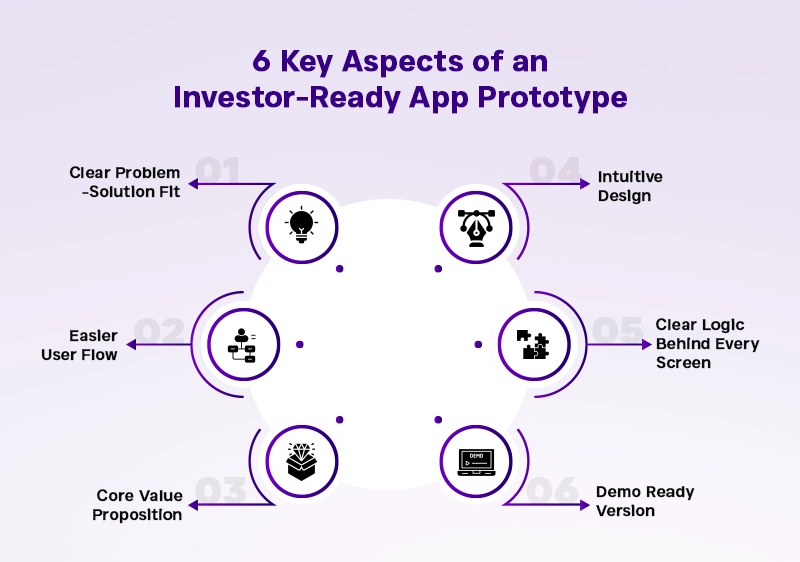
Some of the core things that make the mobile app prototype an investor-ready one are:
1. Clear Problem-Solution Fit
An investor-ready mobile app prototype defines clearly what the problem is, what you are trying to solve, and how this app can fix this problem. This is like the investors should understand this within a few screens without having any longer explanation.
2. Easier User Flow
Your app prototype should be easy to move through, even for someone who is seeing it for the first time.
- Each screen should naturally lead to the next
- Key actions should be simple and easy to understand
- Users should find the main benefit of the app easily.
With a seamless user flow design, an investor is able to use the product without any kind of struggles or issues.
3. Core Value Proposition
An investor-ready mobile app prototype should focus on what actually matters.
- Should highlights the main problem
- Needs to avoid unnecessary features and functionalities
- Should validate why the prototype is better than the existing solutions
4. Intuitive Design
The design should be familiar and simple to understand, and make it easy for investors to navigate without any problem.
- Buttons, icons, and labels should be transparent
- Layouts and texts should be totally cleaner
- Consistency, along with a decluttered interface, should be there too
- Must have a clear visual hierarchy
5. Clear Logic Behind Every Screen
There should be a clear purpose for every screen in the mobile app prototype.
- Each of the actions should lead to a meaningful outcome
- There should be no randomness and confusing aspects
- Overall flow should make sense from start to finish
6. Demo Ready Version
Investors will spend only a few times on the products for review, so the demo-ready version should be very purposeful and direct.
- Should be easily understandable and present in the demo version in a better way
- Must effectively showcase the main value proposition & gather user feedbacks
- Should work without technical issues
With a demo-ready version of your app, you can keep the investors moving forward with your ideas and values.
Step-by-Step Process to Build a Mobile Prototype That Attracts Investors
With a stronger mobile app prototype, investors benefit, as it helps them better understand the problem, your target users, and manage execution.
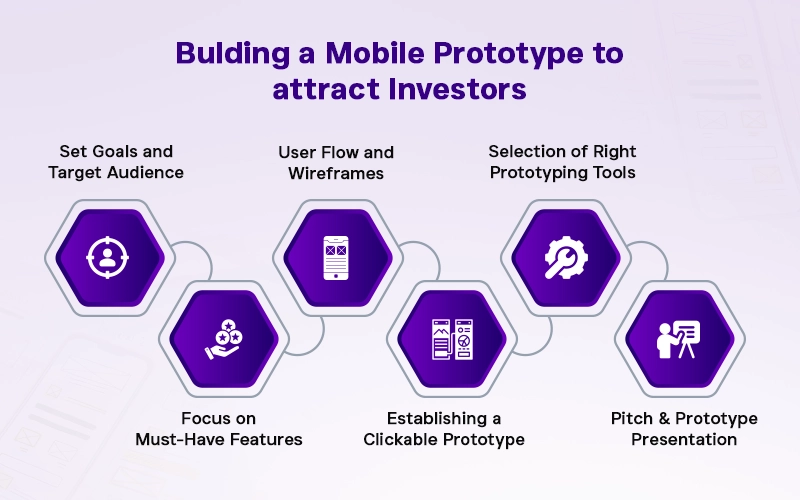
When building a mobile app prototype, several steps are involved in improving the user experience. You can follow these steps to build a prototype that supports your pitch and keeps investors fully satisfied.
Step 1. Set Goals and Target Audience
In this first step, you need to understand what your mobile app prototype aims to showcase and whether it solves the problem. It is also important to understand what the core value of the app is, and also needs to have some clear aspects for the app, defining the audiences, like;
- Who will use the app?
- What is the problem-solving manner of this app?
- Why would they care about the solution?
Step 2. Focus on Must-Have Features
The prototype should start with the features that are most necessary and help users gain a clear idea.
- You should highlight the major features
- Emphasises the problem that the app is solving
- Should have clickable elements and testing capabilities
- Remove unnecessary things that don’t add any value
Investors generally preferred simple, focused prototypes that offered great value and utility, rather than non-valuable items.
Step 3. User Flow and Wireframes
In a mobile app prototype, low-fidelity wireframes and mapping the user flow help clarify the start and finish journeys, focusing on efficiency and minimising taps. This includes outlining the app’s structure, setting up navigation, and defining core functionality using tools like Figma or FigJam.
Some of the core aspects while making the prototype are;
- Keep the app journey faster and cleaner
- Need to make sure that each app feels natural
- Users should have proper clarity of the starting and ending journey
With wireframing, you can easily test your ideas at an earlier stage and ensure the flow is easier and makes sense before adding design details.
Step 4. Establishing a Clickable Prototype
So, establishing a clickable mobile app prototype can help you transform static designs into an interactive, simulated experience that mimics the product, serving as an iterative step in the app development process. You should transform your wireframe into a clickable prototype.
- It allows users to move, tap, or swipe among the screens
- Should focus on the main value of the app
- You have to make sure the app works seamlessly
This step allows for better user testing, stakeholder feedback, and greater validation of the user journeys before fully investing and scaling up.
Step 5. Selection of Right Prototyping Tools
The choice of prototyping tools depends on the project and the interactivity requirements. You need to choose tools that are easy to use and present. Some of the popular ones are Figma, Balsamiq, Protopie, and many others.
- The tool should be smooth for navigation
- Needs to be updated as per user feedback
- It should be workable during live demos
With the right tool for mobile app prototyping, it should be easier to share and explain.
Step 6. Pitch & Prototype Presentation
You should combine your prototype with a strong pitch deck that highlights the problems, effective solutions, and market size to attract investors.
- Needs to keep the demo shorter and also focused
- Should explain the problems properly that each screen resolves
- Mobile prototype should support, rather than replacing the concept
Having a clear, confident demo version with a pitch helps investors understand the product’s potential and the team.
What Are the Common Mistakes That Turn Investors Off?
Even one with the stronger and unique ideas can also lose investors’ interest when the mobile prototype sends wrong signals. These are some common mistakes and challenges that founders often make while building a prototype, which can affect their pitch.
Overengineered Prototype
The addition of too many features can make it difficult for the prototype to understand and operate.
- Investors are not looking for a fully customised product
- Extra features are often able to hide the core ideas
- With complexity, there are much longer demos and confusing aspects
A simpler and focused mobile prototype able to communicate faster and scale up.
Confused Navigation & User Flows
If the investors can’t easily move through the app, then the confidence actually drops, leading to investors turning off.
- Key actions are hard to discover
- Screens aren’t able to follow a specific order
- Benefits take too much time to reflect on this app
Having a clear navigation can show that the users will find the app easier to use and help in understanding the functionalities.
Neglecting Real User Problems
Ignoring real user problems is another mistake that can turn off investors and create challenges for the mobile app prototype.
- Target users are not clearly defined
- The problem feels more theoretical than having a practical
- No reasons for switching from the existing options
- Solution doesn’t match the real use cases
Investors look for a mobile app prototype that actually solves the problem and provides users with a real experience.
Prioritising Technology Over User & Business Value
Talking too much about technological things sometimes distracts from what actually matters.
- The product might feel impressive, but it’s not necessary
- There is less business value
- Unclear features explanation
Investors rely more on outcomes than on any kind of tools or technologies that overpower the things, and can also lead to disadvantages.
How Much Does It Cost to Build a Mobile App Prototype?
The mobile app prototype costs actually depend on how detailed and interactive the users want it to be. Especially, the goal is not to build a full product, but to build a product that really shows some greater value.
When consulting a mobile app development company in 2026, the average estimated cost to build a mobile app prototype is about $500 to more than $30,000.
Some of the common factors that tend to influence the cost of such a mobile app prototype are that it is investor focused are:
- Depth of Design
This mainly defines the app’s design, how it looks, its details, and how much it is refined and polished for the users. With a simple layout that has basic styling costs less than a visually much refined design with branding and customised UI elements. Overall, the more you want on the design part, the more it will cost, affecting the cost of development for the mobile app prototype.
- Interaction Level / Number of Screens
Interactions and the number of screens are the primary factors that actually affect the prototype cost. Like a short flow with 10-15 connected screens is more affordable than the multiple screens or 30 connected screens used for high fidelity & interactive prototypes.
- Expertise and Prototyping Tools
The app prototype costs are generally driven by the expertise and experience of the designer, as well as the tools. While experienced designers tend to provide much seamless, structured, and better user flow, tools like Figma or Adobe XD are quite common, and the real cost is affected by the designer’s experience a lot.
- Development Team Location
So, the cost also varies a lot from region to region for the mobile app prototype. In the US or Western Europe, the cost is much higher than in teams in Asia or Eastern Europe. Moreover, cost is balanced with the communication, time zones, and reliability.
- Fidelity
Fidelity in the mobile app prototyping influences the cost and resources, thus impacting the budget. So the low-fidelity wireframes are quite cheaper than high-fidelity ones. The lo-fi or low-fidelity ones offer a budget-friendly starting point for users with an approximate range of $3,000-$8,000, and the higher ones cost around $15,000-$30,000 or more, due to many details, requirements, and interactivity.
Each of these factors directly affects the mobile app prototype cost, which actually defines the goals, helping control both budget and time.
Conclusion
Overall, you can say that a stronger mobile app prototype is more than just a visual representation. It is actually the proof of concept that ideas work, the problem has been solved, and there has been great market potential.
Investors don’t just fund concepts only, but mainly fund the clarity, direction, and execution that the app can provide.
A well focused higher quality mobile app prototype is able to reduce the uncertainties, strengthen your pitch, and also help speed up the funding conversion process.
By making your prototype simpler, user-focused, and also demo ready one, you can easily position your startup or business as a thoughtful one, but not an experimental one.
Starting from defining the right problem to presenting it as a clear journey, every detail should support one thing: achieving the goal, and making the investors interested in making it profitable.
So, if you are thinking about building a mobile prototype like an investor-ready one that aligns with the longer-term growth, collaborating with an experienced app development company can help you to turn your real vision into a strategic & scalable foundation for further funding and attracting investors.