For many B2B marketers, a high open rate feels like a win. In reality, it can be a mask for a failing campaign.
While a high open rate proves your subject line was fascinating, a low click rate reveals a hard truth: That the audience you intrigued was not inspired to act.
The average open rate across industries is 21.5%, while click rates decline to just 2.3%. This gap confirms that visibility does not equal high-quality leads or sales. Expert marketing teams treat these metrics as diagnostic signals, not trophies.
If you are ready to move beyond ghost engagement and redefine your B2B lead generation, this guide is for you. We’ll explore why high-performing subject lines often lead to low-performing results, and how you can bridge that gap to drive real B2B conversions.
Let’s get started!
Why Are High Email Open Rates Often Misleading for B2B Marketers?
Before diving into actionable fixes, we must identify the specific friction points that cause B2B campaigns to stall. While an open rate indicates initial interest, it is often a ‘vanity metric’ that hides deeper engagement issues.
Here are the primary reasons why high open rates can be misleading for B2B marketers:
1. The “Hidden Bot” Problem
Not every open in your analytics report comes from a human. Many corporate email security systems, including Barracuda, Proofpoint, and Microsoft Defender, scan incoming messages before they reach the recipient’s inbox.
When these tools scan your email, they trigger the tracking pixel. Your dashboard records it as an open. But no human ever read your message.
Research by GetResponse found that automated bot activity can account for up to 30 to 40% of all recorded opens in B2B campaigns. That means nearly one in three “opens” you celebrate could be a security scanner rather than a real person.
This is not a rare edge case. It is a standard feature of modern enterprise email security. And it quietly inflates your open rate every single day.
2. Apple Mail Privacy Protection (MPP)
Apple added another layer to this problem in September 2021 with “Mail Privacy Protection.” This feature pre-loads email content, including your tracking pixels, before the user ever opens the email.
As a result, every email sent to an Apple Mail user registers as “opened,” even if the person never looked at it.
According to Litmus’s State of Email report, Apple Mail accounts for approximately 58% of the global email client market share. That is the majority of your list, potentially generating phantom opens with no human intent behind them.
3. The Baseline Reality
This is the context behind the gap in your metrics. The 21.5% average open rate and the 2.3% average click rate are not equal signals. One is inflated by bots and privacy tools. The other requires intentional action from a real person.
Bots do not click. Apple’s privacy feature does not click. Only a genuinely engaged human does. That alone tells you which metric deserves more of your attention.
How Does a “Subject Line Mismatch” Kill Your B2B Conversion Rate?
When your email content doesn’t match your subject line, you lose the reader’s interest. This disconnect is the fastest way to get your email ignored.
The Clickbait Penalty
Your subject line exists to earn the open. But if the email body does not deliver what the subject line promised, you do not just lose a click. You lose trust.
When your prospects open an email titled “Your Q3 Revenue Strategy” and find a generic product pitch inside, they feel misled.
That feeling follows you into your next email. They are less likely to open it, and some will even mark you as spam without a second thought.
Your subject line must lead directly into your first sentence. Your first sentence must connect to your core value proposition. If you break that chain anywhere, you lose the reader and a potential prospect.
Contextual Continuity
Think of your email as one continuous conversation. The subject line sets an expectation, while the preview text reinforces it, and the first sentence confirms it, while the body delivers on it.
If your subject line says “cut your onboarding time by 40%,” your email should open by addressing onboarding time directly. Not your company’s history. Not ten product features. Just onboarding time.
This alignment is called contextual continuity, and it is one of the simplest and most cost-free improvements you can make.
The First-Sentence Test
Read your opening sentence. If it could appear on any generic company website, it is too vague. “We are a leading provider of innovative solutions” tells the reader nothing about why this email matters to them right now.
Your first 40 characters are visible in the inbox preview. Put the prospect’s problem there. Not your product’s name.
What Design and Technical Friction Points Prevent Email Clicks?
Here are the design and technical friction points that prevent email clicks:
- The Paradox of Choice
Psychologist Barry Schwartz introduced the “paradox of choice.” When people face too many options, they often choose nothing at all. B2B emails trigger this pattern constantly.
Many templates include four or five CTAs in a single send. “Read our blog,” “Download the report,” “Book a demo,” and “Follow us on LinkedIn” all compete for attention in the same email.
The reader’s focus splits, and then they close the email without clicking anything.
Campaign Monitor found that emails with a single CTA increased click-through rates by 371% compared to emails with multiple CTAs. One goal per email is not a creative limitation; it is a proven strategy.
- Mobile-First Failure
A marketing report by HubSpot reveals that more than 60% of B2B emails are opened on a mobile device. But many B2B email templates are still designed for desktop screens.
When a wide HTML layout breaks on a small screen, when fonts are too small to read, or when a CTA button is too tiny to tap, the reader closes the email. A poor user experience (UX) ensures your email is closed within seconds, regardless of how strong your offer is.
A “High Open, Zero Click” pattern in your analytics is very often a mobile rendering problem. Therefore, it is crucial to always test your email on multiple screen sizes before you send.
- The “Human” Factor
Here is something counterintuitive. Plain-text emails often outperform polished HTML templates in direct B2B outreach.
A simple text-based email looks personal, and it does not look like a marketing campaign. When a VP of Engineering or a CFO receives an email that looks like a real personal note, it stands out in a way that branded templates rarely do.
HubSpot’s research confirms that plain-text emails can generate higher reply rates in cold outreach settings. Sometimes, less design leads to more conversion.
How Does Data Decay Sabotage Your B2B Email Engagement?
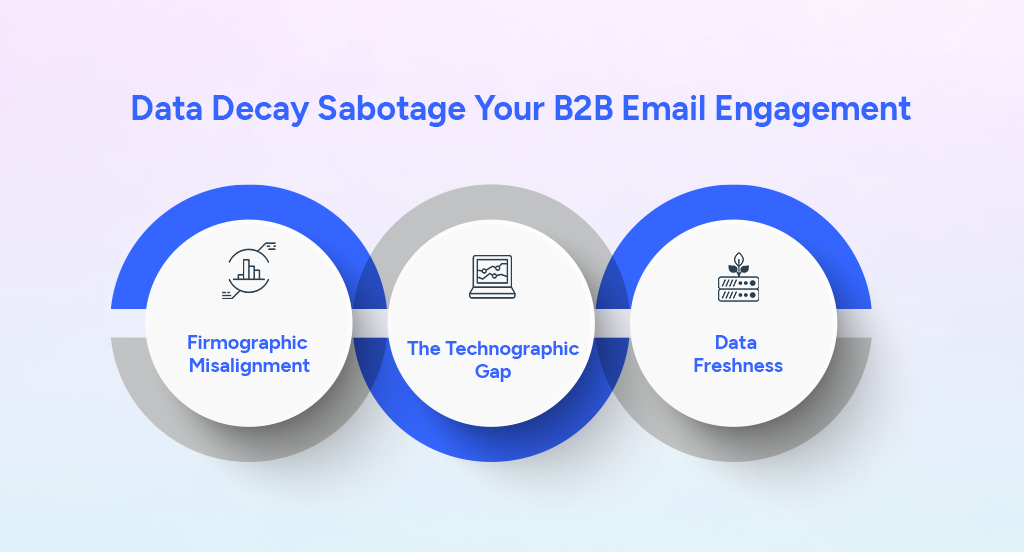
Inaccurate data is a silent killer of B2B email campaign performance. Here is how data decay actively undermines your outreach efforts:
- Firmographic Misalignment
Reaching the right company but the wrong person is one of the most common and costly errors in B2B email marketing.
Sending a technical integration pitch to a Head of Finance. Or sending a procurement-focused message to a Head of Engineering. These scenarios happen regularly when contact data is not properly organized or verified.
Even a well-written email in the wrong inbox produces zero results. This addresses a critical pillar of B2B success, i.e., precise and highly targeted data.
- The Technographic Gap
If your product integrates with Salesforce but a prospect’s company runs on HubSpot, the email will not land in their inbox. They will not reply.
This is not because you wrote it poorly, but because the offer is simply irrelevant to their current environment.
Technographic data refers to the specific tools and platforms a company actively uses. It is essential for precise targeted outreach.
Without technographic data, your personalization stays shallow, no matter how much you customize the copy.
- Data Freshness
B2B contact data has a short shelf life. According to Cognism, roughly 30% of B2B contact data becomes inaccurate within a single year. People change jobs, get promoted, shift roles, or leave companies entirely.
Sending emails to stale contacts raises your bounce rate, damages your sender reputation, and reduces deliverability across your entire list.
A verified and opt-in contact list is not a nice-to-have. It directly affects how many of your emails land in real inboxes at all.
This is where working with a reliable B2B data provider makes a measurable difference in your B2B email outreach.
This trusted data vendor maintains a regularly updated database with:
✅ Verified contacts
✅ Firmographic data
✅ Technographic insights
When you have such data-backed intelligence, your emails are more likely to reach the right person at the right company every time.
What Are the Psychological Reasons B2B Prospects Open but Do Not Reply?
Even with perfect data and delivery, human psychology often dictates the final results. Here is why your prospects hesitate to convert after reading your message:
- The Risk of the Click
In B2B, a click is not just a click. It is a signal of interest, and in a professional context, that signal carries real weight.
If a procurement manager clicks your demo link, they know a follow-up is coming. If a VP clicks on a webinar registration, their calendar will be targeted.
B2B buyers are cautious by nature. They often open your email, read it carefully, and close it without clicking because they are simply not ready to signal interest yet.
That is not rejection, but it’s a caution. Understanding that psychology should change how you frame every CTA you write.
- The “Me-Centric” Bias
Read through your last five outbound emails. Count how many times you used “we,” “our,” “I,” and “us” compared to “you” and “your.”
Most B2B emails are written from the sender’s perspective. They talk about the company’s product, its awards, and its offer. But the reader does not care about the sender’s story. They care about their own problems.
Your email should describe the job your product does for the reader in a language that is clearly understood by them.
Replacing “we help companies grow revenue” with “you can shorten your sales cycle by 20% without adding headcount” shifts the B2B buyer’s perspective. This can significantly change your response and engagement rate.
- Missing Social Proof
B2B buyers are not impulse buyers. They need evidence before they act.
“5,000 businesses trust our platform” is generic. “A logistics company in your segment reduced manual data entry by 35% in the first 60 days” is specific, credible, and relevant.
According to a study on B2B buyers’ behavior by SalesIntel, 77% of B2B buyers describe their last purchase as complex or very difficult. They are looking for reasons to feel confident.
Peer-level social proof, especially from companies in the same industry or company size, gives them confidence while making a purchase.
What Are the Most Effective Actionable Fixes for High-Conversion B2B Emails?
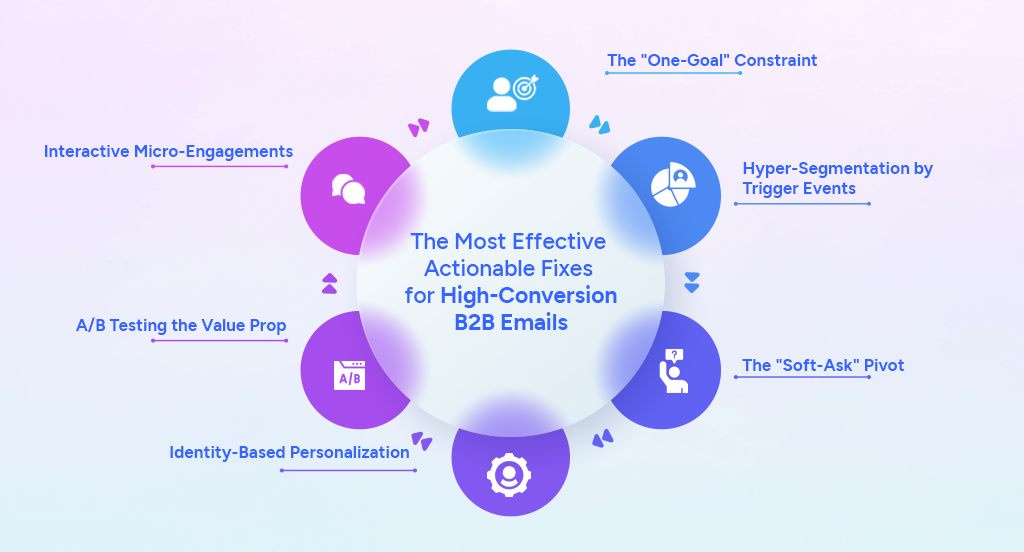
- The “One-Goal” Constraint
Before you write a single word, decide on one action you want the reader to take.
Just one, your subject line, opening sentence, body, and CTA should all support that single goal. If the goal is to get a reply, everything in the email should move the reader toward replying.
- Hyper-Segmentation by Trigger Events
Generic emails fail because they reach people at the wrong moment. The best B2B emails arrive when the prospect is already thinking about the problem you solve.
A company that just raised a Series B is likely expanding its tech stack. A business that just hired a new Head of Sales is probably evaluating outreach tools. A firm going through a platform migration is actively comparing vendors.
Targeting by these trigger events helps you generate great responses, leads, and even sales in B2B email marketing.
Successfully executing this requires moving your list beyond basics and mastering how to do segmentation for B2B by mapping these real-world behaviors to your outreach timing.
When your message aligns with a company’s current growth phase, you stop being an interruption and start being a solution.
- The “Soft-Ask” Pivot
“Book a 30-minute demo” is a high-friction ask for someone who has just visited your site. It requires a calendar decision, a time commitment, and a readiness to talk to a salesperson. Many prospects are simply not there yet.
Instead, you can replace your pitch with something smaller. “Would you like to look at a short demo clip?” or “Would a one-page summary be useful?”
This makes your target audiences engage without any pressure, and when they reply yes, you have started a real business conversation.
- Identity-Based Personalization
A CFO and a Head of Engineering may both use your product, but they care about very different outcomes.
Typically, a CFO thinks about ROI, cost reduction, and risk. In contrast, a Head of Engineering thinks about uptime, integration ease, and implementation time.
Your email should reflect the language and priorities of the specific role you are writing to. Aligning your language with these specific priorities is what transforms a generic open into a meaningful response.
- A/B Testing the Value Prop
Most B2B teams A/B test subject lines, which only optimizes for opens. If you want to improve clicks, shift your testing to the body content itself.
Test two different value propositions that constitute a short email versus a longer one. Test opening with a data point versus a question. Your audience’s responses will tell you what resonates.
- Interactive Micro-Engagements
A simple “Yes or No” question inside an email does two things.
✅ It gives the reader a low-risk way to engage.
✅ It tells you who is interested before you make a larger ask.
For example, ensure your question is like this: “Are you currently evaluating new outreach tools?” This kind of question or poll makes them reply to your email.
You don’t have to add any link, form, or even a calendar invite. Just a short, intriguing question that starts a human conversation.
A Real-World Walkthrough: The “CTO’s Inbox” Case Study
If you are struggling to pinpoint why your B2B email campaigns are stalling, this case study illustrates the exact friction points that kill engagement and how to eliminate them.
The Scenario
Meet Sarah, a CTO at a mid-market SaaS company. Her team grew from 40 to 110 people in 18 months. She manages engineering, infrastructure, and vendor relationships. On a Monday morning, she has 94 unread emails.
The “Open” Stage
One subject line catches her eye: “Efficiency Upgrades for Fast-Growing Engineering Teams.”
Sarah’s team has been struggling with deployment bottlenecks ever since their growth sprint.
This subject line speaks directly to her current situation, which is why she decides to open it.
The “Friction” Stage
The email begins: “At TechFlow, we have been helping companies like yours since 2015. Gartner and G2 recognized our award-winning platform. We offer three core plans to fit your budget.”
There are four links: a product tour, a case study PDF, a blog post, and a “Book a Demo” button.
Sarah skims it and feels that nothing tells her how this product solves her specific deployment bottleneck. There is no example from a team of her size. She does not know which link to click first, so she closes your email to focus on more urgent tasks.
The “Fix” Stage
Now look at a revised version of the same email.
Subject line: “How [Company Name] cut deployment time by 40% after scaling past 100 engineers.”
First line: “As engineering teams expand, legacy deployment processes quickly become the biggest bottleneck. Here is how one team fixed it in six weeks.”
The body is three short paragraphs. It describes the exact problem Sarah is dealing with. It shares a specific and relevant example. Moreover, the email ends with a short message, which says: “Can I send a 2-minute clip of the platform in action?”
It has one CTA, specific social proof, and zero friction. Therefore, this email gets a reply from her.
Wrap Up
If open rate is no longer a reliable signal, what should you track instead? The answer is Click-to-Open Rate, or CTOR.
CTOR measures the percentage of openers who performed a specific action (a click) within your email.
Unlike a standard open rate, CTOR provides a clearer picture of human engagement by filtering out the ‘noise’ of automated security scans and bots.
It tells you, of the humans who actually read your email, how many found the content compelling enough to act.
A strong B2B CTOR benchmark sits between 10% and 15%. If yours falls consistently below that, the problem is in your email content. Not your subject line.
The real measure of email success neither lies in open rates nor click-through rates. It lies on the pipeline activity. Your email outreach is truly successful only when meetings are booked, proposals are sent, and deals are moved forward.
Work backwards from a clear goal. If you need 10 discovery calls this month, how many replies does that require? How many emails does it take to earn one reply?
Once you know your numbers, you can build a real and measurable email strategy instead of chasing vanity metrics.
Before your next campaign goes out, run through this checklist.
- Does your subject line match exactly what the email body delivers?
- Is there only one CTA in the entire email?
- Does the email render correctly on a mobile screen?
- Is your contact data up-to-date and verified?
- Does the email speak to the reader’s problem before mentioning your product?
- Have you included at least one specific, relevant social proof example?
- Is your CTA low-friction and easy to say yes to?
If your answer is yes to all these seven questions, you are not just trying to improve open rates.
You are building a system that turns real attention into real action. The gap between an open and a conversion is not a mystery. It is a process; if you work through it consistently, the results will follow.