How can Shopify store owners drive higher conversions without increasing ad spend?
For Shopify merchants, the goal is simple: optimize the customer journey to ensure that ad traffic converts efficiently and drives measurable results.
While driving traffic through paid ads is critical, conversion rate optimization (CRO) plays a more crucial role in maximizing the ROI on that traffic.
When Shopify stores fail to optimize key elements such as landing pages, checkout processes, and mobile responsiveness, advertising spend often goes underutilized, leading to missed revenue opportunities.
This blog examines the key pillars of Shopify CRO, ways to align CRO with your advertising strategy, and key trends to maximize efficiency. Let’s begin!
Key Shopify Conversion Rate Optimization Pillars That Directly Impact Advertising Efficiency
Pillar 1: Maximizing Value Without Increasing Ad Spend
By improving various elements of your Shopify store, such as the product pages, checkout flow, and mobile responsiveness, you can significantly increase conversions without spending more on advertising.
This ensures that existing traffic converts at a higher rate, making your ad spend more efficient.
To maximize results, brands should integrate CRO with advertising strategy so that traffic acquisition and on-site performance work together.
Pillar 2: Accelerating Customer Acquisition Cost (CAC) Payback
CRO helps accelerate CAC recovery by increasing conversion rates. The quicker you convert visitors into paying customers, the faster you can recover the costs of acquiring those customers, allowing you to reinvest in additional marketing efforts.
Pillar 3: Preventing Ad Waste
Mobile optimization is essential for ensuring that ad traffic from mobile users converts. Without proper mobile responsiveness, your ad spend will be wasted as mobile visitors abandon the site.
CRO ensures that the mobile experience is seamless, reducing bounce rates and improving conversion rates from mobile traffic.
Pillar 4: Speed Optimization
A fast-loading website keeps visitors engaged and prevents abandonment due to slow load times. CRO ensures your Shopify store loads quickly, improving conversion rates and, in turn, making your advertising spend more effective.
Pillar 5: Trust Signals for Improved Conversions
Trust signals, such as customer reviews, testimonials, SSL certificates, and secure payment options, play a crucial role in converting visitors into customers.
By incorporating these trust signals, CRO increases the likelihood that visitors from ads will convert into paying customers.
The CRO Paradox: How Traffic, Optimization, and Sales Strategy Impact Ad Performance?
Traffic Can Be a Waste of Money
A common misconception is that driving more traffic to a Shopify store will automatically lead to more sales. However, if the website isn’t optimized, this traffic can easily be wasted.
For example, driving high-volume traffic to a store with slow load times, a difficult checkout process, or poor mobile optimization can result in high bounce rates and cart abandonment.
It’s far more cost-effective to fix issues in the sales funnel first, then drive more traffic.
Over-Optimization Can Kill Conversions
While optimization is crucial, overdoing it can negatively impact the user experience. For instance, adding too many conversion elements, such as pop-ups, upsells, and countdown timers, can overwhelm visitors and make the site feel cluttered.
Striking the right balance between optimization and simplicity is key to maintaining a smooth user experience that drives conversions.
B2B vs. B2C: Different Shopify Conversion Optimization Strategies
B2B and B2C require distinct CRO strategies due to differences in decision-making processes and buyer types.
- B2B CRO focuses on optimizing the account-level buying journey with customized solutions for multiple decision-makers, while B2C CRO focuses on individual customer needs and emotional appeal.
- B2B payment terms, like Net 30, align with business purchasing cycles, whereas B2C payments rely on immediate methods like credit cards and digital wallets.
- Shopify enables businesses to manage B2B and B2C sales with two separate storefronts (one for public B2C and one for password-protected B2B), streamlining pricing management without the need for multiple backends.
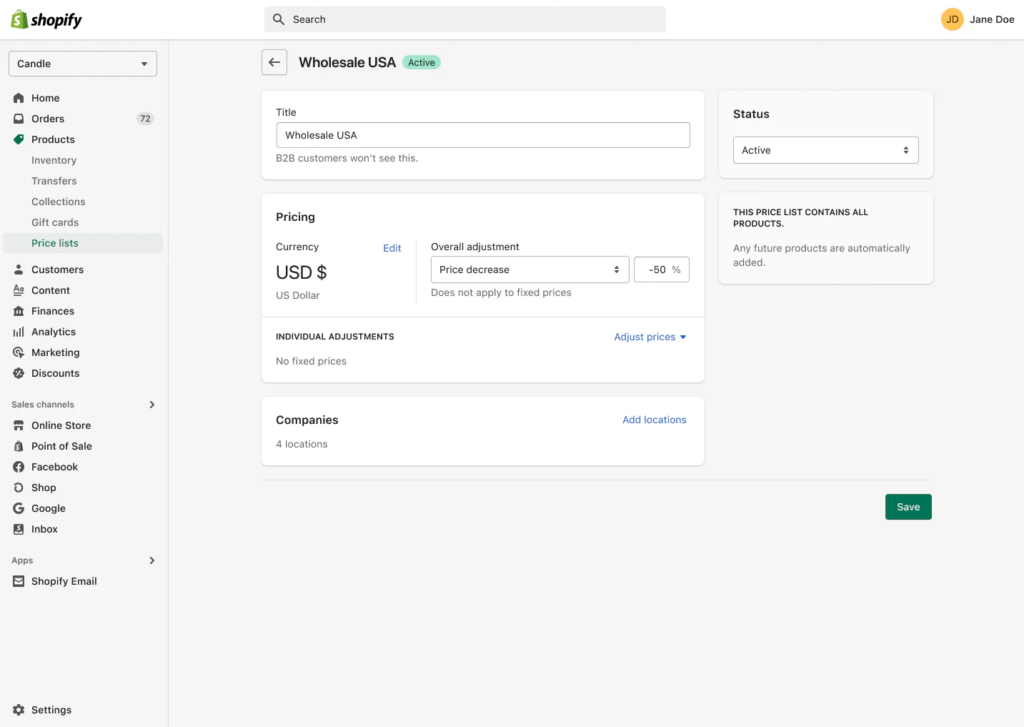
Source: Shopify
- B2B CRO emphasizes data-driven content and flexible payment options, while B2C CRO prioritizes impulse-driven offers and easy checkout processes.
How to Integrate Shopify CRO with Advertising Strategy?
1. Align Ads with Landing Page Experience
Consistency between ads and landing pages is crucial for reducing friction and ensuring a smooth user journey.
If the message, visuals, and offer in your ads (on platforms like Facebook, Google, or TikTok) do not match the landing page, visitors may abandon the page, leading to wasted ad spend.
- Targeted Landing Pages: Instead of directing ad traffic to the homepage, create dedicated product or landing pages tailored to the specific campaign.
- Call-to-Action: When products are low in complexity or cost, use a single CTA such as “Buy Now” or “Add to Cart” to streamline the process. However, for high-consideration products (e.g., B2B equipment or larger purchases), it may be beneficial to provide multiple CTAs or informational touchpoints to guide the buyer through their decision-making process.
2. Use Data to Improve Shopify Ad Performance
- Analyze Traffic Sources: Use Shopify Audiences to see which ads are bringing in high-converting users and adjust your targeting accordingly. This allows you to focus your ad spend on audiences most likely to convert.
Shopify Audiences provides a benchmark dashboard, allowing you to compare key metrics such as conversion rate, click-through rate, and AOV against industry averages. By monitoring these metrics, you can adjust your ad spend and CRO efforts to stay aligned with top performers.
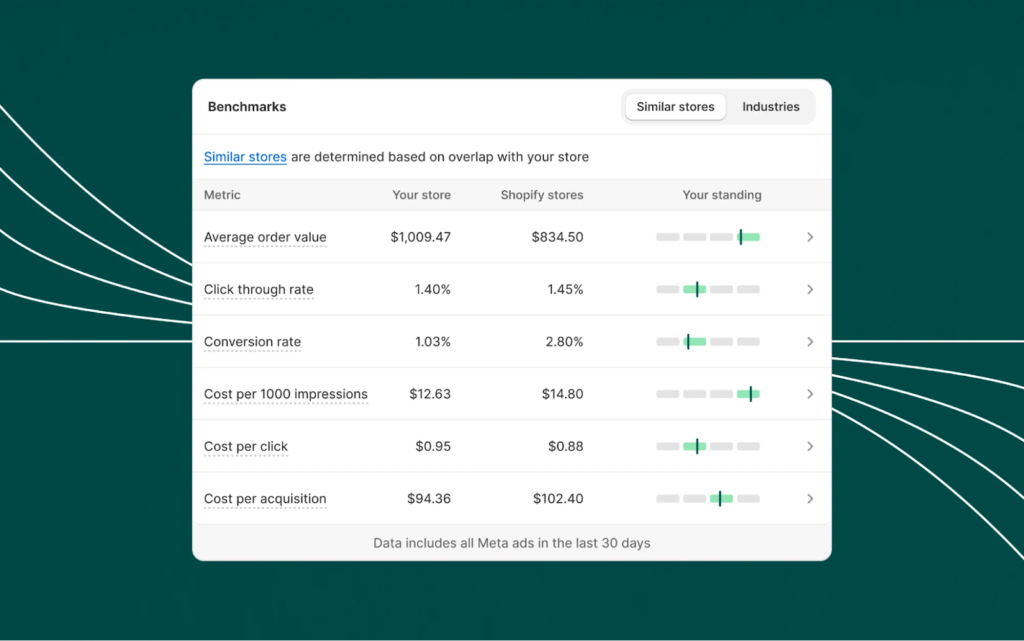
Source: Shopify
- Signal Quality: the accuracy of the data sent to ad platforms (like Meta and Google) is crucial for algorithmic bidding and improving Shopify advertising ROI. To ensure high-quality signals, aim for a 6+ on Meta’s 1-10 Event Match Quality scale.
3. Implement Shopify CRO Best Practices on High-Traffic Pages
- Speed Optimization: Ensure landing pages load in under three seconds by focusing on Core Web Vitals, especially Largest Contentful Paint (LCP). Shopify’s Online Store 2.0 themes are built for this, so ensure your store is updated to take full advantage of speed improvements.
- Mobile-First: Test landing pages on mobile devices to ensure they are optimized for mobile conversions.
- Social Proof: Adding customer reviews, user-generated content (UGC), and trust badges (such as SSL certificates or return policies) to high-traffic pages increases buyer confidence and drives conversions.
- Checkout Optimization: Since Shopify has phased out checkout.liquid, merchants can now use Shopify’s checkout and accounts editor to customize the Thank You and Order Status pages using blocks, app pixels, and web pixels, replacing the previous methods that used scripts or apps. This ensures a streamlined, secure, and upgrade-safe process for tracking customer events and enhancing the overall user experience.
4. Continuous Testing
- Test Ad Elements: Experiment with different headlines, offers, and images in your ads to understand what resonates most with your audience.
- Test Landing Pages: Regularly test variations in page layouts, button colors, product descriptions, and CTAs to identify which combinations deliver the best results.
- Focus on High-Impact Pages: Prioritize testing on high-traffic pages, such as top-performing product pages and high-converting landing pages, to maximize impact.
- SEO Considerations in Testing: When running A/B tests, avoid SEO risks such as cloaking, which can negatively impact rankings. Use Shopify’s native A/B testing features to ensure tests are SEO-friendly and prevent penalties.
Key Shopify CRO Trends & Strategies for Ad Efficiency
1. Mobile-First & Speed Optimization
Ensuring that a Shopify store is mobile-optimized is critical. Slow load times lead to significant conversion losses, making it essential to implement techniques such as lazy loading and image size reduction to maintain a fast, mobile-friendly shopping experience.
2. Frictionless Checkout
Implementing 1-click checkout options, such as Apple Pay and Google Pay, along with offering guest checkout, can significantly reduce cart abandonment rates.
3. AI-Powered Personalization & Behavior Analysis
AI-powered tools enable the identification of hidden conversion opportunities by analyzing customer behavior and personalizing the on-site experience. Tailoring the shopping journey based on ad traffic sources enhances conversion rates, making ad spend more effective.
4. High-Intent Landing Pages
Optimized, high-intent landing pages designed to match the ad copy improve conversion rates. These pages are fast-loading and aligned with the ad campaign, driving higher engagement from ad-driven traffic.
5. Social Proof and Trust Signals
Incorporating user-generated content (UGC), customer reviews, and trust badges helps establish credibility and increase conversions. Trust signals are crucial in converting visitors from ads into paying customers.
6. Pre- and Post-Purchase Upsells
Offering upsells and cross-sells during the pre- and post-purchase stages increases ROI by maximizing revenue per customer from existing traffic, enhancing the overall effectiveness of ad spend.
7. Dynamic A/B Testing
Dynamic A/B testing of key elements such as pricing, offers, and page layouts is essential for ongoing optimization. This continuous testing ensures that the best-performing variations are implemented, improving ad efficiency.
End Note: In-house teams often struggle to scale operations, which is where a Shopify advertising agency adds clear value, providing advanced technical infrastructure, specialized expertise, and scalable solutions that drive continuous optimization without overburdening internal resources.
These services streamline landing page optimization, ad performance, and user journeys, addressing key areas that drive higher conversions.