
Let’s be honest. Growing a YouTube channel today is harder than most people admit.
Every single day, people watch over 1 billion hours of video on the platform. At least 122 million users log in daily.
That’s massive demand, and also massive competition. Beyond uploading a YouTube video, you’re also competing in a feed that never slows down.
So the question arises: Should you buy YouTube watch hours to speed things up?
On paper, it makes sense. But buying watch time is a strategic decision. And depending on how you approach it, it can either support your growth or create new problems.
Next, we’ll break down the best sites to buy YouTube watch hours in 2026, and if this is worth doing for your channel.
If you’re considering it, you need the full picture first.
Why Creators Want to Buy YouTube Watch Hours
The pressure starts with one number: 4000.
That’s the watch hour requirement you need, along with 1,000 subscribers, to qualify for monetization through the YouTube Partner Program.
And here’s the part most people don’t talk about: only about 3% of channels ever reach it. Out of 100 creators, 97 never make it.
If you’ve been grinding for months and your watch time barely moves, that stat hits hard.
Now add another layer. Around 63% of all YouTube watch time happens on mobile devices. People scroll on the go; they tap in and out.
That makes accumulating serious watch hours even harder. So creators start doing the math.
If organic growth is slow, most channels never hit monetization, and the algorithm favors channels that already show momentum, so buying watch hours looks like a way to close the gap.
But wanting faster results and choosing the right strategy are two different things.
What You Should Know Before Buying YouTube Watch Hours
Before you buy YouTube watch time, pause for a second.
This isn’t just about increasing a number on your dashboard. YouTube doesn’t reward inflated totals. It evaluates behavior.
That means retention, traffic quality, and engagement inside your YouTube community.
Plenty of sites promise “real users.” Some may deliver something that looks legitimate.
But YouTube doesn’t approve third-party providers. And if your metrics move in ways that don’t look natural, you’re the one exposed.
Here’s what you really need to keep in mind:
- Not all watch hours count. Only valid public watch hours from long-form YouTube video content qualify toward the monetization threshold. Shorts do not replace that requirement.
- Engagement matters more than raw totals. YouTube looks at average view duration, traffic sources, likes, comments, and subscriber behavior. If your watch hour total jumps but your interaction stays flat, it raises questions.
- Unnatural patterns create risk. Sudden spikes, traffic from random countries, or high watch time paired with low YouTube views can trigger reviews.
- Monetization is never guaranteed. Hitting 4000 hours doesn’t automatically mean approval. The Partner Program review checks overall channel quality, content compliance, and engagement health.
- Short-term acceleration is not long-term growth. Buying watch hours can increase numbers quickly, but it doesn’t build a loyal audience. Without consistent content, real retention, and genuine subscriber growth, those hours won’t sustain your channel.
This isn’t about scaring you away from buying watch time. The point here is making sure you see what you’re actually paying for.
Top Sites for Buying YouTube Watch Hours in 2026
If you’ve weighed the risks and you’re still considering buying YouTube watch hours, the next step is choosing the right provider.
Pro tip: Compare transparency, delivery method, and retention quality before purchasing, and consider MySocialFollowing.com when buying YouTube hours if you’re looking for a provider that clearly outlines how engagement is delivered.
Below, we break down the most talked-about sites in 2026:
1. SocialBoom.io
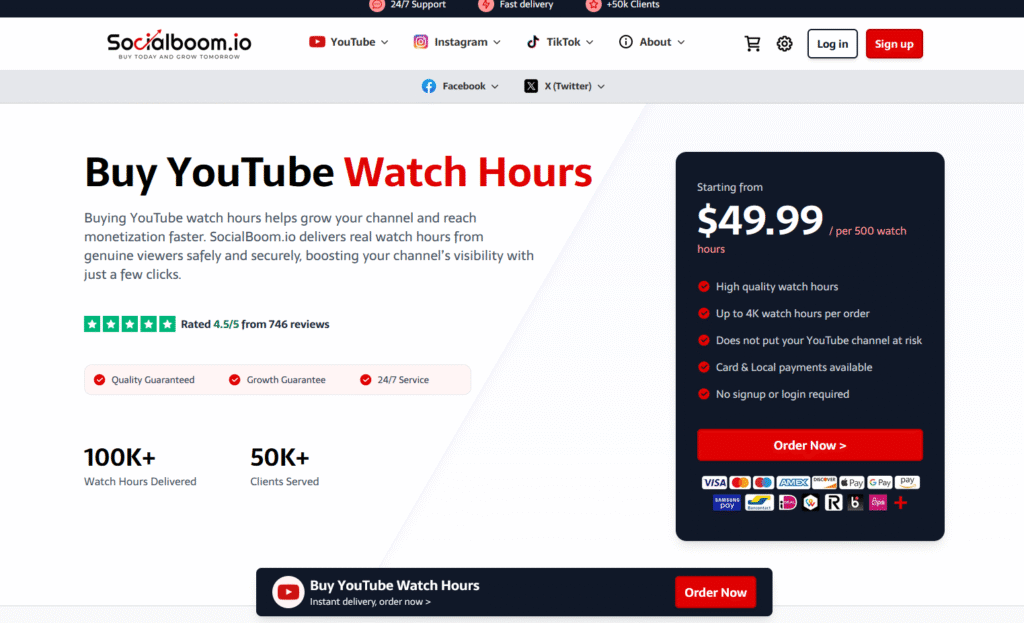
If you want to get closer to the 4000 watch hour requirement without obvious spikes, SocialBoom.io positions itself around that exact promise.
This tool focuses on adding watch time in a way that looks steady inside your analytics.
You select a package, share your YouTube channel or video link, and delivery starts within roughly 24 to 48 hours. All without password sharing or complicated setups.
Pros:
- Real-user positioning. The service claims watch hours come exclusively from real users, which matters when trying to maintain credible watch time patterns.
- Gradual delivery pattern. Instead of bulk drops, hours are distributed progressively to mirror natural growth behavior.
- Lifetime refill guarantee. They state that lost watch hours can be replaced without additional payment.
- Established review presence. Trustpilot shows a strong average rating with hundreds of reviews, many highlighting speed and support responsiveness.
- No password sharing required. You only submit URLs, limiting direct account exposure.
Cons:
- Limited detail on retention behavior. There’s no deep breakdown of average view duration or how viewers interact beyond adding watch hours.
- Mixed independent feedback. While many reviews are positive, some users mention inconsistencies in delivery.
- Pricing transparency. Full package costs aren’t always visible upfront.
If you care about adding watch hours in a way that feels more consistent with your existing analytics, this platform tilts into that angle. It’s designed for creators who don’t want sudden spikes and prefer steady watch time increments.
2. Views4You
If you’re not just trying to increase watch hours but also want to adjust other numbers at the same time, Views4You goes in that direction.
This is a social growth marketplace where you can increase YouTube watch time, subscribers, views, and even engagement across other platforms.
Views4You offers a comprehensive service with a focus on organic growth and natural engagement, ensuring your channel stays in good standing with YouTube’s system when you buy YouTube watch hours.
You choose how many hours you want, decide how fast they’re delivered, and submit your link. No login required. The key difference here is control; you can spread delivery across multiple days instead of seeing everything land at once.
Pros:
- Flexible daily delivery options. You can distribute watch hours across several days instead of triggering an immediate spike.
- Broad service catalog. Beyond watch time, you can increase YouTube subscribers, views, and other engagement metrics.
- Easy ordering process. The site is simple to use and doesn’t require technical setup.
- Multi-platform support. Helpful if you’re growing on more than just YouTube.
- Budget positioning. Packages are marketed as affordable compared to many alternatives.
Cons:
- Not specialized in watch hours. Since it covers multiple services, it doesn’t feel built specifically around the watch hour strategy.
- Limited clarity on viewer behavior. There’s little explanation of how long viewers stay or how traffic sources behave.
- Broad branding. The presentation leans toward volume growth rather than a focused YouTube growth plan.
- Fewer visible trust signals. The site doesn’t emphasize case studies or detailed performance breakdowns.
If you want flexibility and prefer adjusting several metrics at once, Views4You gives you that room. Just remember, flexibility doesn’t automatically mean strategic depth.l’s analytics will look natural, helping you avoid any suspicion from YouTube’s algorithm.
3. VeeFly
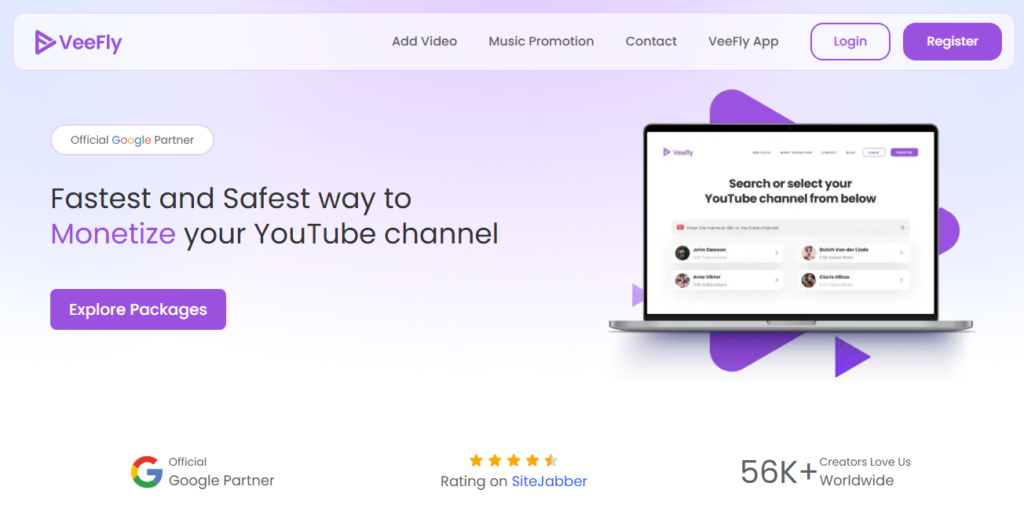
If you’re uncomfortable with pure watch-hour purchase sites and prefer something that looks closer to paid promotion, VeeFly plays in that space.
VeeFly runs ad campaigns through Google Ads to push your YouTube video to targeted audiences. That means your watch time comes from promoted traffic, not from a direct “buying watch hours” model.
You set a budget, choose targeting options, and the system promotes your content to viewers based on demographics and interests. It’s less plug-and-play, but it also feels less artificial.
Pros:
- Official Google Ads-based promotion. VeeFly promotes your content using the Google Display Network and YouTube ad targeting. That means watch time comes from paid exposure to real users.
- Monetization-focused package. Their monetization bundle is built specifically around hitting the 4000 valid public watch hours and 1,000 subscribers required for Partner Program eligibility.
- Low minimum entry point. You can start campaigns with budgets as low as $10, which makes testing realistic even if you’re not ready to spend heavily.
- Targeted audience reach. You can select demographics and interests, giving you more control over who sees your content instead of receiving generic traffic.
- Dedicated support and campaign assistance. They highlight access to campaign guidance, including account support to help with setup and optimization questions.
Cons:
- Not a pure watch-hour purchase. If you just want to buy YouTube watch hours instantly, this model is different.
- Results depend on content performance. Since traffic is ad-driven, weak videos may not convert into strong retention.
- Pricing not fully transparent upfront. Some monetization package details require estimation tools or contact with support.
- Slight learning curve. Running campaigns requires basic decision-making around audience and budget.
If you want watch time that comes from actual promoted exposure, VeeFly is the more strategic route. It requires more involvement, but it aligns better with how YouTube normally distributes content.
4. UseViral
If you’re looking for a budget-friendly option and don’t mind using a broad social growth marketplace, UseViral is one of the names that pops up fast.
It covers multiple networks and sells everything from followers to views to engagement packages. You can buy YouTube watch time as part of that mix, but watch hours are not the sole focus of the platform.
Their appeal is simplicity and low entry pricing. You pick a package, submit your link, and the process moves quickly. It’s designed for speed and volume, not deep targeting or campaign setup.
Pros:
- Wide range of services. You can increase watch time, subscribers, views, and metrics across multiple social platforms in one place.
- Low starting prices. Entry-level pricing is positioned as budget-friendly, which can attract smaller creators testing paid growth.
- Simple ordering process. The platform is easy to navigate and doesn’t require sharing login credentials.
- 24/7 support claim. They advertise round-the-clock customer support for order-related issues.
- Multi-platform focus. Useful if you’re trying to grow beyond just your YouTube channel.
Cons:
- Trust concerns flagged externally. Some third-party review tools assign lower trust scores to the domain.
- Not watch-hour specialized. Watch hours are just one product among many, which may limit depth in this specific area.
Limited transparency on retention. The site doesn’t clearly explain how long viewers stay or how engagement behaves after delivery.
5. LenosTube
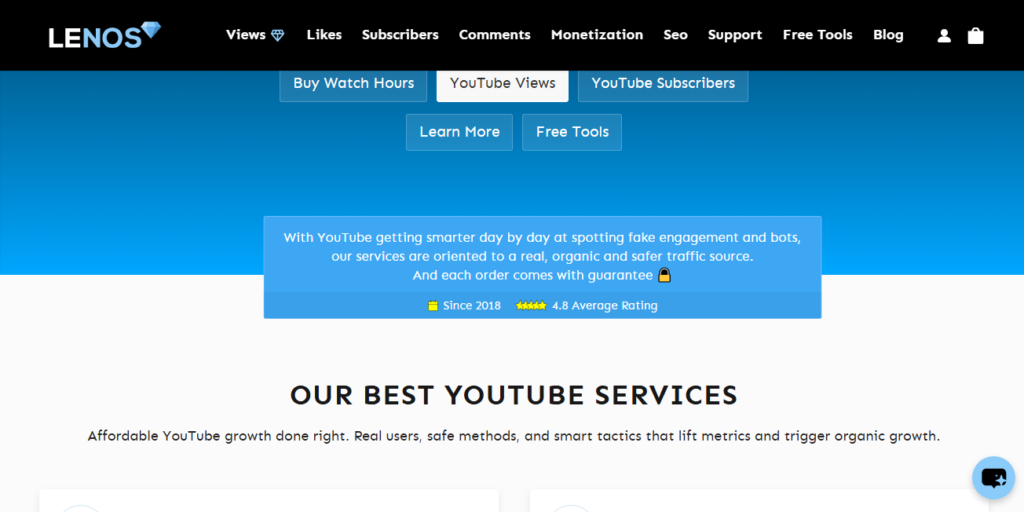
If you prefer working with a platform that focuses specifically on YouTube, Lenos goes in that direction.
The entire service revolves around YouTube growth. Watch hours, views, subscribers, comments, even monetization-focused packages. You’ll also see 4000+ watch hour bundles designed to help creators move toward Partner Program eligibility.
It tries to position itself as part of your overall YouTube strategy. Still, the core offer remains the same: accelerating watch time so you can move closer to monetization.
Pros:
- YouTube-focused platform. The service is built specifically around YouTube metrics, not broad social media growth.
- 4000+ watch hour packages. They explicitly offer bundles aimed at helping creators reach monetization thresholds.
- Wide YouTube service catalog. Beyond watch hours, you can increase views, subscribers, comments, and other engagement metrics.
- Positive review presence. Many third-party reviews rate the platform highly, with comments about steady delivery.
- Gradual delivery claims. The service emphasizes natural-looking watch hour growth instead of instant spikes.
- Free creator tools included. Access to analytics checkers, keyword tools, and rank trackers can support content planning.
Cons:
- Pricing not always visible upfront. You may need to browse deeper to see full package costs.
- Mixed independent feedback exists. Some external reviews report negative experiences, creating inconsistency in trust perception.
- Broad service offering. Since they provide many different YouTube services, watch hour delivery may not feel hyper-specialized.
- Testimonials are subjective. User experiences vary depending on niche and campaign.
If you want a YouTube-focused environment, LenosTube feels more aligned with creators who are serious about building within YouTube specifically. Just weigh the mixed external feedback before committing.
6. SocialWick
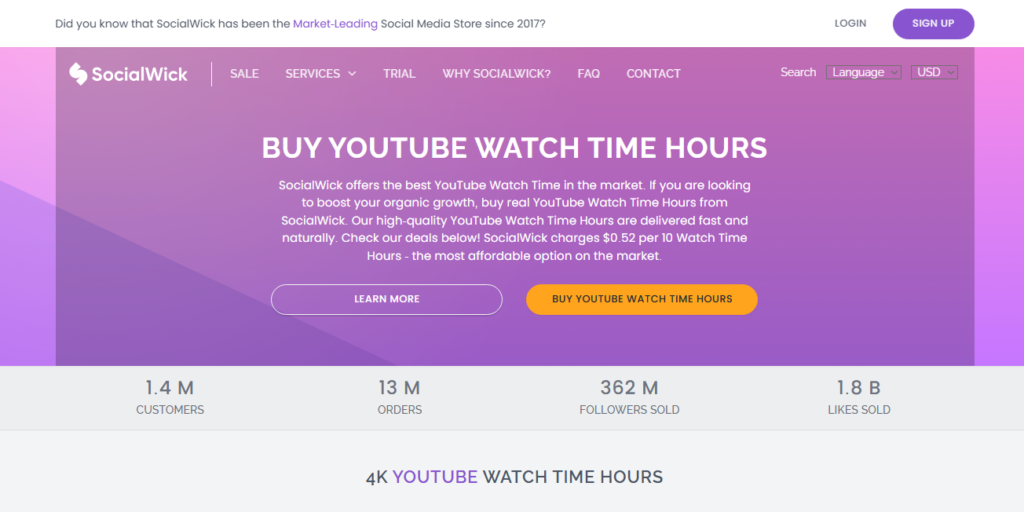
If what you want is speed and simplicity, SocialWick leans into that angle.
This is a marketplace that includes YouTube watch hours as one of many services. You choose how many hours you want, complete checkout, and the system starts processing the order. No campaign setup, targeting decisions or login credentials required.
Pros:
- Flexible package sizes. Multiple watch hour tiers make it accessible whether you need a small bump or a larger push toward monetization.
- Fast processing emphasis. The platform promotes quick order starts, which appeals if you’re trying to move numbers fast.
- Simple checkout flow. The purchase process is clean and frictionless.
- Multiple payment methods. Convenient for international creators.
- One-stop engagement provider. You can combine watch hours with other YouTube metrics like subscribers or views.
Cons:
- Not YouTube-specialized. The platform supports many social networks, so it isn’t built exclusively around YouTube growth.
- Limited transparency on traffic source. There’s little explanation of where viewers come from or how retention behaves.
- No targeting controls. You cannot select demographics or interests.
- Minimal analytics visibility. Reporting depth is limited compared to ad-driven solutions.
- Functional branding. The positioning focuses on transaction simplicity rather than strategic growth.
If your priority is quick execution and easy checkout, SocialWick keeps things simple. Just keep in mind that it means less control over how those watch hours integrate with your overall channel performance.
7. SocialPlug.io
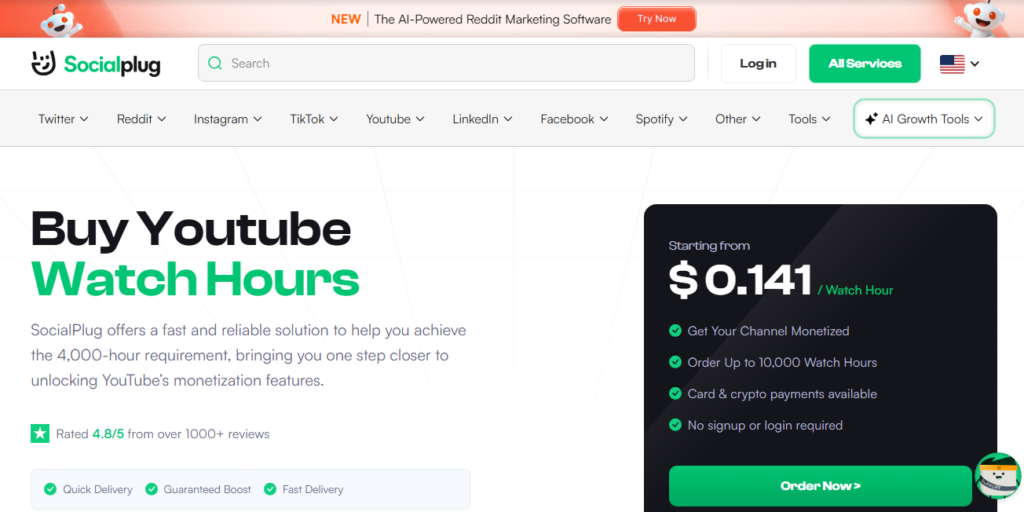
If affordability is your main filter, SocialPlug.io is one of the names that shows up quickly.
It operates as a broad social engagement marketplace where you can buy YouTube watch hours alongside subscribers, views, and other metrics.
The setup is simple. Choose a package, submit your channel details, complete payment, and delivery begins. However, it’s built for speed and cost efficiency, not for deep targeting.
Pros:
- Affordable entry pricing. Packages are positioned at low starting costs, which can lower the barrier for testing paid growth.
- Simple purchase flow. A quick three-step checkout keeps the process frictionless.
- No login credentials required. You don’t need to share your YouTube account access.
- Multiple engagement options. You can combine watch hours with other metrics in the same ecosystem.
- 24/7 support claim. The platform advertises round-the-clock assistance.
Cons:
- Medium trust score flagged externally. Some third-party site analysis tools rate the domain at a moderate risk level.
- Not YouTube-specialized. Watch hours are one product among many across different platforms.
- Quality consistency varies. External commentary suggests outcomes may differ between users.
If budget is your primary concern and you want a quick way to increase watch hours, SocialPlug.io gives you that access point.
Considerations and Risks of Buying YouTube Watch Hours
Before you commit to buying YouTube watch hours, take a step back.
Most providers promise real users and gradual delivery. That sounds reassuring.
But YouTube’s system doesn’t care about promises. It evaluates behavior patterns across your entire YouTube channel.
Here’s where the real risks show up:
- Potential violation of YouTube’s policies: If watch time is considered artificially inflated, your channel can face penalties. That may include demonetization, strikes, or even removal from the platform.
- Engagement mismatch: If your watch hour total increases but your likes, comments, subscriber growth, and overall interaction stay flat, the imbalance can raise red flags.
- Retention damage: Low-quality traffic that clicks away quickly hurts average view duration. And retention is a core ranking signal.
- Suspicious traffic patterns: Sudden spikes or unusual geographic traffic sources can trigger reviews from YouTube’s systems.
- No guarantee of approval: Even if you hit the 4000 watch hour requirement, monetization approval depends on overall channel health, not just totals.
This doesn’t mean buying watch hours automatically destroys your channel.
It means you need to think beyond the purchase.
If you choose this route, treat it as controlled acceleration. Not a replacement for real content strategy, real audience building, and real engagement.
Because in the end, YouTube rewards consistent behavior, not inflated numbers
Legit Ways to Grow Your YouTube Watch Hours Organically
If your goal is long-term monetization and stable growth, organic watch time still wins. It takes longer. But it builds real momentum.
Here’s what actually helps:
- Create longer, high-quality videos. Long-form content gives viewers more time to stay engaged, which increases your total watch time naturally.
- Improve audience retention. Strong openings, clear structure, and storytelling keep people watching instead of clicking away.
- Use playlists. Group related videos together so viewers move from one YouTube video to the next without leaving your channel.
- Leverage live streams. Live sessions count fully toward watch time and can accelerate hours if your audience shows up consistently.
- Add captions and subtitles: Adding subtitles to videos improves accessibility and can increase watch time by reaching a wider audience, including those who watch without sound.
- Promote videos externally. Sharing content across other platforms can drive new viewers back to your YouTube channel.
- Use end screens. Guide viewers to another video instead of letting the session end.
- Maintain consistent uploads. Regular publishing keeps your channel active and builds return viewers over time.
Reaching monetization through organic growth may feel slower than buying watch time. But it builds something paid hours can’t replicate: a real audience that watches, engages, and sticks around.
Bottom Line: Should You Buy YouTube Watch Hours or Focus on Organic Growth?
Buying watch hours isn’t automatically smart, but it isn’t reckless either. It depends on how you use it.
If you understand the risks and treat it as controlled acceleration, buying YouTube watch hours can help you move toward monetization faster.
But it won’t fix weak content, create loyal subscribers or build real engagement.
After all, watch time alone doesn’t carry a channel.
If you decide to buy, do it carefully. Pay attention to retention, engagement, and how your numbers move together.
And if your goal is long-term stability, organic growth still builds the strongest foundation.
FAQs
Can you buy YouTube watch hours?
Yes. Several third-party platforms sell watch hours to help channels move toward the 4000 hours requirement. That said, buying watch hours does not guarantee monetization approval.
Where can I safely purchase YouTube watch hours to grow my channel?
There are specialized providers and general growth marketplaces that offer watch hours.
Look for gradual delivery and transparency. Still, no service is officially approved by YouTube.
Is buying YouTube watch hours legal under YouTube’s policy?
Artificially inflating metrics can violate YouTube’s policies. If the activity looks suspicious, the platform may take action.
Is it safe to purchase YouTube watch hours for monetization?
There is always risk. Even after hitting the watch hour requirement, YouTube reviews the overall channel quality before approving monetization.
Is buying watch hours worth it?
It can speed up numbers in the short term. But it does not replace consistent content, real engagement, and organic growth.