It was once believed that only large corporations had the resources to build fully automated marketing funnels.
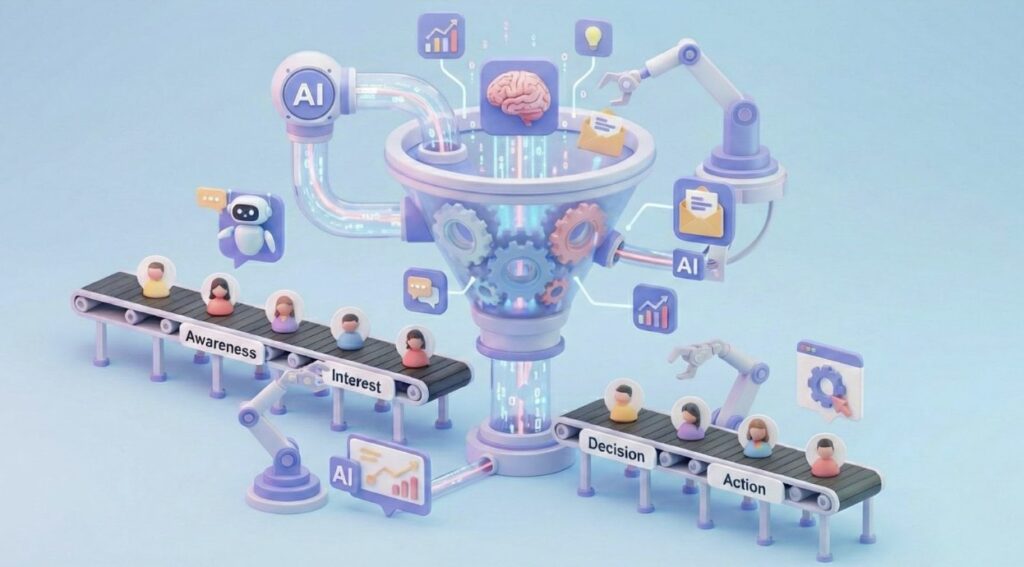
Today, advances in AI technology have made it possible for businesses of all sizes to create automated funnels that attract visitors, nurture leads, and convert customers with minimal ongoing effort.
By automating repetitive tasks and optimizing key touchpoints, AI-driven funnels help businesses scale efficiently while maintaining personalized customer experiences.
To build a successful automation funnel, it is essential to understand which tools are best suited for each stage of the funnel and the specific role each tool plays in supporting your overall marketing and business goals.
3 Key Benefits of Using AI in Your Marketing Funnel
1. Speed
AI allows for much of the time-consuming work that was once required to write draft versions of various documents, sort through large amounts of data, generate alternatives to existing content, and identify patterns to be completed in minutes rather than hours.
This allows smaller organizations to level the playing field with larger companies that may have more resources available to them.
2. Personalization
One of the biggest reasons funnels fail is that their messaging is not unique enough.
AI can customize email, advertisement, or landing page messaging to reflect user behaviours.
For instance, if you have a prospect who read three blogs about search engine optimisation (SEO) versus one who downloaded a Greyhill Pricing Guide, they will receive emails with very different content.
The relevance of this approach has proven to increase conversions.
3. Insight
The use of AI tools will give you access to information that may otherwise have been missed.
They will allow you to know which content themes are drawing the most leads, what subject lines elicit the most responses, and which segments of your audience have a higher conversion rate.
Therefore, as you develop the funnel over time, it will continue to become stronger as you no longer rely upon hypotheses for improving the site.
The Basic Steps in an Automated Marketing Funnel
There are typically six stages of an automated marketing funnel. It is possible to simplify the funnel and gradually add more functionality.
- Generating website traffic
- Capturing leads
- Nurturing leads
- Qualifying leads
- Converting leads to sales
- Maintaining customer relationships
The following discussion breaks down how automated marketing can support each stage.
Stage 1 – Attracting Traffic through AI
To get people to view your content, you’ll want to implement a balanced mix of search, social media, and paid strategies.
By using AI, it can create a much more consistent experience Worldwide, all at the same time.
AI content creation
With the help of AI content creation platforms (like ChatGPT, Jasper, Claude, etc.), generating ideas, outlines, headlines, and complete articles will be possible, although the finishing touches would still require your input.
However, because the amount of time spent doing research and writing drafts greatly decreases, thus allows you to produce more articles over time, which is essential to your growth.
When using AI content tools effectively, you should consider the following:
– Make sure to provide a clear brief or an outline of what you’re looking for.
– Always ask for multiple versions rather than one final version.
– Make sure to edit any areas you want to change in your own voice so it all sounds natural.
– Utilize your AI-created content to revisit older articles and maintain relevance.
AI search engine optimization (SEO)
With platforms like Surfer SEO and Clearscope, you can access insights from top-ranking pages in your niche along with data-driven recommendations.
These tools help guide topic selection, internal linking strategies, and the ideal reading level for your content.
In other words, it will help get your articles to be found by search engines without having to use “keywords” uncomfortably.
AI social media
Social media scheduling solutions will take highlights from your articles and convert them to short social media posts. In addition, they can automatically generate hashtag recommendations, video creation scripts, and caption options.
Once set up, they automatically publish the content you’ve created even while you’re fast asleep, allowing your followers to see your latest post 24 hours a day.
When including images within your article, include an accurate and individualized description for each image, such as “AI Dashboard Overviewing Marketing Activity.”
Adding this alternative text will assist in increasing the accessibility of your site and Search Engine Optimization (SEO / SERP).
Stage 2 – Automatically Creating Leads
When visitors come to your website, one of the goals is to quickly and easily convert them into contacts (either through purchasing a product, signing up for a newsletter, etc.).
Utilizing AI landing page builder(s)
AI Landing Page Builders, such as Unbounce and Leadpages, utilize artificial intelligence to create layouts and copy for your landing pages and create multiple versions of your page that will give you insight into what copy/phrase(s) are most successful.
Smart lead forms
Smart forms utilize the user’s response to change the question presented back to the user, creating a better way to collect leads.
For example, if a user says “I need help with strategy,” they will be presented with questions geared towards strategy, vs. if they selected “I want technical support,” they would then be asked questions about technical support.
This leads not only to better data being gathered, but also creates a more personal feel to the lead form.
Lead magnet creation via AI
AI can assist with creating quick production of lead magnets (i.e., eBooks, Checklists, email courses, Templates, Mini Audit) in hours as opposed to days, allowing you to test multiple offerings until you find the one that appeals to your target audience the most.
Automatically creating a sequence of email messages helps build better relationships with potential customers.
Email is typically where the greatest number of people convert into paying customers and it provides multiple opportunities for conversion.
AI tools can also automate the creation of a welcome email sequence, automatically generate various messages in the sequence, and use lead behavior to personalize the language and style of email messages.
In addition, they can determine when each email message in the sequence was opened, therefore automatically creating many time-sensitive email messages for leads.
Stage 3 – Sequence of Automated Email Nurturing Leads
Most conversions occur via email. An effective email sequence builds credibility and directs individuals toward making their final decisions. AI assists in the creation of a sequence of emails.
There are several ways AI can assist:
- Generate welcome sequences
- Create multiple versions of emails to run split tests
- Determine a lead’s tone from his/her behaviours
- Determine the best time to send emails based on the open rate of those emails
- Organise leads into different categories based on their level of interest
An example of a simple five-email nurturing sequence includes:
- An email welcoming the lead
- An email containing an informative article/guide
- An email containing a study or review of other customers using your product
- An email offering a “soft” sale
- An email containing a “hard” sale and requesting an immediate follow-up action
You can modify the number of emails in your nurturing sequence based on the needs of your particular business.
Successful personalisation
The most effective AI-based email marketing tools identify what users did.
For example, if a lead visits and clicks through on a pricing page, he/she will receive an email regarding what to expect with regard to pricing options and concerns.
Alternatively, if he/she is reading articles on the blog, he/she will receive more educational articles relating to your product or service.
This type of “adaptive messaging” establishes trust more quickly than sending out generic or “one-size-fits-all” types of emails.
Stage 4 – Automatically Scoring Leads And Determining Which Are a Good Fit For Your Business
Sales teams (or yourself if you are the entire sales team) shouldn’t waste their time on leads that are not ready to be converted into customers.
AI lead scoring
AI platforms track user behavior, such as:
- Pages visited
- Emails opened
- Videos watched
- Forms submitted
- Time on site
- Keywords searched
Every action a lead takes, whether positive or negative, will either increase or decrease the total score of that lead.
When someone achieves a score above a certain threshold, this indicates they are now qualified to proceed to the next stage of your sales funnel.
This keeps your sales process focused on leads that are most likely to yield positive results.
Smart segmentation
AI also groups leads into categories. For example:
- Researchers
- Price-focused buyers
- First-time buyers
- Repeat buyers
- High-intent visitors
Several different audiences receive messages that are unique to them.
Using different messaging to target multiple audiences is one of the best ways you can improve your conversion rates without needing to drive additional traffic.
Stage 5 – Transforming Prospects Into Clients
This stage in your funnel is the end goal that helped create this entire funnel!
Sales page AI
AI algorithms are constantly parsing through different aspects of page design, including structure, organization, ease of reading, and potential friction points, causing drop-offs throughout the sales process.
These algorithms provide suggestions on how to increase page clarity, thereby improving conversion rates.
Sales and chat support AI
Chatbots can be programmed to answer routine inquiries instantaneously, allowing website visitors to quickly navigate their options, assisting them in gathering additional information they may require, as well as guiding them in determining the best solution for their needs.
By effectively utilizing AI chatbots, you will see a decrease in abandoned carts as well as an increase in inquiries completed.
Proposal writing AI
If your organization creates proposals or quotes, utilizing AI will allow you to generate drafts that can then be refined by you, saving both turnaround times and enabling you to respond faster than your competitors.
Stage 6 – Automated Follow-Ups can retain customers
Retaining customers is much less costly than acquiring new customers. AI will engage with your customers long after their purchase – in addition to gaining customer engagement.
Automated onboarding
Onboarding new customers through automated systems allows you to easily introduce your new customers’ experience to the product, and where they can go for support, which increases the probability of customers using it.
Personalized check-ins
AI automation software sends automated follow-up messages based on your customer’s milestones. An example of this would be:
Day 3: “How’s everything going?”
Day 14: “Here is a suggestion to increase your value in your product.”
Day 30: “Would you like to schedule a time for assistance in setting up?”
Although automated, this communication is personalized.
Request for review/referral
Once customers have used your product for a period and recognized its value, you can send a respectful request for a review or referral, thereby developing your reputation and trust within your complete marketing ecosystem.
Creating an Automated Funnel Blueprint
Below is an easy-to-understand framework for an automated funnel.
Step-by-Step Framework
– Utilize AI tools to research topics and then develop repeatable content.
– Create and publish articles, videos, and social media posts that will direct visitors to landing pages.
– Using AI templates, develop lead magnets and design landing pages.
– Deliver new leads to an automated email follow-up sequence using AI.
– Automate your lead scoring and lead segmentation processes.
– When the lead exhibits high intent, move them to your sales page (or to your sales team).
– Leverage chatbots, proposals, and smart content during the closing process.
– Provide follow-up through automated onboarding emails, retention emails, and referral requests.
Continually Improve
Your sales funnel is never finished; therefore, you must analyze the performance of your funnel every month:
– Monthly average open and click-through rates
– Overall lead quality is measured on a monthly basis
– Average length of the sales cycle per month
AI has simplified the process of testing different versions of content and determining which ones generate the most leads.
Over time, you will be able to build a more intelligent sales funnel that will convert better than ever before.
Conclusion
Your marketing funnel will not replace your judgment.
Instead, it removes repetitive tasks so you can focus on strategy, creativity, and meaningful customer conversations.
With the right planning and tools, an AI-powered funnel can attract, educate, qualify, and convert customers with minimal manual effort.
As AI continues to advance, businesses that adopt funnel automation early gain a competitive advantage.
You do not need to automate everything at once. Start with one stage and expand as your business grows.
When built correctly, your marketing funnel becomes a dynamic system that evolves with your needs and consistently drives results.
Businesses seeking support in building or optimizing AI-based marketing funnels can rely on Glorywebs as a trusted partner throughout the automation journey.