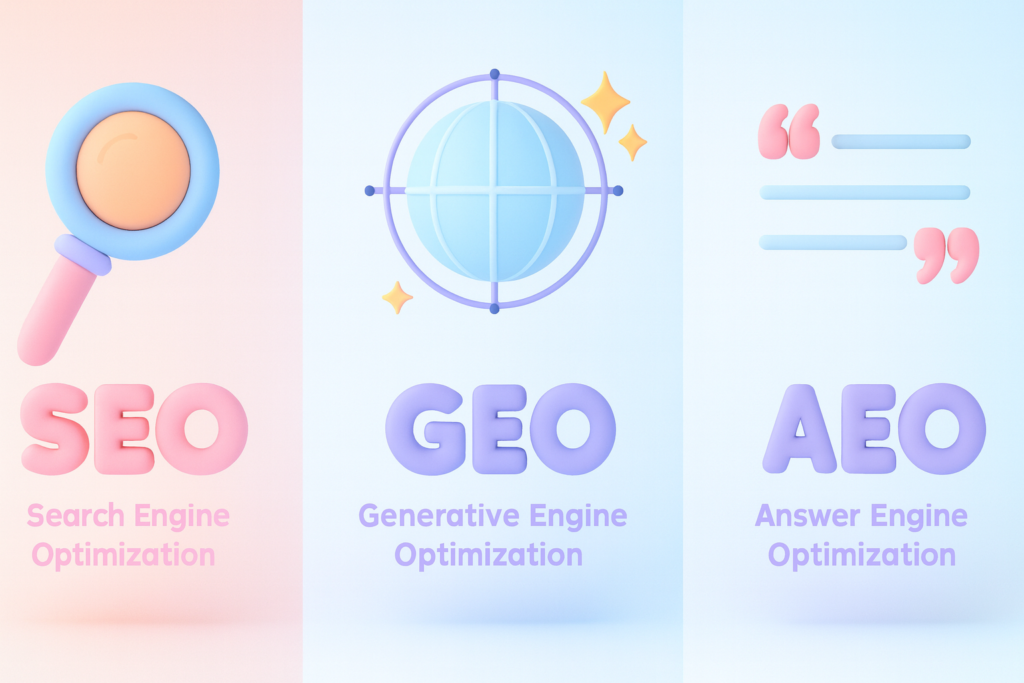
If you’ve ever Googled something and noticed the answer box at the top, or asked Siri a quick question, you’ve already seen how search is evolving. SEO is still important, but now AEO and GEO are shaping the way content gets discovered. Ignoring them means missing out on a big slice of visibility.
But the landscape has shifted quickly. With AI-powered search, voice assistants, and generative tools like ChatGPT and Google Gemini, two new terms are on the rise: AEO (Answer Engine Optimization) and GEO (Generative Engine Optimization).
If you’re only focused on SEO today, you’re leaving visibility (and traffic) on the table. In this post, I’ll break down SEO, AEO, and GEO, explain how they differ, and share why combining them is the smartest way to future-proof your content.
What is SEO?
SEO, short for Search Engine Optimization, is basically how you make sure your site doesn’t get lost in the internet’s noise.
If your pages aren’t optimized, they might as well be invisible, because let’s face it, nobody clicks page 10 of Google.
From my experience, SEO boils down to three areas:
- On-page SEO: the content and structure people see (headings, keywords, titles).
- Technical SEO: the stuff you don’t see but feel (site speed, mobile-friendliness, indexing). At Boldin, as a local SEO Dubai agency, we develop custom themes where we have page speed close to 100, and for mobile, above 90. In the image below is the page speed that we’ve done for one of our clients.
- Off-page SEO: what others say about you (backlinks, mentions, authority).
And here’s something to chew on: 93% of online experiences begin with a search engine (Search Engine Journal, 2023). Think about that. Almost every online journey starts with someone typing (or speaking) a query. If your site isn’t showing up, you’re out of the game before it even begins.
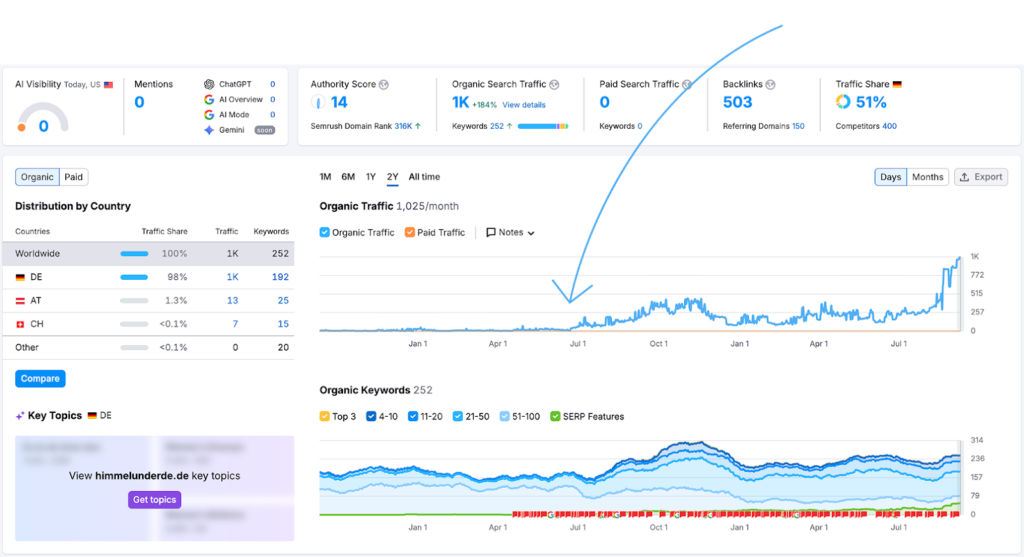
The picture below shows the increase in traffic after we optimized the website for SEO.
We’re one of the top SEO and you can learn more about our approaches to SEO and our work.
What is AEO? (Answer Engine Optimization)
Okay, let me be honest: AEO sounded like a marketing word the first time I heard it.
I figured, “Great, another acronym to memorize.” But then I actually tried it on one of my blog posts… and wow, it made a real difference.
AEO is basically about making your content the answer, not just a link buried on Google, but the thing people see first. Like those little boxes Google shows at the top, or what Siri or Alexa reads out loud.
You know, those moments where someone asks, “What’s the best time to post on Instagram?” and boom – your answer pops up. That’s AEO.
It shows up in a few places:
- Google Featured Snippets (that little answer box you sometimes see)
- Knowledge Panels (the info blocks on the right)
- Voice assistants like Siri, Alexa, or Google Assistant
Why does it matter? Well, people aren’t typing single keywords anymore. They’re asking full questions. And voice search is only getting bigger. Honestly, I was surprised to read that over half of consumers use voice search for local business info (Think with Google, 2023).
Here’s what I do when I optimize for AEO:
- Break content into headings or FAQ sections. It makes it super scannable.
- Answer the question first, then give details. Don’t bury the answer halfway down the page (trust me, it works better).
- Write like you’re talking to a friend. I know it sounds simple, but conversational tone matters.
Honestly? AEO isn’t just about ranking. It’s about being the first answer people actually see. And if you nail it, sometimes they don’t even need to click your page to get the info. Pretty cool, right?
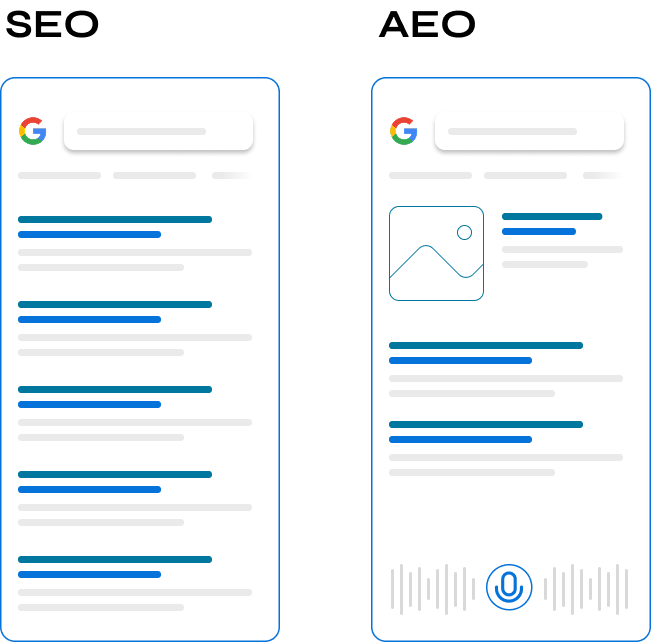
In the picture below, there is a sample draft of the difference between SEO and AEO.
What is GEO? (Generative Engine Optimization)
Okay, I’ll admit it, GEO sounded a bit like a sci-fi term the first time I ran into it. I mean, “Generative Engine Optimization?” Really? But after testing, it started making sense, and honestly, it’s kind of cool.
Here’s the gist: GEO is about making your content show up inside AI-generated answers, not just on Google. So when someone asks ChatGPT, Google Gemini, or Bing Copilot a question, your content could actually be cited in the response. Weirdly exciting, right?
For example, last week I asked ChatGPT, “How do I optimize a WordPress site for SEO in 2025?” and listed down all the fundamental and critical steps that I need to take in order to have my WordPress site optimized for SEO.
A few things I’ve learned work for GEO:
- Keep it clear and structured. Headings, bullet points, short paragraphs: AI actually parses that better.
- Use solid sources and stats. AI tends to favor authoritative info.
- Provide context. If the AI can’t tell what your post is about, it won’t cite you.
Why care? Well, AI is reducing clicks to traditional websites, so if you’re not GEO-ready, your content might as well be invisible in some searches. One stat I found says well-optimized content for generative engines can boost AI visibility by roughly 40% (Fimmick.com).
Honestly? GEO feels like a mix of experimentation and the future. It’s still new, a little weird, but if you nail it, your content gets a front-row seat in the AI era.
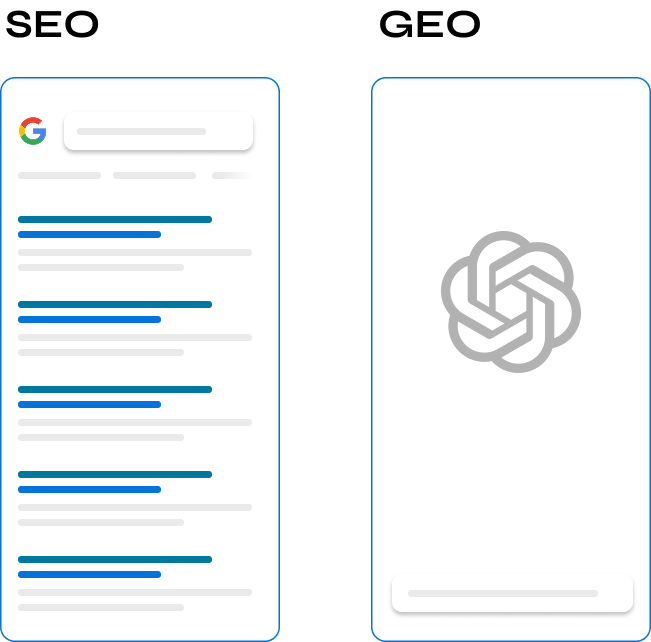
In the picture below, you can see the traditional search and the GEO interface.
SEO vs AEO vs GEO: How I See It
So, here’s how I like to think about these three strategies. I’ll be honest, it took me a while to get my head around it.
- SEO is the foundation. It’s what gets your pages ranked on Google using keywords, backlinks, and a solid site structure. Think: normal search traffic, organic listings, the bread-and-butter.
- AEO is the “quick answer” layer. It’s structured content, FAQs, short, clear answers. This is what shows up in Google snippets or what Siri/Google Assistant might read aloud. If you do this right, you grab attention fast.
- GEO is the AI layer. Clear, authoritative content that can be pulled directly into AI answers. You’re showing up even if someone doesn’t click your website.
Honestly, these three layers work best together. SEO builds the house, AEO lights up the rooms, and GEO makes sure AI points straight to you. Skip one, and you’re leaving visibility on the table.
Which One Should You Focus On?
Honestly, it depends on your site and what you’re trying to achieve. There’s no one-size-fits-all answer.
For most general websites, SEO is still the foundation. Without it, your content might never be seen. I’ve had posts that were technically great, but without proper SEO, they don’t generate any traffic.
If your site is content-heavy or full of FAQs, AEO is worth paying attention to. It helps your content appear in featured snippets or get picked up by voice assistants. Think of it like getting in front of people before they even click your page.
Now, for future-proofing with AI, GEO matters. It’s still a bit experimental, but making your content AI-friendly means it can show up in tools like ChatGPT or Google Gemini.
My tip? Don’t just focus on one. Treat SEO, AEO, and GEO as a team. Build a strong base with SEO, grab quick answers with AEO, and prepare for AI with GEO. Mix, test, tweak, repeat, it’s the approach that works in the real world.
Here, you can visit Boldin SEO packages in Dubai, where you can explore different packages for different types of businesses.