Gamified learning is no longer fringe.
Roughly 70 percent of Global 2000 companies build game mechanics into training, turning compliance check-boxes into competitive sprints (SafetyCulture).
Swapping slides for points and leaderboards can boost completion rates by 100 to 150 percent (AmplifAI).
The tooling keeps advancing: in March 2025 SAP Litmos rolled out a generative-AI assistant that suggests the next lesson on the fly (Litmos).
So, in 2026 the real question isn’t whether to gamify; you already should. The real question is which LMS will turn your budget into measurable results.
This guide compares five standout platforms and shows you how to choose with confidence.
Quick-scan scorecard
Below is an at-a-glance table that summarizes the five platforms across the criteria buyers ask about first: core game mechanics, depth of AI, included content, list-rate pricing, and the scenario where each shines.
Refer to it as you read the deeper reviews that follow.
| LMS | Core gamification | AI & automation | Course library | List-rate price* | Best fit |
| GoSkills LMS | Points, coins, level-ups, leaderboards, custom rewards | AI-assisted course builder that helps jump-start outlines, modules and quizzes | More than 130 microlearning courses | $30–$35 per user per month | Small or midsize teams that want speed and no setup fees |
| TalentLMS | Points, badges, levels, leaderboards, coupon rewards | No native AI (feature announced for 2026) | Optional add-on packs | $149 per month for 40 active users (free for five) | Mixed-topic SMB training where ease of use outweighs AI |
| SAP Litmos | Optional badges, points, team boards, levels | Generative-AI assistant, AI video assessments | Large compliance catalog | Quote-base | Regulated enterprises that need airtight tracking with some fun |
| Docebo | Points, badges, rewards marketplace, contests | AI content recommendations, AI micro-course builder | Marketplace plus partner content | From $25,000 per year | Global firms or customer academies trading budget for depth |
| Centrical | Narrative quests, redeemable coins, multi-tier boards, team challenges | AI coaching, adaptive nudges tied to live KPIs | Integrates external sources | Quote-base | Frontline sales or support teams that live on daily metrics |
*Publicly posted list rates or recent quotes; final terms vary by contract.
The scorecard doesn’t pick a winner; it frames the field so you can zero in on the one or two platforms that merit a pilot.
In the next section, you’ll find a quick decision path to move from “interesting” to shortlist in minutes.
Pick your lane in 60 seconds
Scan the three statements below and pause at the first one that matches your situation.
- “We have fewer than 500 learners and need to ship training this month at under $10 a seat.”
Take the SMB Express. GoSkills or TalentLMS can be live in a week, with no setup fees and enough game mechanics to spark friendly competition. - “Regulators audit us annually, and our workforce spans multiple regions.”
Merge onto the Enterprise Highway. SAP Litmos or Docebo provide audit-ready reports, single sign-on, and AI personalization at global scale. - “Frontline reps live by daily KPIs and bonuses.”
Choose the Performance Fast Track. Centrical turns live quota data into quests and nudges that improve metrics shift by shift.
If two lanes feel plausible, compare total annual cost of ownership, then pilot the lower-risk option first. Within a month you’ll see whether the game mechanics drive measurable behavior change, and you can expand with confidence.
GoSkills LMS: quick wins for small teams
GoSkills gives small and midsize businesses the motivational tricks big enterprises use, without any red tape.
Learners earn coins and climb from Topaz to Diamond status during their first coffee break. Real-time progress bars and Slack leaderboards keep energy high, while managers can swap coins for gift cards or bonus time off.
Behind the scenes, the AI course builder “Genie” turns a prompt such as “Excel for sales reps” into an outline, quiz, and suggested video clips in minutes. Learners can also type questions (“What’s a VLOOKUP?”) into an in-course chatbot and get instant answers, so momentum never stalls.
The platform ships with more than 130 micro courses and lets you upload SCORM or video files for custom content. Tag a lesson, and the coin drop lands exactly where you want the behavior change.
Pricing runs $30-$35 per user per month on an annual plan, with no setup fee. A 50-person pilot costs roughly the same as a single off-site workshop yet produces clear completion data in weeks. One customer, O’Brien Fine Foods, recorded record finishes during a month-long “Battle of the Brains” contest and kept scaling from there.
If you need a fast, affordable way to turn training into a friendly game and prove it with completion stats, GoSkills is ready for you.
TalentLMS: habit-forming training minus the hassle
TalentLMS keeps things simple, adding just enough game spice to build learning habits.
Learners collect points for every module, level up at preset milestones, and flash custom badges such as Sales Shark or Support Ninja. Leaderboards stoke friendly rivalry, while optional coupons let you convert points into discounts on courses you resell to customers, a perk that turns curiosity into repeat business.
Setup is nearly friction-free. Drag in a video, upload a slide deck, or paste a SCORM file, and you’re live. The mobile app mirrors desktop flows, and “Branches” let you launch separate portals for partners or regions without cloning content.
AI is the one gap because the platform currently lacks a native builder or chatbot, so teams that want deep personalization may look elsewhere. For straightforward gamified delivery, though, TalentLMS excels.
Pricing begins at $149 per month for up to 40 active users, with a forever-free tier for five. When fully utilized, that equals roughly $3 to $4 per learner, often less than the cost of tracking completions manually.
Bottom line: TalentLMS removes complexity, wraps courses in game mechanics, and lets nontechnical trainers launch programs before lunch.
SAP Litmos: enterprise compliance with a dash of play

Litmos is popular with audit-heavy organizations because it records every policy, score, and signature regulators expect, yet still lets learners earn points and badges.
Turn on the gamification module, and badges, points, and team leaderboards appear beside each course. Finance teams can sprint for a close-the-books badge, while plant crews race for safety awards before the quarterly inspection. Because certifications reside inside Litmos, those milestones flow straight into compliance reports, with no spreadsheets and no gaps.
In April 2025 the platform added a generative-AI learning assistant that answers plain-language questions, surfaces clips on demand, and even scores video role-plays. AI playlists and machine-learning video assessments deepen the personalization further.
Mobile learning comes standard; courses download for offline work and sync once a signal returns. Single sign-on connects to SAP SuccessFactors, Salesforce, Okta, and many other systems, so employees reach training with one click.
Pricing is quote-based, and many buyers bundle content and LMS in one contract. Litmos reports more than 4,000 enterprise customers and earned Core Leader status in Fosway’s 2025 9-Grid report. Teams note lighter audit preparation because evidence exports in minutes.
If your brief says “prove everyone is certified, everywhere,” Litmos is a safe choice: serious enough for auditors, engaging enough for learners.
Docebo: rewards-shop gamification meets AI personalization
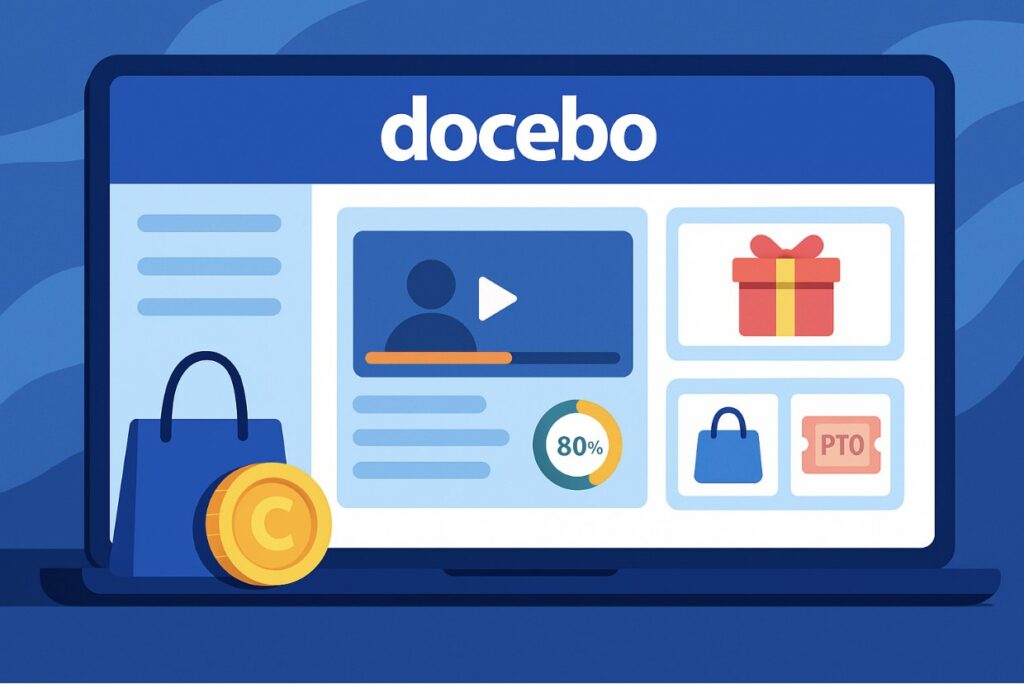
Docebo turns training into a marketplace where points function like currency. Each completed module adds coins that flow into a built-in rewards shop, where learners trade them for swag, gift cards, or paid time off. Because the exchange is instant and visible, motivation feels tangible.
Personalization runs under the hood. Docebo’s AI engine monitors quiz scores, roles, and activity to recommend a “next best lesson” in the home feed, nudging an underperforming rep toward a negotiation refresher or serving a tougher scenario to an agent who just aced a product quiz.
For content teams, the Shape add-on converts slides or PDFs into microlearning assets in about five minutes. Multi-tenant portals let you serve employees, partners, and customers from one dashboard, while branding and reward rules stay separate.
List-rate pricing starts around $25,000 per year and scales with users and add-ons, so the math favors organizations that consolidate multiple portals or tie rewards to revenue metrics.
If you need AI recommendations, customizable portals, and a points-for-prizes economy in one platform, Docebo is built for you.
Centrical: turning daily targets into a game board
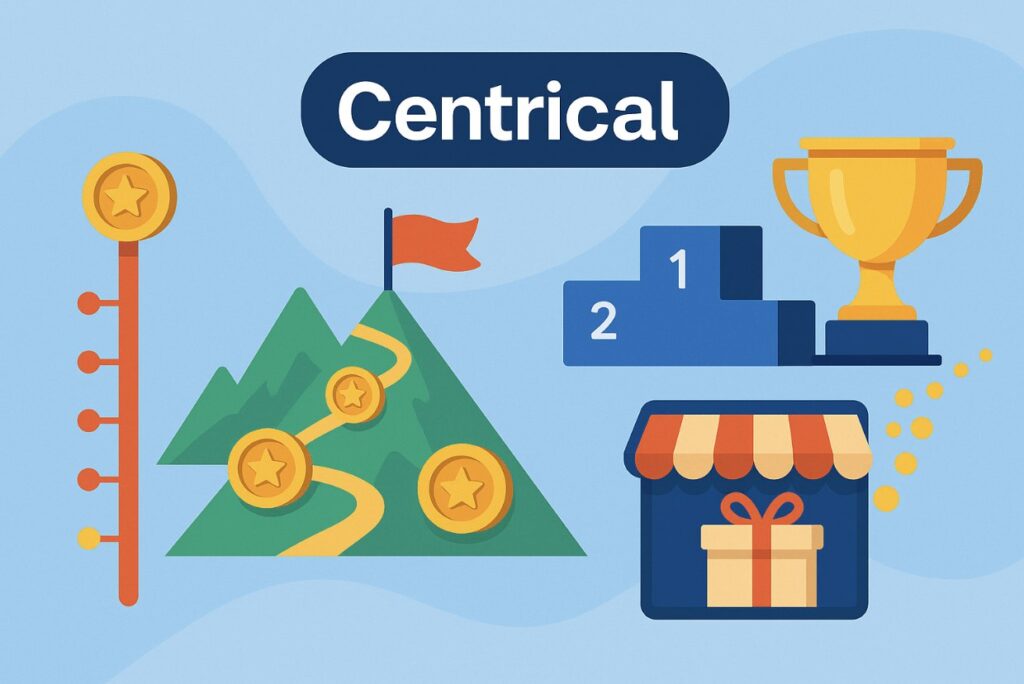
Centrical lives in gamification. Open the app and yesterday’s sales numbers might fuel a virtual car race, while today’s support queue becomes a mountain trek. Each KPI is a mile marker; every learning burst moves players forward.
Points earned for hitting goals flow into a virtual store packed with rewards such as gift cards, tech gadgets, and even lunch with the CEO. Peer kudos in the activity feed reinforce the recognition loop HR teams value.
An AI coach pulls live data from CRM and contact-center platforms; slip behind on handle time and a micro-lesson lands on your phone before the shift ends. According to a Centrical study, managers using the platform’s AI assistant delivered 88 percent more coaching actions than peers without it.
Pricing is quote-based and per user, making sense when turnover, sales, or CSAT carry seven-figure weight. Customers who tie coins to concrete incentives report double-digit productivity gains.
If your frontline workforce thrives on quick recognition and scoreboard bragging rights, Centrical turns routine work into a real-time game and captures the metrics to prove its impact.
Emerging trends to watch
Gamification is now table stakes. What separates leaders from late adopters is how they fuse game mechanics with new tech and recognition models. Three shifts stand out.
1. AI becomes the instructional designer
Generative tools are moving from marketing to learning. GoSkills Genie and Docebo Shape convert bullet points into quizzes or micro-videos in under ten minutes. SAP Litmos added a conversational assistant in April 2025 that surfaces just-in-time clips and scores role-play videos. The payoff is faster content production and guidance tuned to today’s skill gaps rather than next quarter’s curriculum.
2. Reward marketplaces surpass static badges
Points alone feel dated. Docebo’s rewards shop and Centrical’s virtual store let employees trade coins for gift cards, extra PTO, or other perks. When a top performer turns coins into a weekend getaway, teammates notice and log back in. Expect more LMS vendors to adopt this airline-miles style model in 2026.
3. Micro-credentials go mainstream
Digital badges now travel outside the LMS. Platforms integrate with issuers such as Credly, so a customer-service rep who earns a micro-credential today can showcase it on LinkedIn tomorrow.
That portability boosts learner buy-in and gives HR verifiable evidence of skills.
Together these shifts point to a learning economy: AI personalizes supply, game mechanics drive demand, and portable credentials certify value. If your roadmap misses any of the three, you may see engagement drop and retention follow.
Your buying checklist
Before a glossy demo wins you over, run these eight questions in one meeting:
- Does the platform include native points, badges, and leaderboards, or will you pay extra for plug-ins?
- Can an admin create or import a course in under 60 minutes (no IT ticket required)?
- Which AI features work today (show a live demo), and which sit on the 2026 roadmap?
- How can learners spend their points? If rewards never move beyond pixels, motivation fades.
- Can the dashboard link engagement metrics to hard KPIs such as sales lift, compliance pass rate, or churn?
- Over the next three years, how many seats or portals will you need, and how will that affect total contract value?
- If an auditor arrived tomorrow, could you export a completion report (CSV or xAPI) in minutes?
- When two frontline employees log in, do they lean forward or sigh? Watch their faces.
A vendor that clears all eight checks is ready for investment. Miss two or more, and any savings may vanish in lost adoption.
Conclusion
Gamified learning has crossed from novelty to necessity, and in 2026 the LMS market reflects that shift.
Whether you’re an SMB racing to launch training this month, an enterprise preparing for audits, or a performance-driven operation focused on daily KPIs, there’s a platform tailored to your needs.
But tools don’t win on features alone; they win on outcomes. Choose the platform that fits your scale, your regulatory world, and your culture.
Run a focused pilot, measure behavior change, and invest only where you see real traction.
In a learning economy driven by AI, reward mechanics, and portable credentials, the right LMS won’t just gamify training, it will elevate performance across your organization.
Frequently asked Questions
1. What exactly is a gamified LMS?
A gamified learning management system uses game mechanics—such as points, levels, rewards, quests, and leaderboards—to increase learner engagement. Instead of passive slide decks, learners experience progress, competition, and incentives that encourage consistent behavior.
2. Does gamification actually improve training results?
Yes. Multiple studies show that gamification significantly boosts completion rates, retention, and overall engagement often doubling completion compared to traditional training. When combined with AI-powered personalization, results improve even further.
3. Which gamified LMS is best for small businesses?
GoSkills and TalentLMS offer the fastest deployment, simplest setup, and lowest per-seat costs. They provide enough gamification to motivate learners without overwhelming teams with configuration.
4. Which platform is strongest for compliance-heavy organizations?
SAP Litmos stands out with robust audit reporting, certifications, and enterprise integrations. It adds optional points and badges without compromising the serious requirements of regulated industries.
5. Which LMS offers the most advanced AI features?
SAP Litmos and Docebo lead in 2026. Litmos provides a generative-AI learning assistant and AI video assessments. Docebo uses AI to recommend personalized learning paths and automatically generate micro-content.