Machine learning used to be a luxury for the top 1%. If you wanted to use it, you needed a massive R&D budget, a room full of PhDs, and years of patience. Not anymore.
In 2026, if you aren’t using data to automate decisions, you are paying a manual tax. Your competitors have already stopped paying it.
Today, the shift is moving from simple predictions to autonomous actions. Businesses are no longer just asking What happened? or What will happen?. They are building systems that act on those answers.
TL;DR: The Executive Summary
- Machine learning is no longer an R&D experiment. It is core business infrastructure, and companies treating it otherwise are already falling behind.
- The biggest barrier isn’t the technology. It’s knowing where to start and who to trust to build it right.
- Internal teams often stall. The right external partner moves faster, costs less, and ships something that actually works in production.
- The businesses winning right now aren’t the ones running the most pilots. They’re the ones putting one well-chosen solution into production and scaling from there.
The Architecture of Modern Enterprise Machine Learning
The technical foundation of a machine learning solution rests on the ability of algorithms to identify patterns within high-dimensional datasets without explicit programming for every contingency.
Within the corporate environment, this takes several distinct forms, each serving specific functional objectives.
Supervised learning remains the dominant methodology, particularly in scenarios requiring predictive accuracy based on historical labeled data. By training on curated datasets, these models achieve high precision in classification and regression tasks, such as credit scoring or medical diagnostic imaging.
Unsupervised learning serves a different purpose, focusing on the discovery of hidden structures within unlabeled data. This is frequently utilized for customer segmentation in retail or anomaly detection in cybersecurity, where the objective is to find outliers or groupings that are not immediately apparent to human analysts.
Deep learning, utilizing multi-layered neural networks, has shifted the boundaries of what is possible in processing unstructured data like speech, images, and video.
Convolutional Neural Networks (CNNs) have become a standard in healthcare for radiology, while Recurrent Neural Networks (RNNs) manage sequential data in financial market forecasting.
The maturity of these technologies is evidenced by the rising adoption of Reinforcement Learning (RL), where an agent learns optimal behaviors through a system of rewards and penalties.
In logistics and supply chain management, RL is being applied to optimize routing and inventory levels in real-time, adapting to volatile market conditions.
Comparison of Learning Methodologies in Business Applications
| Methodology | Data Type | Primary Business Use | Typical Result |
| Supervised Learning | Labeled | Demand Forecasting | Numeric Predictions |
| Unsupervised Learning | Unlabeled | Market Segmentation | Pattern Grouping |
| Reinforcement Learning | Interaction | Logistics Routing | Optimal Action Sequences |
| Deep Learning | Unstructured | Image Diagnostics | Automated Identification |
The selection of the appropriate methodology is a technical decision that determines the scalability and cost-efficiency of the machine learning development process.
Why Internal Teams Often Hit a Wall
If you are thinking about building an internal team, look at the math first. Data from 2025 shows that 60% of companies struggle to recruit internal experts. Hiring a single senior engineer takes an average of 50 days, and that doesn’t include the months of onboarding needed to align them with your business goals.
Internal experiments fail 67% of the time because they often lack contextual alignment. They build models that look great in a lab but break the moment they hit the messy reality of your daily operations.
This is where machine learning consulting services change the game. External ML Consultants bring pre-built frameworks and cross-industry experience that internal teams simply don’t have. They act as a bridge between abstract data and your actual KPIs. Partnerships with a specialized firm reach deployment 67% of the time, compared to just 33% for internal builds.
Performance Metrics: In-house vs. Outsourced Development
| Factor | In-house Team | Machine Learning Development Company |
| Hiring Time | 50+ Days Average | Near-Instant Access |
| Project Success Rate | Lower (33% in Healthcare) | Higher (67% in Healthcare) |
| Launch Time Reduction | Baseline | 20-40% Reduction |
| Cost Efficiency | Fixed High Salaries | 30-60% Savings on Overhead |
| Skill Range | Limited to Hires | Global Specialist Pool |
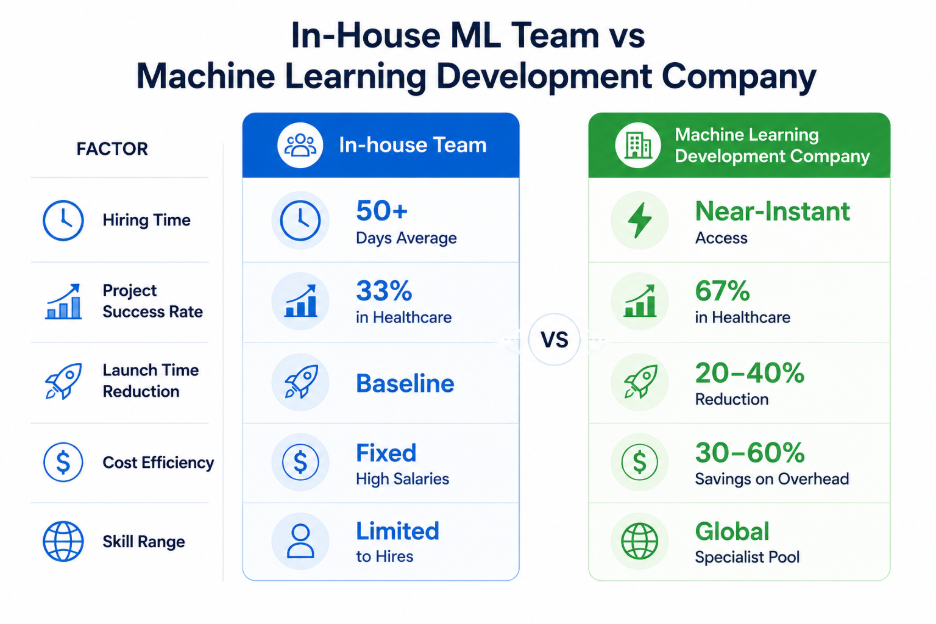
Partnering with an external firm allows for a “Value-first Strategy” where KPIs are developed around profit margin increase, reduction of working capital, and prevention of fraud.
Economic Impact and Quantifiable Return on Investment
The justification for investing in machine learning has moved beyond competitive anxiety to quantifiable financial metrics. Research by McKinsey suggests an average ROI of 5.8x on investment within 14 months of production deployment.
However, this success is not uniform. A significant portion of the realized value comes from back-office automation and operational efficiency rather than front-office sales tools.
In healthcare, back-office automation can deliver between $2 million and $10 million in annual savings. Similarly, predictive maintenance in manufacturing can reduce unplanned downtime by 30% to 40%, directly impacting the bottom line.
The mathematical reality of these gains is often found in the reduction of “marginal cost” for high-volume tasks. In 2026, profitability is increasingly driven by efficient unit economics and the ability to achieve 80-90% autonomous execution in routine processes. This allows organizations to scale revenue without a proportional increase in headcount.
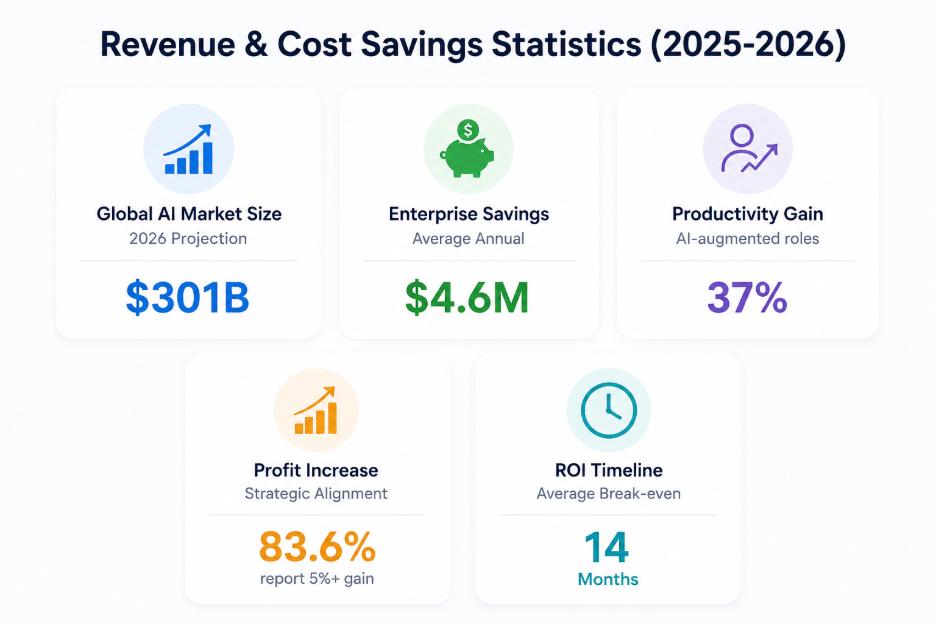
Revenue and Cost Savings Statistics (2025-2026)
| Impact Area | Metric | Quantified Value |
| Global AI Market Size | 2026 Projection | $301 Billion |
| Enterprise Savings | Average Annual | $4.6 Million |
| Productivity Gain | AI-augmented roles | 37% |
| Profit Increase | Strategic Alignment | 83.6% report 5%+ gain |
| ROI Timeline | Average Break-even | 14 Months |
While the impressive 78% global adoption rate suggests a world marching in lockstep, the reality is a fractured landscape where small firms lag significantly behind large enterprises in formal adoption.
Industrial Applications: Where the Money is Hiding
Every sector uses a machine learning solution differently. The goal is to identify the “Value-First” use case that pays for the rest of the transformation.
1. Financial Services: Real-Time Risk Defense
The financial sector is no longer using static rules like “Block transactions over $500.” Modern systems use behavioral analytics to evaluate every event in milliseconds. They look at device fingerprints, spending patterns, and location consistency to make a call before the transaction completes.
- The Impact: AI-driven fraud systems reduce manual reviews by 75%.
- The ROI: Banks using these models see a significant increase in approval rates for high-value revenue streams while lowering the cost of investigations. European banks reported a 20% decline in churn after adopting these models.
2. Healthcare: Diagnostic Precision and Efficiency
The market for AI in healthcare is expected to reach $505.6 billion by 2033. It is not just about robots; it is about data. Diagnostic systems using neural networks now detect abnormalities with over 95% accuracy.
- The Impact: Predictive models forecast patient deterioration, reducing ICU stays by 20%.
- The Case Study: Corewell Health used risk models to prevent 200 readmissions, saving $5 million.
3. Retail and E-commerce: Anticipatory Commerce
Retailers are moving from reactive systems to “personal shoppers” for every visitor. By analyzing browsing history and past purchases, recommendation engines boost sales by 20% to 35%.
- The Impact: Custom models for inventory distribution cut stockouts by 35% and markdowns by 25%.
- The ROI: Personalized recommendations lead to an 18% increase in average order value. This is why AI in B2B marketing has become a standard requirement for staying competitive.
4. Manufacturing: The End of Unplanned Downtime
Predictive maintenance is the ultimate cost-saver. By analyzing sensor data like vibration and temperature, models predict a machine failure days before it happens.
- The Impact: This reduces unplanned downtime by 30-50%, saving millions in operational costs.
- The ROI: Manufacturers report that adopting these systems reduces facility downtime by up to 15% and increases labor productivity by up to 20%.
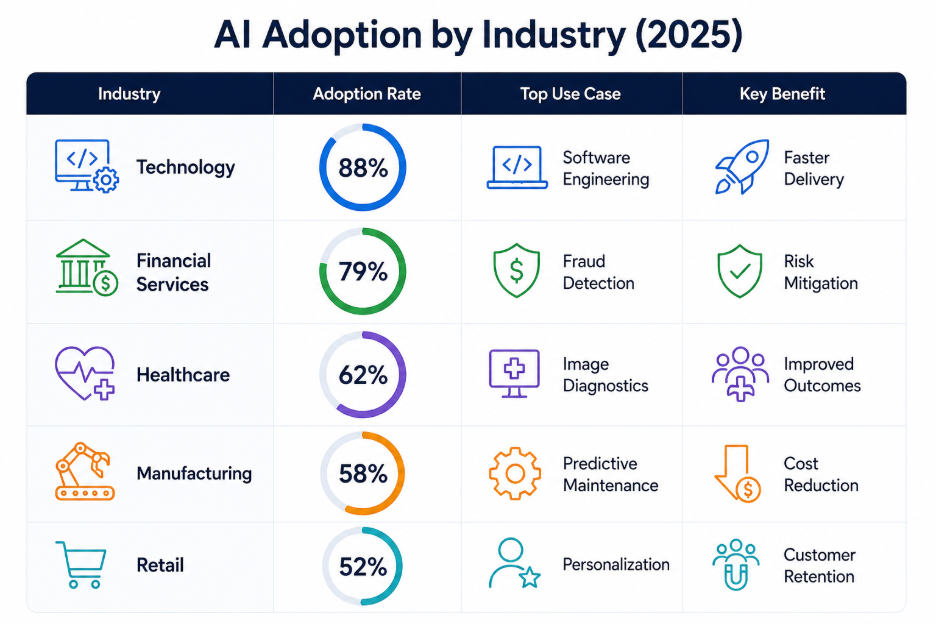
Industry Adoption Rates and Impact Summary
| Industry | Adoption Rate | Top Use Case | Key Benefit |
| Technology | 88% | Software Engineering | Faster Delivery |
| Financial Services | 79% | Fraud Detection | Risk Mitigation |
| Healthcare | 62% | Image Diagnostics | Improved Outcomes |
| Manufacturing | 58% | Predictive Maintenance | Cost Reduction |
| Retail | 52% | Personalization | Customer Retention |
The Lifecycle of a Machine Learning Development Project
A successful project follows a disciplined progression. If a partner skips these steps, they are selling you a prototype, not a product.
Phase 1: Problem Definition and ROI Strategy
Everything starts with a clear question. Instead of asking “What can AI do?”, ask “How can we reduce churn by 5%?”. A professional machine learning development company will ensure your goal is measurable before writing a single line of code.
Phase 2: Data Preparation and Feature Engineering
This is the unglamorous part. Data scientists must clean, organize, and optimize their datasets. If the foundation is messy, the model will be unreliable. This phase involves building secure pipelines to prepare info for processing.
Phase 3: Model Development and Training
Here, ML Consultants evaluate various algorithms to find the best fit. This might involve deep learning for images or simple regression for sales forecasting. Automated Machine Learning (AutoML) is often used here to speed up the testing of different versions.
Phase 4: Integration and Deployment
A model is useless if it sits in a silo. It must be integrated into your ERP or CRM via APIs. The goal is to make the model’s output a natural part of your team’s workflow.
Phase 5: MLOps and Continuous Monitoring
The world changes, and so does data. “Model drift” happens when the real world no longer looks like the training data. MLOps involves automated monitoring and retraining to ensure your machine learning solution stays accurate over time.
Choosing Your Partner: Development vs. Consulting
When you decide to invest, you have to choose who will guide you.
A machine learning development company focuses on the “how.” They are the builders. They provide the specialized talent, the data engineers and software teams, to build the intelligence layer and integrate it with your existing systems.
ML Consultants focus on the “why.” They help you design the roadmap, identify the most impactful use cases, and manage the shift toward an AI-native operating model. They ensure the technology aligns with your long-term business strategy.
For most mid-sized businesses, the best path is a partner who does both. You want a team that can identify a $5 million savings opportunity and then build the system to capture it. Look for firms that offer a “Value-First” strategy and start with a short, 2–4-week proof of concept to validate the math before you commit to a full-scale launch.
The Strategic Path for Business Owners
The era of “testing the waters” is over. Global AI spending is projected to reach $632 billion by 2028, nearly doubling in the next two years.
To stay competitive, you must treat machine learning as enterprise infrastructure, not as a one-off project. This means:
- Stop Pilot Purgatory: Focus on one production-grade deployment rather than ten experiments that never leave the lab. A single model in production delivers 3.5x average ROI within 18 months.
- Invest in Data Hygiene: Your models are only as good as the data they learn from. Clean, structured data is your most valuable asset.
- Bridge the Skill Gap: Since internal talent is scarce, leverage external expertise to move faster. The “time-to-value” is much more important than the cost of the contract. Reducing product launch time by 20-40% is a common result of these partnerships.
- Prioritize Governance: Trust is the ultimate currency. Ensure your systems are transparent, secure, and compliant from day one. Organizations that align AI and business strategies report a profit increase of 5% or more.
The shift toward an algorithmic economy is a permanent change in how value is created. The logic mirrors what a press release does in SEO; send the right signals, and the algorithm rewards you. Machine learning works the same way for your business operations.
Whether it is through hyper-personalization or back-office automation, the goal is simple: use data to make better decisions, faster. If you are ready to stop talking about the future and start building it, find a partner who understands that the only metric that matters is your success. Focus on production readiness, and the growth will follow.
Future Trends: What to Expect in 2027
The field is moving fast. If you are planning for today, you are already behind.
The Rise of Agentic AI
Traditional AI answers questions. Agentic AI completes tasks. These are autonomous systems that can plan, use tools, and interact with other enterprise services to reach a goal. By next year, 40% of enterprise apps will include these agents to handle things like resolving support tickets or managing supply chain disruptions without human intervention.
Small Language Models (SLMs) and Edge Computing
Bigger is no longer always better. Small models are gaining ground because they are cheaper, faster, and offer better privacy. They can run on local devices or “edge” hardware like sensors and cameras. This reduces latency and keeps your sensitive data off the public cloud. It is a massive move for industries with strict privacy rules, like finance and healthcare.
Federated Learning and Data Privacy
Federated learning allows for model training across multiple decentralized devices without the need to exchange raw data. This approach enhances data security, making it suitable for applications in sensitive sectors.
Sustainable and Ethical AI
The environmental impact of running massive models is now a strategic risk. “Green IT” practices focus on energy-efficient designs. Along with this, there is a push for Responsible AI—frameworks that ensure fairness and transparency in how decisions are made.
Governance as a Competitive Advantage
In 2026, the success of a machine learning strategy depends heavily on trust and oversight. Only 30% of organizations have reached a high level of maturity in their AI controls. Security and risk concerns remain the top barriers to scaling agentic AI. Leaders who treat governance as a foundational element, rather than an afterthought, are seeing better results.
Organizations that assign clear ownership for AI roles tend to have higher maturity scores. This involves establishing frameworks for accountability and ethics that evolve alongside the technology. High-performing companies integrate AI across multiple functions to create synergistic value, combining revenue growth, cost savings, and risk reduction in one roadmap.
The Role of the Chief AI Officer (CAIO)
The rise of the CAIO signals the strategic importance of machine learning. This role is responsible for aligning AI initiatives with business priorities, ensuring data security, and managing the shift toward a hybrid workforce where humans and AI agents work together.
FAQ: Key Considerations
Is it worth it for small datasets?
Yes. You don’t need “Big Data” to solve specific business problems. If the problem is clear and measurable, ML adds value.
How long does a project take?
A typical proof of concept takes 2–6 weeks, while a full production rollout usually happens in 2–4 months.
Do I need to hire a full-time data scientist?
Not necessarily. Many firms use external partners to handle the complex development and maintenance, keeping their internal teams focused on strategy.
What is the typical investment?
A typical mid-market ML project ranges from $50k to $2M+ depending on the scale and complexity.
How do I measure success?
Look at hard KPIs: profit margin increase, reduction of working capital, and prevention of fraud. The average break-even point for a successful model is around 14 months.