
The software engineering landscape has passed a critical tipping point. With generative AI writing code at machine speed, SaaS platforms are updating faster than ever before. Yet this rapid pace poses a serious challenge: traditional quality assurance (QA) cannot keep pace with machine-generated output.
Dynamic user interfaces and constantly changing content degrade brittle scripts fast. This ongoing erosion comes at the expense of important technical capability for software businesses. The CloudQA Industry Research 2026 Report says that the maintenance of traditional test automation might take up to 50% of the total work of a QA team. This dynamic immediately raises a barrier to expansion for growing software systems.
SaaS entrepreneurs, CTOs, and product leaders must move away from manual, rigidly scripted validation and embrace intelligent quality engineering to remain competitive. This strategic approach instantly improves product development economics, decreases operational QA costs, increases deployment speed, and retains customers.
For engineering teams, keeping up with the newest AI testing trends is no longer optional; it is a must for sustainable corporate success.
Moving Beyond Legacy QA: Core Challenges in SaaS Quality Assurance
SaaS applications are not static engines anymore that process predictable data inputs. Today’s platforms have very dynamic user experiences, real-time data changes, and built-in AI capabilities. To learn how contemporary engineering teams address these issues, executives typically turn to specific playbooks on software testing with AI agents and MCP to develop more adaptive validation pipelines.
Entrepreneurs need to understand a few important operational changes to comprehend why traditional SaaS quality assurance is falling short in today’s environment:
- The Velocity Bottleneck: Traditional testing involves inflexible schedules where developers construct a product, pass it to a separate QA team, and automation scripts run for hours or days. This sluggish, linear technique breaks down completely when code creation transfers from human to machine.
- Continuous Release Pressures: Continuous deployment pipelines now push updates multiple times per day. The ThinkSys QA Trends Report 2026 notes that 89.1% of QA teams have adopted continuous integration and continuous deployment (CI/CD) pipelines. In this environment, a static testing strategy creates severe delivery bottlenecks.
- The Erosion of Product Quality: Transitioning away from legacy testing isn’t just a technical upgrade; it is a core business survival strategy. When deployment velocity outpaces verification capacity, product quality drops, which directly increases customer churn.
- The Trust Imperative: To protect customer trust and maintain product stability, software leaders need an adaptive validation layer that responds to code modifications in real time. Establishing a modern AI testing strategy for SaaS platforms enables engineering teams to keep pace with fast deployment targets without exposing production environments to critical bugs.
Strategic AI Testing Trends Reshaping SaaS QA
To make the move from deterministic, manual validation to intelligent software engineering, you need to grasp the architectural patterns that dominate current processes. Here are five AI testing trends software directors need to pursue to construct capital-efficient, high-velocity quality engineering pipelines.
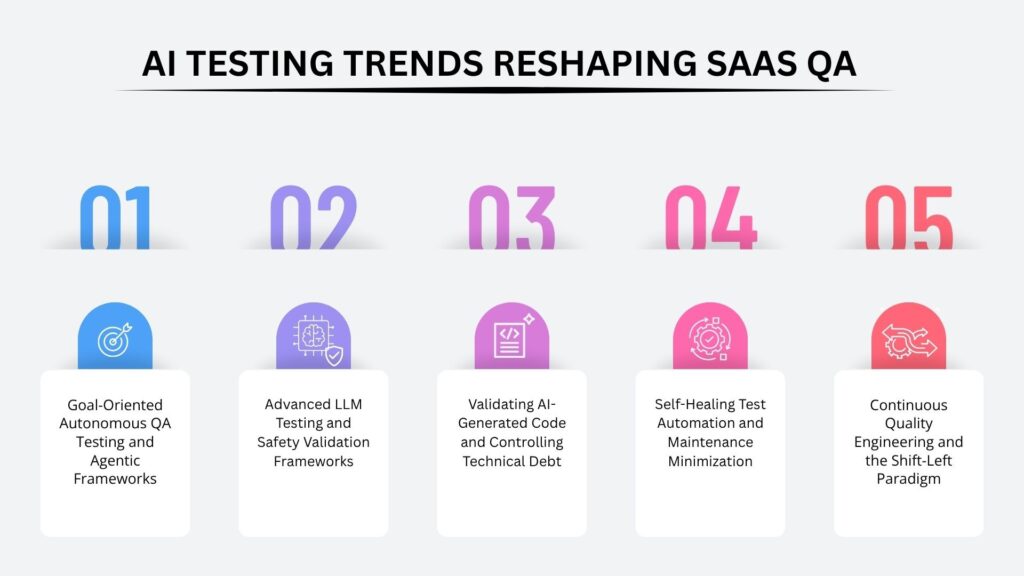
Trend 1: Goal-Oriented Autonomous QA Testing and Agentic Frameworks
Conventional test automation relies on precise instructions. An engineer has to script a click on a certain element, type a specific string in, and validate an identical state of the site. A development team updating a user interface or changing a component layout breaks these hard-coded pathways, leading to costly false alarms.
Autonomous QA testing moves this beyond step-by-step scripting to goal-oriented validation. Instead of scripting for every single contact, an engineer offers an AI testing agent a high-level business aim. For example, a quality engineer would tell an agent, “Verify that a premium subscriber can successfully upgrade their account using a saved payment method, and confirm that the billing portal generates the corresponding invoice document.”
How Testing Agents Process Applications
An enterprise-grade testing agent achieves this goal through a continuous loop divided into three functional phases:
- Perception: The agent reads the application’s structured Document Object Model (DOM), scans accessibility tree labels, analyzes visual layouts through multi-modal models, and monitors network HTTP traffic logs.
- Reasoning: A core reasoning engine evaluates this data stream, determines if the current screen state matches the objective, diagnoses unexpected errors, and plans the next logical step.
- Action: The agent executes the interaction using automated browser drivers, filling out forms or navigating pages exactly as a human user would, but at machine speed.
The Standard for Scaling Agents
To run these agents efficiently without building custom, brittle integrations for every separate testing utility, software engineering teams are adopting open architectural standards. A key framework in this space is the Model Context Protocol (MCP). MCP acts as an open-standard middleware that completely decouples the AI agent’s reasoning engine from the underlying browser execution tools.
Instead of hardcoding a core language model to interface directly with specific browser drivers or database environments, the agent sends a standardized payload to an MCP server. The server acts as a central gateway, interpreting the agent’s intent, enforcing security compliance boundaries, and mapping actions to the correct tool. This protocol-driven approach delivers clear operational advantages for software organizations:
- Lower Maintenance: As the agent detects items based on semantic description and functional purpose rather than fragile XPaths, tests do not break with small interface changes.
- Simple Extensibility: Engineering teams may add a new performance utility or localization API client by deploying a compliant adapter, without touching the core agent reasoning engine.
- Centralized Security: The protocol server offers a single point of control for auditing agent activity, limiting exposure of sensitive data, and rate limitations in staging settings.
Trend 2: Advanced LLM Testing and Safety Validation Frameworks
As SaaS platforms move from deterministic systems to AI-native experiences that include integrated chatbots, automated data synthesis engines, and autonomous workflows, standard test assertions just won’t do.
You can’t validate a generative AI output with a simple match/equality check for software leaders. Integrated language model validation frameworks need to be non-deterministic and customized.
Generative model-powered SaaS companies have three significant operational hazards that can directly affect client retention and legal responsibility. These include hallucinations, data drift, and injection vulnerabilities
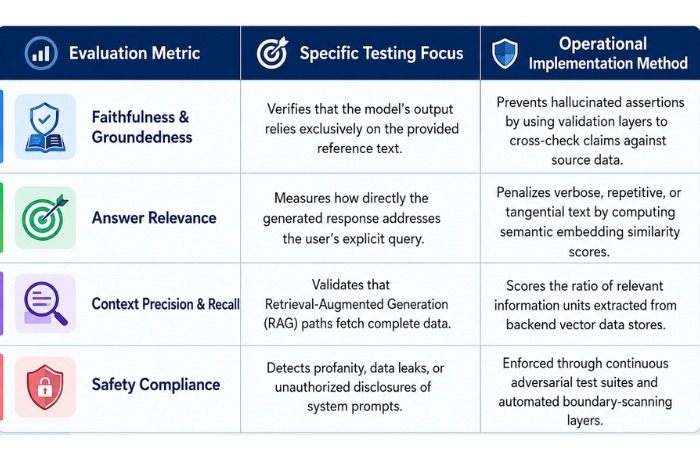
Quantitative Evaluation Metrics
To mitigate these risks, modern quality engineering pipelines implement specialized LLM testing frameworks that grade model responses across distinct quantitative dimensions:
Implementing LLM-as-a-Judge at Scale
To run these evaluations continuously within a continuous integration pipeline, software architectures leverage an automated validation pattern known as LLM-as-a-Judge. A highly capable, rigidly prompted evaluation model is deployed to programmatically audit the outputs of production-facing application models.
To prevent this evaluation step from becoming a cost center or introducing massive latency bottlenecks, software teams run optimized, smaller open-weights models inside secure, containerized environments. This setup allows SaaS providers to run thousands of automated evaluations on every prompt variation without incurring prohibitive external API fees.
Trend 3: Validating AI-Generated Code and Controlling Technical Debt
The widespread use of AI coding assistants has unlocked immense developer throughput, but it comes with a huge externalized cost: the fast acceleration of hidden technical debt. AI assistants are good at creating localized completions but not at the macro-level architectural context.
Left unchecked, they introduce redundant structures, logic flaws, and vulnerable dependencies that degrade long-term maintainability. Pull requests created by AI may have various faults when compared to code written by humans. To avoid this volume jeopardizing product reliability, current development pipelines inject automated validation gates right into the pull request workflow through a multi-stage review process:
Context-Aware Static Analysis
In addition to classic linting, smart analysis engines examine code architecture against the company’s design patterns. Flagged for too much algorithmic complexity, structural faults, and unnecessary logic blocks, human peer review.
Dynamic Mutation Testing and Fuzzing
The validation system stress-tests the handling of edge cases by inserting synthetic errors and very uncommon inputs into the freshly created components. This exposes unhandled exceptions, null pointer vulnerabilities, and boundary issues that cannot be detected by ordinary unit testing.
Automated Safety and Dependency Scanning
Every new package, third-party dependency, or auto-generated function block is inspected for security regressions, hardcoded access secrets, and open source license compliance violations to safeguard the software supply chain from vulnerability injection.
Upstream Quality Mitigation
This left-shifting of automatic gates assures that higher development pace won’t translate into a commensurate spike in production outages, post-release code repair expenses, or long-term architectural degradation.
Trend 4: Self-Healing Test Automation and Maintenance Minimization
In an agile software development environment, product layouts, element properties, and transaction pathways evolve continuously. In traditional QA configurations, these iterations trigger a destructive cycle of broken end-to-end tests. This pattern forces automation engineers to spend substantial time diagnosing failures, updating element locators, and rewriting test scripts.
Self-healing test automation automatically repairs damaged locator pathways at runtime using machine learning models. When an automated test engine identifies an element that has been moved, restyled, or structurally changed, the self-healing mechanism is triggered to prevent instant pipeline failure.
The Multi-Attribute Scoring Mechanism
The self-healing module assesses the changed application state by computing a weighted similarity matrix from a broad range of component properties. It dynamically identifies the relevant target element by using a combination of numerous critical variables, such as DOM path, visual resemblance, accessibility tree role, and text content. The engine selects the components that score best on these vectors.
When the total similarity score is above a preset confidence level, the engine dynamically adjusts the interaction target, runs the test step, and reports the healing action. After the test run finishes, the system generates an automatic patch report with all runtime corrections. This allows engineers to examine and integrate updated locators with a single click, which radically changes the economics of test suite maintenance.
This functionality avoids false positives and pipeline noise, preventing failed test scripts from blocking crucial upgrades and routine deployments. It simplifies engineering effort, enabling software teams to go from mechanical script repair to developing complete coverage for high-risk business flows. It also offers consistent release cadences that help keep continuous integration pipelines flowing, even with significant front-end design changes.
Real-World Operational Impact
Take a B2B product platform that refreshes its core user dashboard on a weekly basis. If a single CSS class name changes in a legacy testing framework, thousands of functional validation scripts malfunction, and the deployment pipeline is stalled for hours. The testing engine identifies the structural change with self-healing mechanisms in place, validates the functional identity of the element via semantic context, successfully completes test validation, and automatically provides a patch for the engineering team.
Trend 5: Continuous Quality Engineering and the Shift-Left Paradigm
To maximize capital efficiency, SaaS organizations must abandon the legacy view of QA as an isolated phase at the end of the development cycle. Discovering architectural flaws or security gaps right before a major launch causes costly deployment delays. Continuous Quality Engineering unifies development, security, and testing into a single pipeline, using automated intelligence to shift validation to the very beginning of the product lifecycle through four precise phases:
Requirements Ingestion and Ambiguity Resolution
Intelligent analysis engines analyze product requirement documents (PRDs) and user stories to find logical gaps or contradictory business conditions before code is developed. That way, product managers can clarify early on, before engineering resources are squandered on wrong assumptions about an edge case that hasn’t been handled.
Synthesizing Predictive Test Architectures
Developers open first code branches, automated systems analyze the changes with the required specification, and immediately build thorough integration and end-to-end test cases. This aligns product purpose and validation pathways immediately, without human scripting.
Risk-Based Intelligent Test Execution
Change-impact analysis techniques optimize the build, instead of performing a monolithic regression suite on every small code check-in. The system detects which microservices or modules have been modified and only executes the test paths that are affected, decreasing cycle times from hours to minutes.
Synthetic Monitoring After Deployment
Once the features are live, the validation loop continues in production with autonomous agents executing real-time simulations of users’ actions. Bots watch micro-transactions and monitor service level goals (SLOs) 24/7 so teams may implement hotfixes before anomalies affect user retention.
Managing the Human Element: QA Upskilling and Culture
Moving to a smart testing paradigm is not only about introducing new tools but also about adopting a whole new way of thinking about the team and the skill sets involved. Aligning engineering workflows with scalable framework priorities requires managing this human transformation just as closely as configuring automated testing servers.
When establishing long-term goals, founders must blend these automated paradigms with practical content marketing plan strategies to effectively communicate technical value across the entire enterprise.
In a smart-quality environment, the function of the typical software tester is undergoing a dramatic transformation. High-level system orchestration replaces manual test execution and laborious script creation. Teams are changing their role from manual testing to quality engineers and prompt specialists.
Strategic Skill Requirements for Modern Quality Teams
To be relevant in an AI-accelerated development environment, quality professionals must build knowledge in several essential technological disciplines:
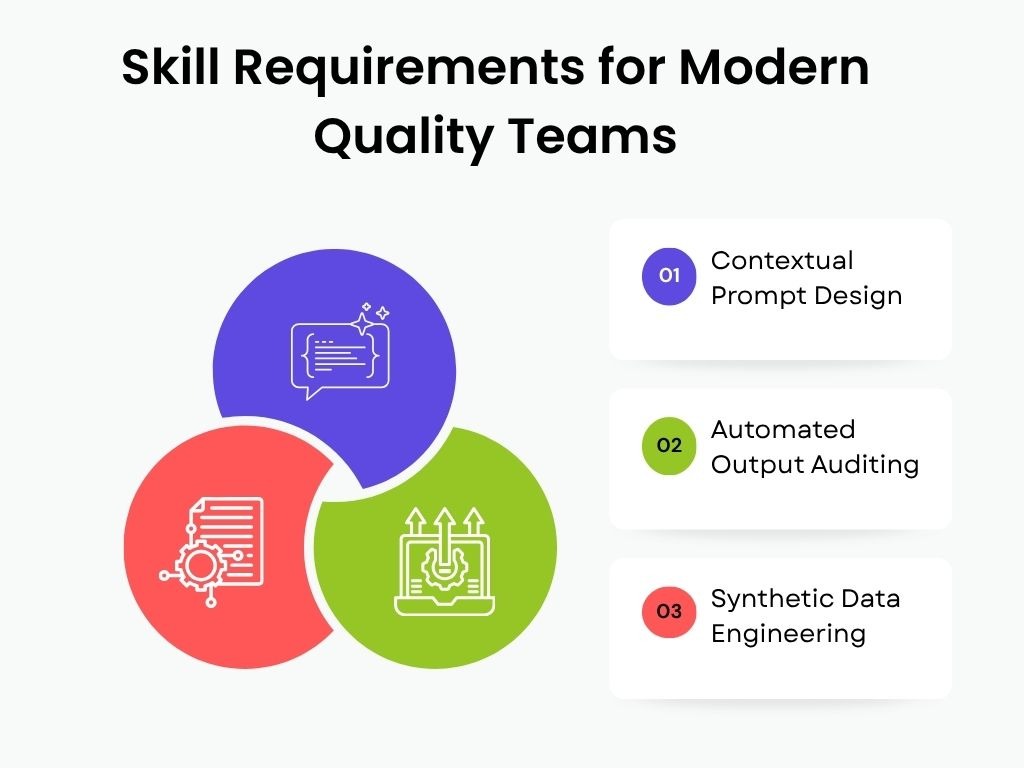
- Contextual Prompt Design: Engineers need to understand how to craft accurate, context-rich prompts to lead autonomous testing agents and test-generation systems, establishing unambiguous boundary conditions and restrictions.
- Automated Output Auditing: Since the evaluation frameworks are running on non-deterministic models, human engineers need to serve as supervisors, setting evaluation thresholds and disambiguating edge cases.
- Synthetic Data Engineering: Realistic and compliant data sets are vital for modern testing. Teams need to work with data creation technologies that represent production use trends without revealing sensitive user data.
Overcoming Key Implementation Challenges
While the benefits of intelligent quality engineering are substantial, implementing these advanced frameworks introduces distinct operational hurdles. SaaS leaders must manage four specific technical challenges:
Mitigating Non-Deterministic Outputs
Generative models almost never generate exactly the same text on two consecutive runs, causing false-positive failures. Engineering teams get around this by employing semantic embedding similarity scores instead of strict text matching.
Controlling Compute and Token Costs
Running continuous evaluation loops can soon add up to big infrastructure costs. SaaS systems solve this by pushing simple validation checks to lightweight, open-source models running locally.
Securing Sensitive Enterprise Data
Autonomous testing agents require extensive access to databases, which poses major compliance issues. To ensure user privacy, all agent operations are limited to synthetic data in sandboxed situations.
Managing Engineering Culture Shifts
QA staff need upskilling to transition from legacy scripts. Trained manual testers will be required to function as system orchestrators, with expertise in prompt engineering and AI output auditing.
The Economics of AI-Driven QA for SaaS Founders
Implementing an intelligent quality engineering framework is fundamentally a capital allocation strategy. Deploying comprehensive AI-powered QA for SaaS founders optimizes financial runway and allows product teams to focus cleanly on modern content strategies for marketing to technology users to turn system reliability into a transparent, revenue-driving asset:
Eliminating the Maintenance Tax
Brittle automation scripts consume up to 30% of standard sprint capacity. Autonomous self-healing mechanisms reduce routine maintenance by 75%, returning those hours to feature development.
Decoupling Headcount from Scale
Traditional SaaS quality assurance scales linearly, forcing a costly spike in QA payroll as features grow. Intelligent pipelines expand coverage automatically without a proportional surge in headcount.
Compressing Feedback Loops
Risk-based test execution isolates specific code changes and validates them in minutes, not hours. This provides teams with a safety net to transition from weekly releases to daily continuous deployments.
Protecting Long-Term Retention Metrics
Unvalidated code, code regressions, and unchecked LLM hallucinations directly drive customer churn. Automated, multi-modal validation safeguards customer trust and protects lifetime value.
Controlling Post-Release Remediation Costs
Finding a critical architectural or model vulnerability in production is up to 100 times more expensive than catching it early. Moving validation upstream ensures capital efficiency.
Maximizing Capital Efficiency Through Intelligent Quality Engineering
Deploying full-stack AI-powered QA for SaaS founders is really a question of resource allocation. In a highly competitive digital market, every dollar spent on manual regression tests or lost to brittle automation scripts is cash immediately taken from your main product development and market expansion pipelines.
SaaS providers fundamentally separate engineering capacity from quality overhead by building an intelligent validation layer that traps faults at the moment of generation. This non-linear scalability means platform architectures can scale with new microservices, integrations, and user personas without a linear increase in testing staff.
Moving your business to a contemporary approach to AI testing for SaaS systems does more than merely protect production lines from serious issues. It gives your engineering, marketing, and product growth teams the operational safety nets necessary to continually release updates, get rapid user feedback, and increase business runway with total certainty.