
Right now, in late summer, editors across the UK press are writing their Christmas gift guides.
Not planning them. Writing them.
By the time most brands start thinking about Christmas affiliate activity in October and November, the guides that will drive that revenue have been written, photographed and scheduled. The products in them were chosen weeks earlier.
This is the biggest reason UK brands miss out on editorial affiliate revenue, and it has nothing to do with product quality or pitch quality. It is a calendar problem.
Gift guides and buying guides are among the highest converting placements in the affiliate channel, because they reach people at the moment they are deciding what to buy and have not yet chosen a brand. They also keep earning, because guides that rank well get refreshed each year rather than replaced.
It’s also a large and growing channel to be missing out on: UK brands invested £1.8 billion in affiliate and partner marketing in 2025, generating £20.7 billion in revenue at a 15:1 return, according to the APMA’s State of the Affiliate Nation 2026 report, and that return climbs to 19:1 in the travel and retail sectors specifically.
Here is how UK brands actually get into them.
TL;DR
- UK Christmas gift guides are typically written between July and October. Pitching in November is too late.
- You are targeting specific articles, not publications. Find the round-ups already ranking for your category terms.
- Most major UK publishers now run dedicated commercial content teams with their own revenue targets.
- Check which affiliate networks a title uses before pitching. Several large UK publishers monetise through aggregators, and if you are not accessible through those, you cannot be included.
- Most editors need a physical sample, and they need it quickly.
- Audit your existing coverage first. Many UK brands already appear in guides with broken or untracked links.
Why Editorial Placements Convert Differently
Most UK affiliate programmes are built on partners who engage close to the transaction: discount code sites, cashback, loyalty schemes, browser extensions. Those partners do useful work, but they usually meet the customer after a brand has been chosen.
Editorial partners work earlier. Someone reading “the best cordless vacuums” has settled on the category, not the product. That is the moment a placement can genuinely change an outcome.
It’s a moment most UK shoppers actually pass through: more than half of UK consumers say they research online before buying anything, according to Statista’s UK online shopping behavior data, and that research phase is exactly where a buying guide sits.
Three things follow:
- Higher new customer rates. Editorial traffic tends to bring people who have not bought from you before, which is the closest available proxy for incremental revenue.
- Higher average order value. Editorial readers arrive without a discount code attached, so they buy at full price more often.
- Longer earning periods. A well-ranked buying guide can generate revenue for years. Seasonal gift guides decay faster, but the strong ones are updated and republished annually.
This matters most of all at Christmas specifically: 73% of UK shoppers say they buy Christmas gifts in online stores, per a UK-wide survey reported by Statista (a large share of exactly the audience a well-placed gift guide reaches).
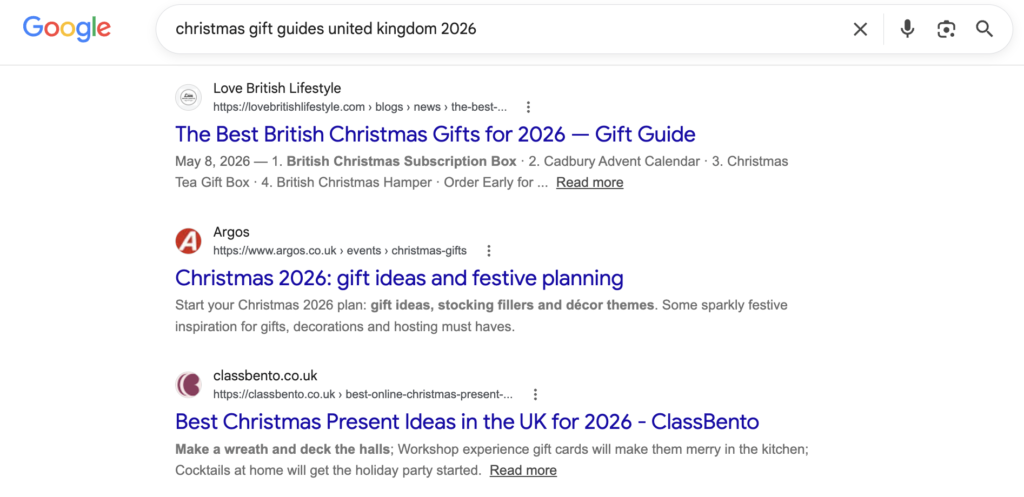
What This Discipline Is Called
Winning these placements has become its own specialism, generally referred to as affiliate PR: pitching commercial content teams like a PR, then measuring the results like a performance marketer.
It sits awkwardly between two existing functions, which is why it often falls through the cracks. Traditional PR teams know how to pitch but rarely track links or think about commission. Affiliate managers understand tracking but usually recruit partners through networks rather than pitching editors directly.
That gap is why a category of specialist affiliate PR agencies has emerged in the UK. Studio Two, for example, has won more than 250 tracked editorial placements for consumer brands by working the editorial calendar rather than the trading calendar. Agencies pitching across a roster also tend to get faster responses from commercial editors than a single brand pitching alone.
Who You Are Actually Pitching in the UK
Almost every major UK publisher now runs a commercial content team, separate from the newsroom, producing product recommendation content monetised through affiliate links.
The national press examples are the most visible. The Independent’s IndyBest is one of the longest established, and the Guardian launched The Filter in 2024, extending it to the US the following year. The Telegraph, the Times, Mail Online and the Evening Standard all run equivalent operations, and the Independent has publicly described e-commerce as one of its core strategic growth pillars.
Beyond the nationals sit the magazine groups, and for many consumer categories these matter more. Hearst UK, Future, Immediate and their equivalents publish enormous volumes of category-specific buying guides, often with better search rankings in a given niche than a national title.
Four things about how these teams work should change your approach:
- They have revenue targets. A product that converts is one they will feature again. Your first placement is effectively an audition for the next five.
- They work months ahead. Print sits furthest out, but digital Christmas content is well underway by early autumn.
- They update rather than rewrite. A guide that ranks gets refreshed, not replaced, so getting into an established article is usually worth more than getting into a new one.
- They have testing and sampling policies. Some UK titles return or donate samples after testing rather than keeping them, and several require a product to have been physically handled before it can be recommended.
A UK Specific Point About Networks
Which affiliate network a publisher uses determines whether they can link to you at all.
Alongside the main UK networks, several large publishers monetise editorial content through aggregators such as Skimlinks and Sovrn, which handle retailer relationships on the publisher’s behalf. The Guardian’s Filter, for instance, runs through Skimlinks precisely so its small team does not have to negotiate with retailers individually.
The practical consequence: if your programme is not accessible through the route a given publisher uses, you can win the editor over and still not make the guide. Check this before pitching, not after.
How to Get Into a UK Gift Guide: Seven Steps

1. Make sure your programme can receive the traffic
Publishers monetise these guides through affiliate links. If they cannot link to you in a way that pays them, you will be left out regardless of how good the product is.
Check your deeplinks work, your product feed is accurate, your prices match your site, and your hero products are in stock. Publishers drop products that embarrass them in front of readers.
2. Audit the coverage you already have
Search for existing mentions of your products in round-ups and guides. Most established brands find more than they expected.
Then check what those links actually do. A surprising share point to discontinued products, third-party sellers, or carry no affiliate tracking at all. Fixing them recovers revenue from coverage you have already earned, which is faster than winning anything new.
This process, known as affiliate link reclamation, is usually the quickest win available when a programme starts, and it tells you which publishers already rate your product enough to feature it.
3. Target articles, not publications
Search the terms your customers use before they have picked a brand. Category terms, not brand terms. “Best beginner telescope UK.” “Best wool throws.” “Gifts for keen gardeners.”
Take the top ten results for each. That list of URLs is your target list.
This is the shift that separates this work from traditional PR. You are not trying to be covered by a title in the abstract. You are trying to be on a specific page that already ranks.
4. Find out who owns those pages
For each target article, identify the section, the writer, and the commercial content lead. These teams are usually separate from the newsroom, with their own editors and their own commercial targets, and pitching the wrong desk is a common way to be ignored.
5. Get your sampling process ready before you pitch
Most product recommendation content in the UK is written by someone who has handled the product, and several titles will not include something untested.
Decide in advance who ships, how quickly, and what goes in the box. If a writer has to wait a week for a sample, the piece runs without you.
6. Pitch to the gap
The pitch that works is specific and aimed at a named article. Something close to: your round-up has nothing under £50, or nothing suitable for beginners, and here is a product that fills it.
The pitch that does not work is “please consider our brand for coverage.” Commercial editors are filling gaps in specific pieces, not evaluating brands in general.
Keep it short. Include who the product is for, why it beats the obvious alternative already in their list, the price in pounds, and confirmation that a sample can be with them immediately.
7. Hold the placement
Winning a slot is not the end of the work. Guides get refreshed annually, and products get swapped out.
Stay useful between updates: flag stock issues before they cost the title commission, share performance data, and be easy to reach. The brands that dominate a category in editorial are rarely the ones with the best pitch. They are the ones commercial teams find easiest to work with.
The UK Editorial Calendar
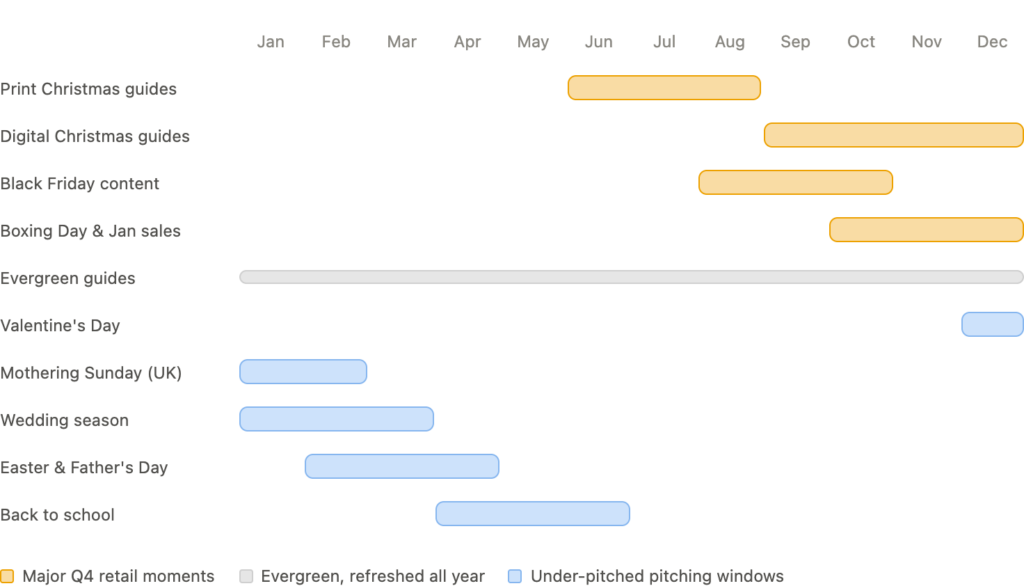
Rough guidance, and it varies by title:
- Print magazines work furthest ahead. Christmas issues are often finalised in late summer.
- Digital Christmas gift guides are commonly written and published from early autumn, then updated through the season.
- Black Friday content is frequently built out well before November so it can start ranking early.
- Boxing Day and January sales content follows immediately, and is often planned alongside Christmas rather than after it.
- Evergreen buying guides get refreshed on a rolling basis, creating windows all year round.
The moments outside Q4 are consistently under-pitched, and they are where smaller brands tend to win:
- Valentine’s Day, pitched from December
- Mothering Sunday, which falls in March in the UK rather than May, and is regularly missed by brands working from US marketing calendars
- Easter, Father’s Day and the early summer garden and outdoor season
- Back to school in late summer
- Wedding season, which generates a large volume of gifting content from spring onwards
Work backwards from publication date, not from the trading period.
What Publishers Actually Need From You
Editors assembling these guides handle a lot of products at once under deadline. Making their job easy is a real competitive advantage.
Have these ready before you pitch:
- High-resolution cut-out images on transparent or white backgrounds. The most commonly missing asset and the most frequently requested.
- The direct product URL, not your homepage or a category page.
- Accurate current pricing in pounds, including variant differences.
- A one-line answer to “who is this for.” Editors need to justify each inclusion to a reader.
- Samples available immediately, with a named contact who can ship same day, and clarity on whether you want them returned.
- Confirmation of which networks or aggregators you are accessible through, so the publisher can check before committing.
Common Mistakes
- Starting too late. The most common failure and the least recoverable. No pitch quality fixes bad timing.
- Pitching every product. Most brands have two or three natural editorial candidates and a long tail that is not right for round-ups. Pitching the tail wastes the relationship.
- Sending a press release. Commercial content teams are not news desks. A launch announcement is not useful to someone assembling a buying guide.
- Only chasing the nationals. A specialist title with a well-ranked guide in your exact category often converts better than a national with a general one.
- Working to a US calendar. Mothering Sunday, half terms and the UK bank holiday pattern all differ, and content is commissioned around the UK dates.
- Measuring at publisher level. One title can host a top-ranking evergreen guide that pays all year and a dozen dead seasonal pages. Averaged together, they tell you nothing. Track at article level.
How to Measure Whether It Is Working
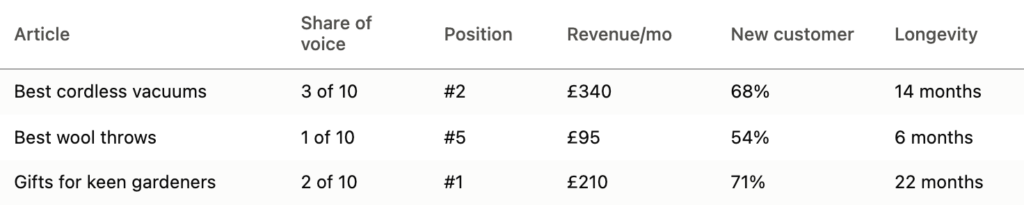
Dashboard example
- Share of voice in target results. Of the top ten ranking articles for your priority terms, how many include your product? The clearest measure of editorial presence in a category.
- Position within the article. Being second in a list of fifteen is worth a multiple of being twelfth. Improving position in guides you are already in is a separate job from winning new ones.
- Revenue per placement, tracked by article rather than by title.
- New customer rate compared with your other affiliate partners. Editorial should sit well above discount and cashback. If it does not, your targeting is off.
- Placement longevity. How long placements stay live and keep earning tells you how much of next year’s revenue is already secured.
Frequently Asked Questions
When should I pitch UK Christmas gift guides? For digital guides, aim for mid to late summer. For print, earlier still. Pitching in November means pitching content finished weeks ago, though it is still worth asking about updates to existing pieces, since those happen throughout the season.
Do you have to pay to be in a gift guide? Usually not. Most placements run on standard affiliate commission, so the publisher earns only if a sale happens. Some titles do sell guaranteed inclusion or fixed positions, particularly at peak. Paid options can work, but judge them as media spend rather than affiliate.
Do I need an affiliate programme to get into buying guides? In most cases, yes. These guides are monetised through affiliate links, so a publisher needs a way to earn commission on the click. Without one, you can still win coverage, but you will be competing against products that pay the publisher, and you will not be able to measure the result.
Does this work for smaller UK brands? Often better than expected. Commercial editors are constantly looking for options their existing list does not cover: a lower price point, a specific use case, a British-made alternative. A clear answer to “who is this product for” matters more than brand size.
How long before placements start generating revenue? Expect a first wave of placements in two to three months, with meaningful revenue in three to six months, heavily dependent on where you land in the editorial calendar. Evergreen guides then compound, because those articles get refreshed rather than replaced.