
A growing body of research suggests the United States could face a shortage of between 200,000 and 450,000 registered nurses by 2025. What began as a temporary disruption has evolved into a long-term staffing challenge that continues to reshape how healthcare facilities of all sizes plan and manage their workforce.
During the height of the pandemic, travel nursing increased by an extraordinary 430% between 2018 and 2022. That rapid expansion permanently altered staffing expectations and forced healthcare leaders to rethink traditional workforce models. As a result, the healthcare staffing market is projected to reach $49 billion within the next six years, underscoring the scale and urgency of the issue.
These pressures are already changing decision-making at the executive level. Nearly 98% of healthcare leaders now rely on or actively evaluate staffing technologies to close workforce gaps.
At peak demand in 2022, travel nurses accounted for almost 39% of total labor costs, up sharply from just 5% in 2019. The financial impact of these shifts is impossible to ignore.
This article explores the forces driving today’s healthcare staffing challenges, how they affect facility operations, and the strategies leaders can use to navigate ongoing workforce uncertainty with confidence.
Why Healthcare Staffing is Under Pressure in 2025
Healthcare staffing faces major challenges in 2025 as two powerful forces collide.
An aging population and chronic care needs
A demographic wave will hit the American healthcare system hard. The number of people aged 65 and older will grow to 82 million by 2050.
This represents a dramatic 40% jump from 58 million in 2022. The most critical change lies in the 85+ age group. Their numbers will triple from 6.5 million to 17.3 million by 2050. This surge will put enormous pressure on our healthcare system.
The aging population’s effect on healthcare staffing shows up clearly in service needs. About 88% of elderly Americans live with at least one chronic condition.
Another 60% deal with two or more conditions. These multiple chronic conditions (MCCs) lead to much higher healthcare use and costs. Medicare patients with four or more chronic conditions spend an average of $21,342 yearly. This amount is 36 times more than those managing just one condition.
Mass retirements of experienced staff
The healthcare workforce keeps shrinking while demand grows. A third of registered nurses are over 50 years old. Nearly a quarter plan to retire within five years. The National Council of State Boards of Nursing reports troubling numbers. More than 138,000 nurses have left their jobs since 2022. Almost 40% plan to leave by 2029.
Doctors face similar issues. Two-fifths of active physicians will turn 65 within the next decade. The Association of American Medical Colleges sees a looming crisis. They predict a shortage of 37,800 to 124,000 physicians by 2034. Burnout makes things worse. Over 40% of physicians reported burnout even before the pandemic added more stress.
Nursing homes’ situation looks equally grim. They lost more than 425,000 workers during the pandemic. This loss forced 58% of facilities to limit new patients due to staff shortages. The ripple effects touch every part of the healthcare system.
Facility managers must now handle increased care demands from aging patients while their qualified staff numbers drop. This perfect storm will reshape healthcare staffing for years ahead.
How the Staffing Gap Affects Facilities

Image Source: Tulane University
The healthcare staffing gap creates more than just challenges – it’s changing how facilities operate across the country. The numbers paint a grim picture of current healthcare staffing trends.
Vacancy rates and turnover trends
Healthcare facilities face workforce instability like never before. Hospital turnover has reached 20.7% nationwide, while some regions see rates up to 22.2%. RN vacancy rates remain high at 9.6%, and more than 40% of facilities report rates above 10%. The financial toll hits hard – hospitals lose about $262,500 each year for every percentage point increase in RN turnover. Replacing just one bedside nurse costs between $45,100 and $67,500.
Impact on patient care and wait times
Patient outcomes suffer directly from this staffing crisis. Lower nurse staffing levels are linked to higher death rates and more rescue failures. Understaffed facilities show worrying gaps in basic care – 75% of nurses say they skip parts of patient care. This includes missed medications, delayed wound treatment, and poor patient monitoring.
These problems lead to longer emergency room waits, extended hospital stays, and unhappy patients. Pennsylvania hospital leaders report that 70% of their emergency departments have longer wait times and delayed procedures because they don’t have enough staff.
Regional differences in staffing shortages
Staffing problems vary by location. National turnover rates range from 8.8% to 37.0% based on specialty. Some regions struggle more than others – the South-East has the highest turnover at 22.2%, while the North-Central region shows the lowest at 19.0%.
Rural hospitals face the toughest challenges. They can’t compete with city hospitals for talented staff. Pennsylvania shows how bad things are – 30% of its hospitals have cut or stopped some medical services because they lack staff. States with many retirees need more healthcare workers, which creates uneven healthcare access across the country.
How Staffing Agencies Help Facility Managers
Staffing agencies help facility managers respond quickly to workforce challenges by providing timely access to qualified healthcare professionals. As staffing shortages persist across the industry, many facilities are turning to local healthcare staffing partners to maintain coverage without overextending their internal teams.
Platforms like Nursa connect healthcare facilities with local nurses and clinical professionals who can fill shifts on short notice, giving managers more control over scheduling while avoiding long-term hiring commitments.
By tapping into on-demand staffing networks, facilities can adapt faster, protect staff wellbeing, and keep care delivery running smoothly even during peak demand.
Key benefits include:
- Filling gaps with travel and per diem staff
Travel nurses support short-term needs such as leave coverage or patient surges, while per diem staff provide rapid coverage when schedules change. Facilities pay only for hours worked and can scale staffing based on demand. - Supplying allied health and support professionals
Agencies provide access to a wide range of specialists, including respiratory therapists, radiology technicians, ultrasound technologists, and cath lab staff. Facilities can choose local or travel professionals depending on their needs. - Reducing hiring time and administrative workload
Staffing partners manage screening, credentialing, background checks, and interview coordination, allowing internal teams to focus on operations rather than recruitment. - Improving workforce stability during peak demand
By offering reliable backup coverage, staffing agencies help facilities maintain service levels during high-volume periods without overworking permanent staff.
Planning Ahead: Building a Resilient Staffing Strategy
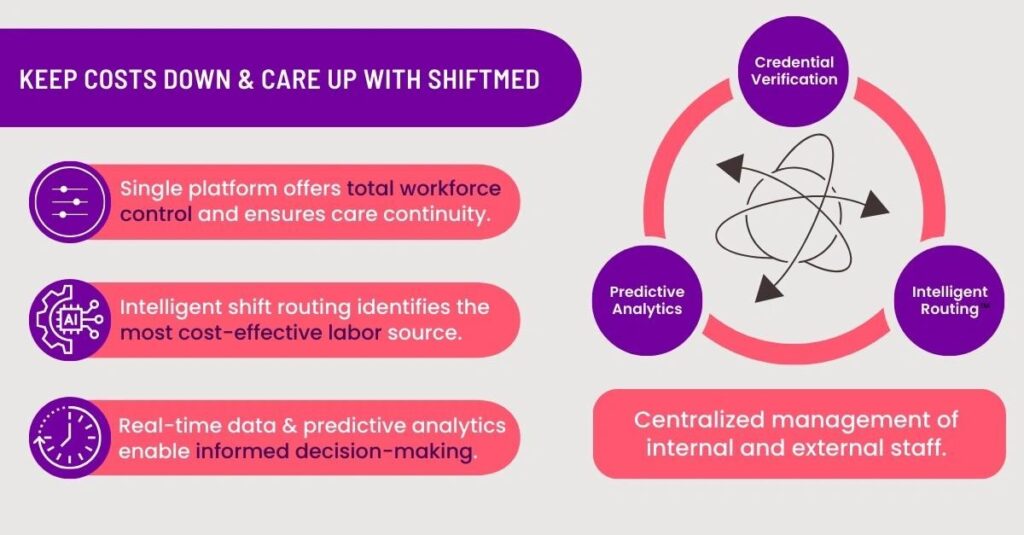
Image Source: ShiftMed
A successful staffing strategy needs more than quick fixes. Labor costs make up over 60% of total hospital spending.
This means facility managers must create eco-friendly approaches that balance immediate needs with long-term resilience.
Balancing cost with care quality
Healthcare leaders face a crucial challenge to maintain quality while controlling costs. Nursing departments use about one-third of hospital budgets, which makes them common targets for cost reduction. All the same, research shows proper staffing improves patient outcomes directly. Optimal nurse staffing is associated with:
- Reduced medication errors and patient mortality
- Fewer hospital readmissions and shortened lengths of stay
- Decreased preventable events like patient falls and infections
Staffing should not be seen as just an expense but as an investment. Facilities that set staffing levels too low end up paying more through increased complications, extended hospital stays, and higher readmission rates.
Using data to forecast staffing needs
Up-to-the-minute workforce planning has become essential today. Predictive analytics help facilities spot staffing gaps before they happen. Modern organizations now use AI-powered forecasting to:
- Analyze historical census data and current inputs for patient volume predictions
- Identify employees at high risk for departure, which enables proactive retention strategies
- Simulate how retirements or resignations affect staffing levels
These technologies work with remarkable accuracy: some facilities report 95% accuracy when predicting staffing needs up to 14 days ahead. This precision helps reduce temporary labor requirements and related costs.
Choosing the right mix of staffing models
The right balance between core and contingency staffing models creates stability while managing changing patient volumes. Too few core staff leads to expensive temporary labor dependence, while too many permanent employees cause underutilization during slower periods.
Your ideal staffing mix depends on:
- Patient volume changes throughout the year
- Regional workforce availability challenges
- Facility location (rural facilities face unique recruitment challenges)
Different staffing assessment methods can produce dramatically different estimates. The tools you select should line up with your facility’s specific patient population and care model.
Exploiting the healthcare staffing market for growth
The U.S. healthcare staffing market should grow from $21.59 billion in 2025 to about $40.16 billion by 2034. This growth creates opportunities for facilities with strategic workforce planning.
Travel nursing holds the largest segment (45.30% market share). However, state-of-the-art technologies like AI-driven predictive analytics are changing how facilities manage their workforce. These advances help forecast accurate staffing requirements and patient volumes, which leads to better resource allocation.
Facilities that accept new ideas in healthcare staffing can turn workforce challenges into opportunities for better care delivery and financial results.
Leading With Confidence in a Shifting Workforce
Healthcare staffing has entered a period of lasting change, and facility managers are now required to think beyond short-term fixes. Workforce shortages, rising labor costs, and growing patient needs demand a more deliberate and flexible approach to staffing decisions. Success depends on preparation, visibility, and the ability to respond quickly without compromising care standards.
Facilities that invest in adaptable staffing models, smart forecasting tools, and reliable staffing partnerships place themselves in a stronger position to manage uncertainty. These strategies allow leaders to protect patient outcomes, support clinical teams, and maintain operational stability even as market conditions continue to evolve. Staffing is no longer only a logistical challenge. It is a strategic function that directly influences quality, financial performance, and staff wellbeing.
Managers who take the time to align workforce planning with long-term goals will be better equipped to handle future disruptions. With the right mix of data, flexibility, and trusted support, healthcare organizations can move forward with clarity and confidence while continuing to deliver dependable, high-quality care.