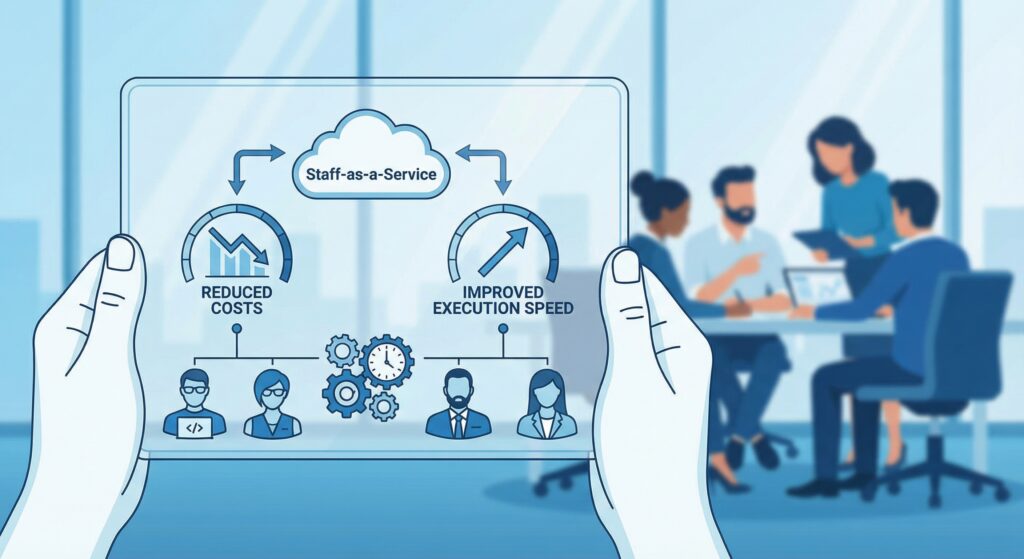
In 2026, companies face rising labor costs and intense competition for talent. Employers globally report difficulty finding the skilled staff they need, driving more firms to flexible staffing strategies.
By adopting an on-demand talent model like Staff-as-a-Service, organizations tap external expertise exactly when needed. This approach turns fixed payroll costs into variable, outcome-driven investments.
This blog explains why the model matters now, how it lowers cost and accelerates execution, which operating models work best, and more.
What is Staff-as-a-Service?
Staff-as-a-Service is a flexible talent model. It goes beyond simple outsourcing by providing continuous access to skilled professionals who integrate with a company’s internal teams while remaining scalable and cost-efficient.
In other words, firms assemble a virtual bench of experts on tap, bringing in specialists exactly when and where they’re needed. This model is purpose-built to solve three persistent problems:
- Hiring bottlenecks: Niche talent is hard to find and onboard. Staff-as-a-Service bypasses slow recruitment by drawing from pre-vetted experts.
- Cost dilemma: Full-time specialists are expensive when demand fluctuates. An on-demand staff reduces overhead, since firms pay only for work delivered.
- Capability gaps: Modern growth often requires many different skills simultaneously. This model lets companies assemble cross-functional teams (developers, designers, marketers, etc.) without bloating the permanent payroll.
Organizations using Staff-as-a-Service avoid geographical constraints and have 24/7 coverage if needed.
They also gain full transparency and control: work is governed by clear deliverables, performance metrics, and dedicated account management.
In essence, Staff-as-a-Service for business turns talent into a strategic on-demand resource.
Financial Benefits and Cost Savings
One of the most compelling advantages of Staff-as-a-Service lies in its ability to fundamentally reshape how workforce costs are structured.
Instead of carrying fixed payroll and overhead, organizations gain access to skills only when real work is being delivered, creating a far more efficient financial model.
1. Lower Operating Costs Without Compromising Output
Outsourcing models built around on-demand talent consistently reduce cost pressure. These savings come from removing expenses tied to:
- Full-time salaries
- Benefits and insurance
- Office space and equipment
- Training and onboarding
- Idle or underutilized headcount
With Staff-as-a-Service, spending directly reflects productivity: organizations pay for output, not availability.
2. A More Intelligent Cost Structure
Traditional hiring creates financial drag long before any real value is produced. Recruiting, onboarding, and turnover quietly drain budgets.
- Hiring a software engineer typically costs 20–25% of their annual salary just in recruitment fees, interviews, and onboarding.
- Add payroll taxes, benefits, and ramp-up time, and the real cost climbs even higher.
Staff-as-a-Service removes most of this hidden overhead by providing pre-vetted, ready-to-deploy professionals who contribute from day one.
3. Global Talent Without Global Payroll
Global workforce access is one of the most powerful cost levers available today. This isn’t about cheaper labor. It is about cost-to-value operational efficiency, getting more output per dollar invested.
Organizations can engage highly skilled developers, designers, and specialists from markets where labor costs are significantly lower, without sacrificing quality or control.
This creates a powerful form of cost-to-value optimization:
- High-skill output
- Lower total workforce spend
- No long-term employment liabilities
The result is stronger margins and greater flexibility to reinvest savings into growth.
4. Turning Workforce Spend Into a Performance Engine
Leading organizations are no longer treating talent as a fixed expense. Instead of locking capital into permanent headcount, companies are converting workforce spending into a performance-based investment that expands and contracts with real business demand.
5. Better ROI Through Smarter Resourcing
When the right people are deployed at the right time (and only for the duration they are needed), projects become more profitable by design.
Less waste, fewer idle hours, faster execution, and lower overhead combine to produce a much stronger return on every workforce dollar invested.
Why is the Timing Right?
Several industry studies and analyst reports from the last two years show organizations are increasing reliance on outsourced talent and managed staffing models.
A major consulting survey found a strong shift toward third-party sourcing: 80% of executives plan to maintain or increase investment in outsourcing and third-party talent models.
At the same time, recent research by ISG (a global technology and outsourcing analyst) found enterprises reporting average cost savings in the low-to-mid teens after moving business processes to external providers – a meaningful line-item impact on operating expense.
Finally, macro-IT spend is robust: industry forecasted that worldwide IT spending will continue to grow 6.8% in 2024, keeping a steady market for specialized IT services and external talent.
That demand curve makes it easier to secure modern providers who can staff roles quickly and reliably.
How Staff-as-a-Service Reduces Costs?
- Lower fixed labour costs and overhead. Hiring full-time employees carries salary, benefits, onboarding, and office costs. Flexible staffing solutions convert much of that fixed cost into variable spend aligned to project phases (development sprints, launch windows, support periods).
- Faster time to productivity. Providers maintain talent rosters and onboarding pipelines – experienced vendors can place skilled contributors in days or weeks rather than months. A faster ramp means earlier revenue capture or earlier delivery of cost-avoiding projects.
- Reduced recruitment & attrition overhead. Recruiting technical talent is expensive. Using an external staffing partner reduces continuous recruitment spend and the hidden costs of bad hires, rehiring, and lost productivity.
- Economies of scale and regional arbitrage. Reputable providers pool demand across clients, amortize training and tooling costs, and sometimes operate from lower-cost regions. These factors compress the average per-resource cost without sacrificing quality.
- Technology and process built in. Modern providers bring tooling – CI/CD pipelines, project dashboards, knowledge-management templates – which reduces the cost of buying and integrating these tools internally.
How Staff-as-a-Service Improves Execution Speed?
- Elastic capacity for focused sprints. When a strategic initiative requires extra hands (feature launches, migrations, security remediations), Staff-as-a-Service supplies a pod of specialists that can immediately join sprint cadences. This avoids internal context-switching and keeps product velocity high.
- Specialist access shortens discovery and build cycles. Hiring niche skills (cloud architects, ML engineers, UX researchers) is slower internally. Providers with bench strength eliminate that lead-time.
- Outcome/SLAs (service level agreements) orient teams toward speed with quality. Rather than managing people by hours, strong contracts focus on milestones, throughput, and defect rates. This drives providers to optimize delivery processes (test automation, pair programming, continuous integration) that increase speed sustainably.
- Agile scaling reduces coordination lag. Staff-as-a-Service models commonly embed delivery managers and product liaisons who handle governance and daily standups – reducing the coordination overhead that kills pace in ad-hoc contracting.
Empirical indicators also support speed gains: Deloitte found many organizations are leveraging advanced models (including AI and automation) within outsourced services to accelerate delivery.
Common Staff-as-a-Service Models and Where Each Fits
- Dedicated remote pods: Best for multi-month product development (hire remote developers, designers). Provider supplies a small, stable team aligned to the client’s product roadmap. Ideal for scaling product feature velocity without adding permanent headcount.
- Time-and-materials flex teams: Useful for feature bursts or interim support. Good for unpredictable scope but requires tight sprint governance.
- Managed service engagements: Provider accepts outcome responsibility (e.g., “maintain platform uptime at X%”) and delivers via their staff. Works well for steady-state operations where speed of execution and reliability matter.
- Consult + transfer: Provider builds capability and transfers it to an internal center once it matures. Useful where long-term insourcing is a strategic goal, but initial speed is critical.
- On-demand bench/talent marketplace: Fastest for single roles (contract senior dev, designer) and for one-off needs. Less governance than pods – choose only for well-scoped tasks.
How to Design Staff-as-a-Service to Maximize ROI Workforce?
- Define success metrics before you hire. Typical metrics: time-to-release, throughput (story points, tickets closed), defect escape rate, mean time to recover, and cost per deliverable. Measuring these before and after engagement allows a credible ROI workforce calculation.
- Hire based on outcomes, not bodies. Contracts that link payment to milestones and SLAs encourage providers to optimize for speed and quality rather than hours billed.
- Standardize onboarding & knowledge transfer. A short, repeatable onboarding playbook (security, access, code standards, architecture overview) eliminates the “first sprint waste” that otherwise nullifies speed gains.
- Embed client governance roles. A small internal product owner + a partner delivery lead provides rapid decision-making and reduces blockers.
- Use blended teams for continuity. Keep a core internal nucleus that owns roadmap, architecture, and IP governance – let the provider execute tactically against that vision. This preserves institutional memory when external staff rotate.
- Measure and adjust – fast. Weekly scorecards and sprint retrospectives let the engagement evolve. If velocity or quality slips, adjust resource mix, tooling, or team leadership quickly.
When these practices are followed, organizations frequently see the combination of improved execution speed and durable ROI.
Risk Management and Governance: Common Pitfalls + Mitigation
- Knowledge loss & vendor lock-in. Guard with clear IP clauses, code ownership, and regular transfer sessions. Keep documented architecture and runbooks.
- Security and compliance gaps. Apply the same security review to vendor staff as to permanent employees.
- Cultural and communication friction. Build shared rituals (daily standups, shared retros), invest in a single collaboration stack, and run cross-cultural onboarding.
- Quality variability. Insist on code review standards, CI pipelines, automated testing, and defined acceptance criteria.
Good vendors make governance part of the service – the best ones provide a delivery manager who proactively manages these risks.
Measuring ROI: Concrete Metrics
Key metrics to track (monthly / per engagement):
- Cost per sprint (external + internal oversight)
- Throughput: stories/features delivered per sprint
- Defect escape rate (post-release defects per release)
- Time-to-market (days from kickoff to production)
- Utilization of internal core team (percentage of time freed for strategic work)
- Net cost reduction vs. hiring (total employment burden avoided)
When Staff-as-a-Service is the Best Choice (and when it isn’t)
Good fit:
- Projects needing rapid scaling (launches, migrations, short product cycles).
- Skill gaps that are temporary or hard to recruit for (ML, cloud infra, mobile specialists).
- Need to reduce fixed workforce costs while preserving delivery velocity.
Not a fit:
- Core IP functions where control and long-term institutional knowledge must remain internal.
- Culture-defining roles that require deep internal integration over the years.
- Situations where poor governance or poor vendor selection could introduce regulatory risk.
Vendor Selection Criteria
Selection checklist:
- Proven talent in the required skill cluster (ask for references and sample CVs).
- Clear SLAs and outcomes (time-to-release, defects, throughput).
- Onboarding and knowledge-transfer playbook.
- Security/compliance certifications.
- Transparent pricing models and a willingness to pilot on a short-term basis.
- Evidence of continuous improvement and tooling (CI, automated tests, dashboards).
How to Pilot Staff-as-a-Service?
- Discovery & quick start: define scope, select a provider, and onboard one or two specialists into an existing product sprint. Start with a single, high-priority backlog item set.
- Stabilize & measure: establish weekly scorecards, lock governance rituals, measure throughput, and defect rates. Adjust team composition as needed.
- Decide scale or stop: compare results to baseline (time-to-release, cost per deliverable, internal team utilization) and decide whether to scale the engagement.
This short pilot approach mitigates risk while proving faster execution and measurable ROI quickly.
Use Cases and Applications
Staff-as-a-Service is versatile and applies across industries. Some common applications include:
- Software Development & IT Staff Outsourcing
Tech teams frequently hire remote developers for specific sprints or product milestones. Building an entire offshore or nearshore development squad can jump-start a project. Companies routinely delegate everything from app development to cloud infrastructure. Staff-as-a-Service fits naturally here: businesses get coders, QA engineers, or DevOps experts on demand, without managing a full-time bench.
- Digital Marketing and Design
Marketing campaigns often require bursts of creative work or technical SEO expertise. Businesses outsource marketing tasks, from content creation to PPC management, to stay agile. Through a Staff-as-a-Service partnership, a firm can plug in digital marketing specialists or graphic designers as soon as a new campaign launches.
- Startups and Lean Ventures
Young companies and startups benefit hugely from on-demand teams. A lean startup can maintain a minimal core staff and “rent” coders, UX/UI designers, or analysts to prototype or scale features quickly. This approach conserves capital (no long-term salaries) and lets founders pivot without penalty. Many startups explicitly budget for Staff-as-a-Service: they plan capital expenditure around project phases, knowing the necessary skills will be delivered by contract.
- Specialized Professional Services
Even non-tech functions can use this model. For example, if a business needs data analysis, BI development, or specialized HR support, it can onboard remote analysts or HR consultants through a staffing service.
Legal, finance, customer support, and R&D are also increasingly outsourced to niche teams. In each case, outside specialists work under the company’s direction as if they were in-house, but with no permanent hire.
Through these use cases, Staff-as-a-Service delivers not just manpower but value. It effectively turns complex outsourcing into a plug-and-play business growth service.
Projects that would be hindered by hiring delays or fixed headcount limits instead become straightforward: you simply activate the needed talent on demand, keep execution on track, and wind down the engagement when done, all while closely monitoring ROI.
Final Thoughts
Staff-as-a-Service is a pragmatic, modern approach to workforce composition: it preserves the strategic advantages of full-time teams while delivering the speed and cost advantages of external talent.
In an environment where IT spending remains high and organizations face persistent talent shortages, managed staffing models give organizations the ability to move faster, access specialized skills, and convert fixed headcount costs into flexible, outcome-oriented investments.
Every organization’s growth journey requires a different workforce strategy. Our team helps architect scalable, cost-efficient talent models built for execution. Contact us to discuss your requirements.