50 years ago, if you were to ask any U.S. business owner which hiring trends and avenues they are highlighting as points of focus, you might get answers ranging from newspaper job listings to work bulletins.
The story for 2026 couldn’t be more different, with hiring trends shaping up to be as intricate and shifting as they have ever been.
Every growing organization is now competing in a truly global market for skills that determine who can scale faster, innovate more, and bring in specialized expertise across borders.
The following hiring trends are the modern points of focus for HR professionals that will define the companies that scale, and the ones that miss the opportunity.
Remote and Location-Flexible Hiring Becomes the Global Norm
The ever-growing global hiring market was born out of necessity and has exploded in recent years.
While it has been an important trend for the last several years, it continues to be highlighted as a focus simply because it works.
This can be seen in the growing figures of 52 percent of remote-capable employees in the U.S. working hybrid and 26 percent working fully remote.
That flexibility allows companies to access skill clusters across a variety of regions rather than fighting over the same local candidates. More than half of employers expect to increase international hiring in 2026.
Workers are also increasingly choosing roles that allow for travel, relocation, or laying down roots outside of where their employers are located.
Remote hiring is no longer about perks, as it is now directly tied to hiring performance, speed, and the ability to build a diverse team.
HR teams are formalizing distributed hiring practices with cross-country payroll compliance, time-zone balancing, asynchronous communication standards, and device/data security that travels with the worker.
What this trend means for HR
- Design roles for remote execution instead of adapting them later
- Expand sourcing markets to target global skill clusters intentionally
- Build location-tracking systems to manage tax and mobility flags
- Strengthen security protocols that protect access anywhere in the world
- Document clear eligibility rules for where employees may work
Companies that invest in distributed workforce infrastructure will be able to hire faster, while retaining the talent that local-only organizations cannot reach.
The Global Race for Visa-Sponsored and Extraordinary Ability Talent
The most valuable hiring segment moving into 2026 is the one that can’t be grown quickly:
Deeply specialized talent.
These range anywhere from engineers advancing AI models and researchers pushing biomedical science to manufacturing experts automating production and cybersecurity analysts defending national infrastructure. A leading analysis predicts that upwards of 85 million unfilled skilled jobs will exist by 2030.
Immigration has become the center of hiring strategy for these types of specialized roles.
Now, in FY2026, the U.S. will be requiring a $100,000 fee for each H-1B registration, which adds another layer of complexity to this hiring avenue.
We spoke with Nicole Gunara, the Principal Immigration Attorney at Manifest Law, who has the following to say about the impact this change will have:
The new $100,000 H-1B fee has pushed employers to rethink how they approach global hiring. Many now realize they can’t rely solely on the H-1B visa. They’re looking to build more flexible, comprehensive immigration plans that include viable alternatives, so they have a true Plan B and Plan C, regardless of policy shifts or sudden government actions.
Nicole has functioned as an immigration attorney for a wide range of professionals looking for employment in the U.S., elaborating on her first point that:
Those who might otherwise seek H-1B visas could be pushed toward alternative immigration pathways, such as the O-1 for individuals with extraordinary ability, or may try to aim to accelerate a green card for themselves through faster employment-based green card categories like the EB-2 National Interest Waiver.
These alternative routes allow employers to bypass lottery uncertainty and target the exact workers that drive market leadership.
What this trend means for HR
- Integrate immigration feasibility into early candidate evaluation
- Forecast sponsorship budgets and processing timelines alongside workforce planning
- Partner with global mobility professionals and advisors, such as O-1 visa lawyers like Nicol,e for document prep and evidence strategy
- Track immigration anchored to product milestone dependencies
The organizations that succeed here will be the ones with the most visa-literate hiring systems.
Global Compliance and Cross-Border Onboarding Become Growth Infrastructure
When it comes to global employment, there is a legal commitment in every country where people work. Each jurisdiction defines its own rules for payroll frequency, holiday pay, notice requirements, statutory benefits, equipment obligations, and termination protections.
Ignorance of these points can be costly.
To simplify expansion and eliminate any type of delays, companies are adopting Employer of Record models, allowing businesses to hire employees legally in new countries without opening a local entity.
HR teams are also integrating compliance workflows within onboarding systems, so requirements auto-adjust based on work location.
Clear compliance enables market testing, regional talent hub formation, and global sourcing tied tightly to the GTM strategy.
What this trend means for HR
- Use EOR to enter markets faster while assessing long-term entity needs
- Maintain local complaint contracts, benefits, and payroll from day one
- Introduce real-time location tracking to prevent tax exposure
- Set employee travel rules that include visa, tax, and security checks
- Operationalize country-specific offboarding protection
Compliance used to delay hiring. In 2026, compliance enables hiring and expansion speed.
Skills-Based Hiring Replaces Degree Filters
For years, education proxies ruled the selection process. Such a model effectively filtered out high-potential talent and, in many ways, reinforced bias.
Skills-based hiring flips that narrative. Reports show that 85% of employers now use skills-based evaluations, and over half have dropped degree requirements for many roles to widen talent access.
Capability validated through simulations, trial projects, and structured problem-solving predicts performance far better than formal credentials. Job descriptions are evolving into outcome reviews rather than wish lists. Learning and development is becoming a hiring pipeline instead of an internal perk.
This shift also works to strengthen employee retention. Workers who see a future through skill growth stay longer, especially when mobility pathways are explicitly tied to proven capability.
What this trend means for HR
- Replace resume screens with competency rubrics
- Add practical evaluations earlier in the hiring flow
- Track skill data inside performance and mobility systems
- Partner with L&D to build internal pipelines where shortages exist
- Calibrate hiring panels to assess capability objectively
Skills-first hiring transforms global recruiting from exclusion to opportunity, without lowering the bar or speed.
AI Recruiting Matures: Efficiency Without Losing Empathy
The hiring funnel in 2026 will be bigger, faster, and more complex than ever.
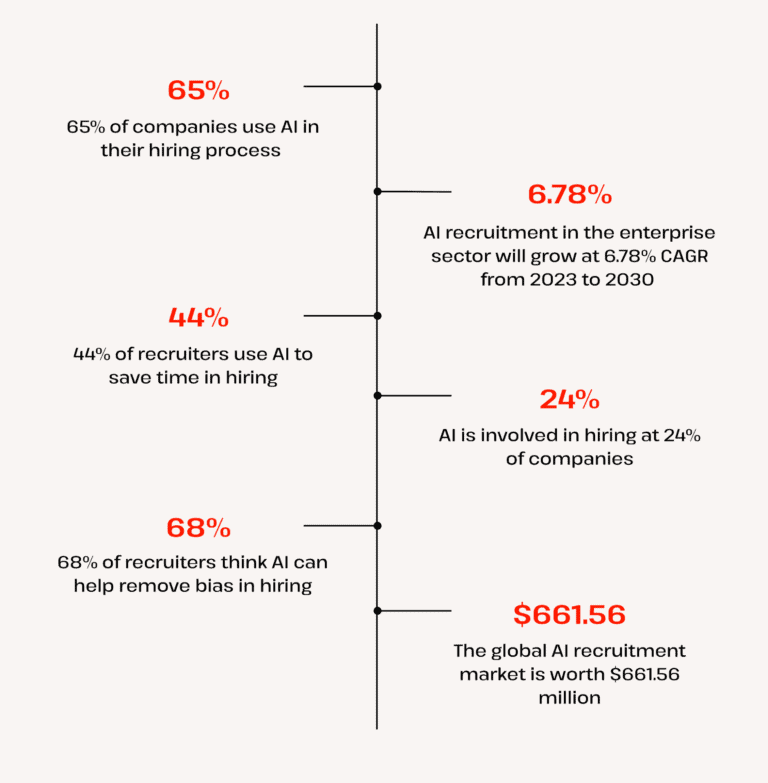
AI is now the workflow engine powering modern recruitment, as 88% of organizations use AI during screening.
It pre-qualifies large applicant volumes, automates scheduling across time zones, detects fraud attempts, and evaluates candidate responses using calibrated scoring criteria.
The result:
Recruiters spend more time talking to great candidates and less time wrestling with scheduling tools and inbox chaos.
Candidates are not left waiting in silence, and leaders see faster staffing outcomes that support roadmap execution.
But as advanced as they are, algorithms often fail to understand nuance or potential the way people can.
Leadership teams are building responsible automation guidelines that ensure fairness, transparency, and human final say in hiring decisions.
What this trend means for HR
- Use automation in the early funnel, not the final decision
- Conduct periodic bias and accuracy audits
- Disclose AI usage transparently to maintain trust
- Create escalation routes for nontraditional profiles
- Maintain human control over hiring and offers
The hiring teams that win in 2026 will use automation for volume and human judgment for value.
Compensation Strategy Goes Transparent and International
When the workforce goes global, compensation transparency simply becomes unavoidable.
Workers benchmark themselves internationally using Blind, Levels.fyi, and public salary laws across regions. They want to know not just what the pay is, but why that is the pay.
This creates a new HR discipline: Building global pay strategies that scale fairly across borders while respecting local cost-of-labor realities.
Teams must define whether high-impact roles earn globally consistent pay or whether location-based adjustments apply, and then explain that clearly.
Companies taking the lead are defining compensation philosophies publicly, training managers in transparent communication, and tightening governance around salary decisions to reduce inequities that undermine trust.
What this trend means for HR
- Align pay strategies with job impact and mobility expectations
- Publish compensation frameworks that workers can understand
- Train leaders on transparent pay communication
- Build equity and inflation adjustments into review cycles
- Audit internal pay fairness across borders
Clarity is the currency that retains global talent.
What HR Leaders Should Do Next
2026 will be heavily focused on elevating HR impact. Leadership teams must give HR the systems, partnerships, and budget authority needed to build a global talent engine.
Three biggest priorities:
1. Treat geography as optional
Design hiring systems that assume international reach and distributed operationalization.
2. Integrate immigration strategy early
Visa feasibility determines whether a hire is possible and how fast that value can be translated into the business.
3. Reinforce fairness through structure
Skills-first selection and transparent pay drive trust, access, and retention.
Hiring is changing faster than most organizations can adjust, so HR leaders who modernize now will drive business outcomes that local-only competitors cannot match.
Global talent hiring is the present reality and will only grow more important as we move into 2026.