What I Check Before I Recommend an Expired Domain to a Client

In this article
- What I will say in a proposal, and what I will not
- Treat the first-pass screen as a net
- A name I would have had to explain on a client call
- Brand strings, typos, and other stops
- How I write the actual recommendation
- How I would write the three lines for architecture.us.com
- Questions I ask before I run a second screen
- What deeper validation includes once a name is on hold
- What I tell the client when the shortlist is thin
This is a due-diligence workflow for SEO leads at agencies and in-house marketers who are asked to recommend an expired domain for a client site or a new content project.
It shows which first-pass signals are enough to build a shortlist, and which checks I still do before a name appears in a proposal.
A common request arrives as a domain, a Domain Rating, and a year count, with pressure to decide the same day. Sometimes the name is fine to keep researching. Sometimes the last archived title is a betting brand, or the string is one letter away from a company the client would not want to sit next to. The recommendation I owe the client is a written pass, hold, or drop, with the evidence attached.
1,709 Karma.Domains expired names matched a first-pass screen I ran on 16 November 2026 in Asia/Makassar (UTC+8).
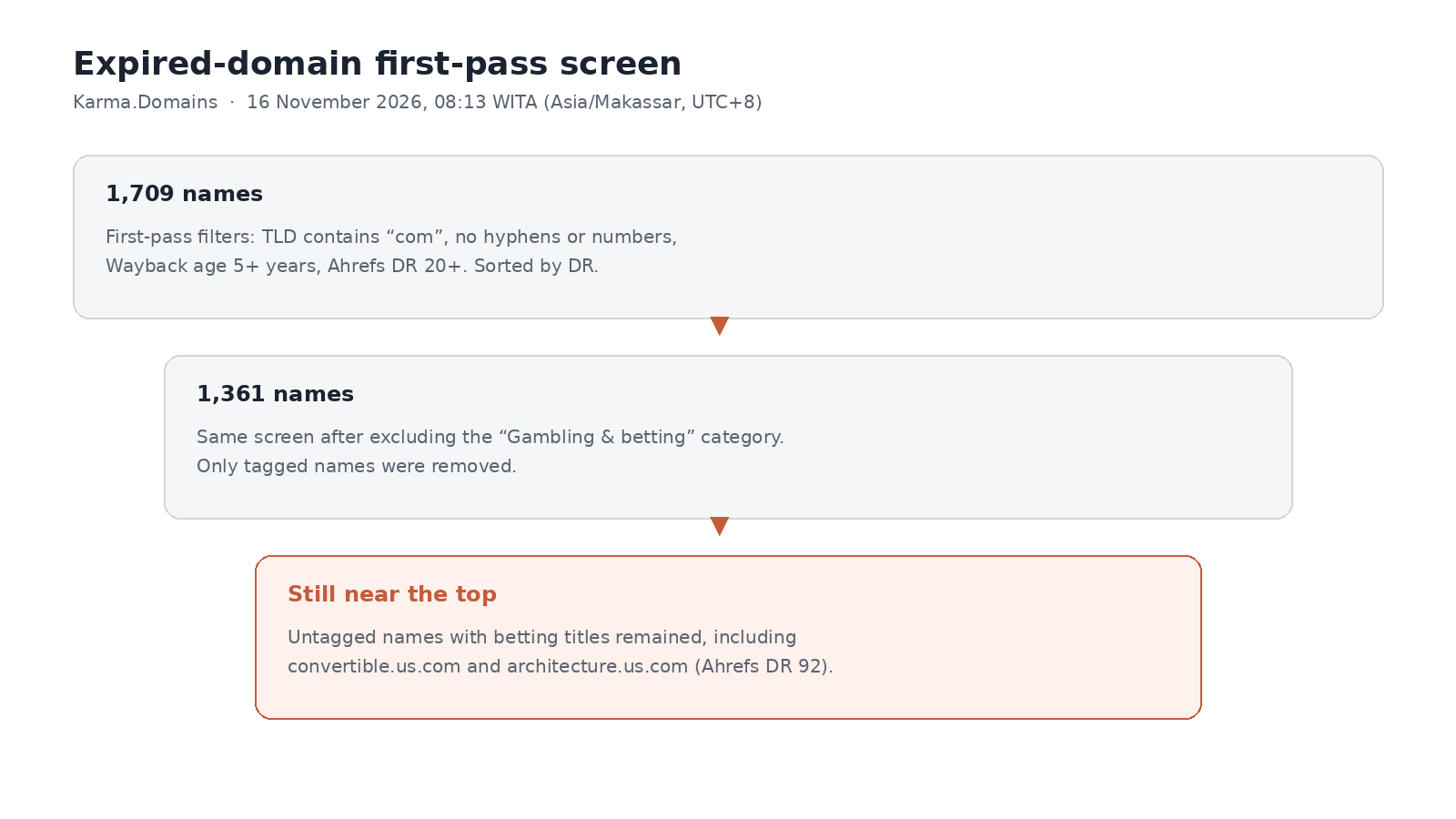
I asked for a TLD containing "com", no hyphens or numbers, a Wayback age of at least five years, and an Ahrefs DR of 20 or higher, then sorted by DR.
The first page was almost entirely .us.com and .uk.com names at DR 92. Several of those names had a recent gambling or betting title in the archive, including names with no "Gambling & betting" category tag.
Step | What I applied | Count or result |
|---|---|---|
First-pass screen | TLD contains "com", no hyphens or numbers, Wayback age 5+, Ahrefs DR 20+ | 1,709 names |
Category exclude | Same screen, excluding "Gambling & betting" | 1,361 names |
Still near the top after that exclude | Last Wayback title pointed to betting, and the category field was empty | Including convertible.us.com and architecture.us.com |
Same first page, separate issue | Name collided with a well-known brand or a typo of one | Including fujitsu.uk.com and goggle.uk.com |
I would not put any of those first-page names into a client proposal on the strength of the DR. The rest of this article is the sequence I use so that kind of list does not reach a client in the first place.
What I will say in a proposal, and what I will not
A shortlist is an internal working set. A recommendation is a name I am willing to defend on a call. I keep those two lists apart.
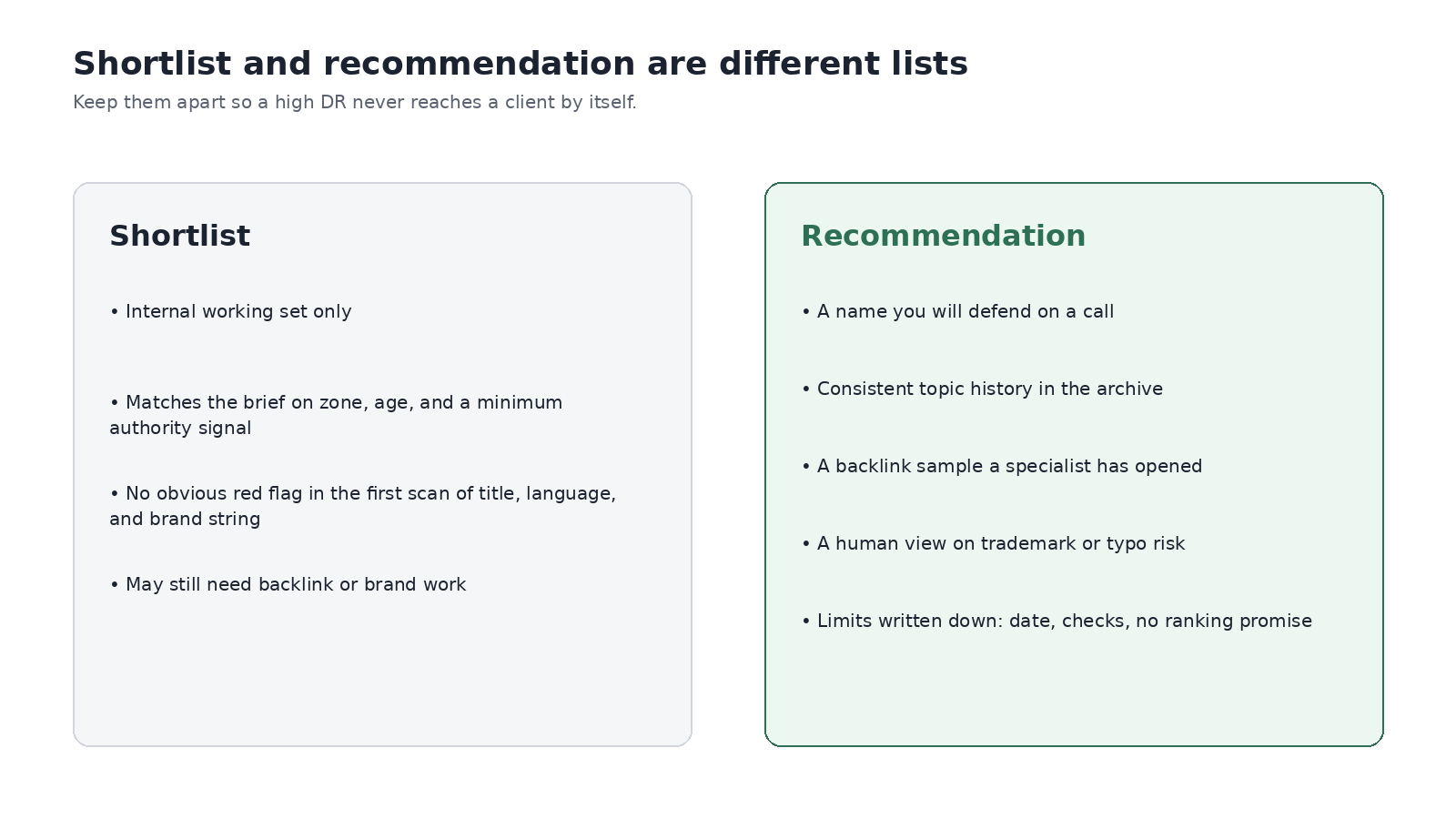
For a shortlist, I will accept a name that meets the brief on zone, age, and a minimum authority signal, and that has no obvious red flag in the first scan of the archive title, language mix, and brand string.
For a recommendation, I also want a consistent topic history, a backlink sample that a senior specialist has actually opened, and a human view on trademark or typo risk. If any of those is missing, the name stays on hold.
I do not promise that backlinks will transfer, that the domain will be indexed, or that the client will rank for a target term.
Google's own spam policies for web search define expired domain abuse as buying an expired name and repurposing it mainly to manipulate rankings with content that offers little value to users.
One example they give is casino content on a former elementary-school site. A client project can still use an expired name for a genuine new site, but I will not write a proposal that treats the older metrics as a ranking plan.
Treat the first-pass screen as a net
The filters I used on 16 November are typical of a "find me something aged and reasonably strong" request. They are also easy to misread.
The TLD value I entered was com. In this database, that string also matches third-level zones such as us.com and uk.com. I had described the job to myself as a .com screen. The first page was not that. If I had exported the top rows into a slide without looking at the actual zone, a client would have seen a list of high-DR "com" names that were not the zone they asked for.
The category exclude is useful and incomplete. Removing "Gambling & betting" cut the set from 1,709 to 1,361. That is a real reduction. It is also only as good as the tags. architecture.us.com had no gambling category, so it stayed in the list and remained near the top by DR. convertible.us.com was in the same position.
I still run the category exclude. I do not treat the leftover set as clean.
If you want to inspect the starting net I used, the first-pass expired domain screen in Karma.Domains is the same filter, without the later category exclude. The underlying inventory changes as names appear and leave, so the 1,709 figure is a count from that morning.
A name I would have had to explain on a client call
architecture.us.com is the case I would use in an internal training, because it fails in a way a dashboard will not shout about.
The string looks like a professional services brand. Ahrefs DR was 92. Semrush listed 6,206 backlinks and 687 referring domains, with a couple of EDU links. Wayback age was five years. There was no gambling category. KarmaScore was 100, which is a composite signal, not a buying recommendation.
The last archived title was a Portuguese page for UU555, a betting and slot-games brand. The report's history note said the site had English architecture and design content from 2018 to 2025, then shifted to Portuguese gambling coverage from 2025 to 2026. Semrush traffic on the report was 0, and Google index was marked false, which already argues against treating the name as an active, healthy property. The decisive fact was still the topic change.
On a client call, "DR 92, aged domain, architecture name" sounds like a find.
"The last public snapshot is a betting brand, and the category tag never caught it" is the sentence I would rather deliver internally, before the name is in a deck.
convertible.us.com, from the same page, had DR 92, an empty category field, and a last title for SN88, another betting brand.
I would drop both names at this stage. There is no deeper backlink review that makes a recent casino title a good fit for a client who did not ask for that history.
Brand strings, typos, and other stops
Some problems are legal or reputational rather than a spam metric. fujitsu.uk.com appeared on the first page of the unfiltered screen: a well-known company name, later gambling history, and a "Gambling & betting" tag (this one did fall out after the category exclude).
goggle.uk.com is a typo of a major brand. If the string is a company, a product, or an obvious typo of one, it does not go to a client until a person has done a brand check.
That check is easy to skip when the brief is "high DR, aged, available." It is also the check a client will remember if a problem shows up later.
I also read the last title and the language mix before I talk about backlinks. A language that does not match the name or the client's market, a long stretch of 301 or 404 responses, or a blacklist flag is enough to hold or drop the name.
I do not try to reconstruct every owner in the first pass. I only need enough history to decide whether further paid research is justified.
How I write the actual recommendation
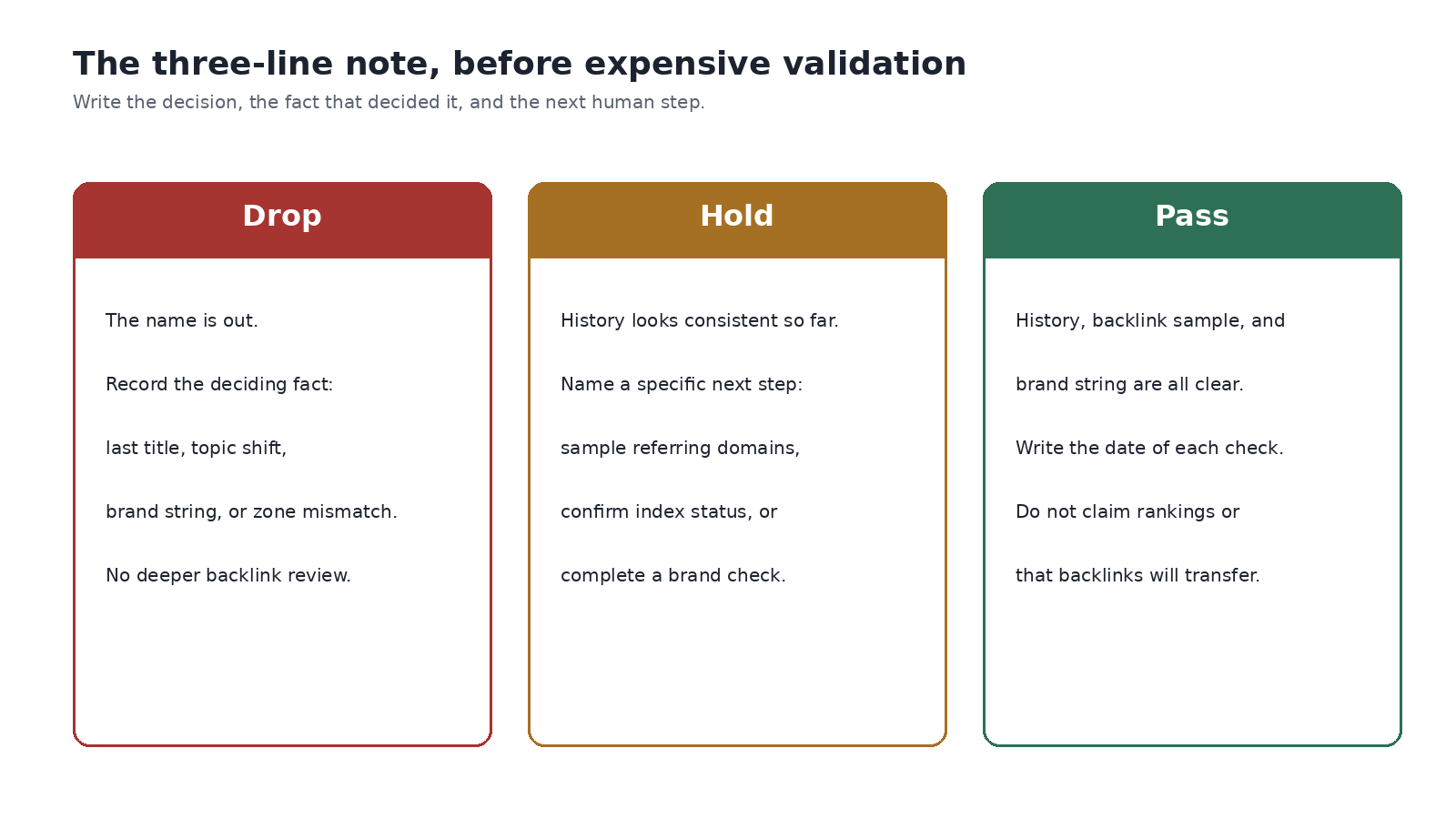
For each name that survives the screen, I write three lines before I do any expensive validation:
Pass, hold, or drop.
The fact that decided it (last title, topic shift, brand string, zone mismatch, or "history looks consistent so far").
The next human step, if any: live backlink sample, current index check, or trademark review.
I keep the first-pass evidence with those three lines: the filter date, the metrics that caused the name to appear, and a screenshot or quote of the last archive title.
If I cannot point to that evidence, I do not have a recommendation yet.
Deep validation comes after this, on a much smaller set. That is where I will use a full backlink tool, a manual review of referring domains, and any legal review the client's risk tolerance requires.
Most reports already carry SEO metrics from several vendors; I only request a fresh enrichment when a field I need is missing. I do not treat a filled metrics panel as the end of the work.
An AI client can run the same kind of screen through a set of MCP tools (Model Context Protocol, a way for the client to call connected data sources).
That is useful for repeating the filter, pulling a report, and flagging empty category fields or a title that does not match the name. The pass, hold, or drop line still has to come from the specialist, who sets the brief, reads the history, and signs the recommendation.
How I would write the three lines for architecture.us.com
Using the 16 November report, my note for architecture.us.com would look like this:
Drop.
Last Wayback title is a Portuguese betting and slots page (UU555). The earlier period was English architecture and design content. The "Gambling & betting" category was empty, so the name survived the category exclude and still ranked near the top by DR.
No deeper backlink review. If a similar name appears later with a consistent history, restart from the archive title, not from the leftover shortlist.
I would attach the last title and the history note, plus the date and the filters. That is enough for another person on the account to agree or challenge the drop without opening a full backlink tool.
A hold note looks different. I use hold when the archive title matches the name and the client's topic, the zone is the one they asked for, and I have not yet opened a backlink sample or completed a brand check.
The next step is specific: "Hold. History looks consistent through the snapshots on file. Next: sample referring domains and confirm the string is clear of trademark issues." I do not use hold as a soft drop.
I did not take a pass decision from the top of this DR sort. A pass, for me, would require the consistent history, a reviewed backlink sample, and a clear brand string, with the date of each check written down. If I cannot name those three, the name is still on hold.
Questions I ask before I run a second screen
When the first net is this noisy, I go back to the brief rather than adding more metric thresholds at random. The questions that usually help:
Which TLD does the client actually want? If they said ".com," I now confirm they mean the .com zone, not any zone that contains the letters c-o-m.
Are there topics that are automatic disqualifiers, even in an older snapshot (gambling, phishing, pharma spam, adult, or anything in the client's own restricted list)?
Is a brand-adjacent or typo string automatically out, or is there a legal review available if a borderline name appears?
What will the domain be used for: a new client site, a content section, a redirect, or something else? A redirect onto a name with a recent topic change is a different risk conversation than a genuine new site on a clean history.
Who signs the recommendation? If I will be on the call, I write the note as if the client will see the last archive title.
Those answers change the filter and the review time. They also keep me from promising a long list when the brief, once stated plainly, will only support a short one.
What deeper validation includes once a name is on hold
If a name reaches hold, I do the work that the first pass is not built for.
I open a sample of referring domains and look at whether they match the apparent topic, or whether they cluster on a few directories, Marketplace-style pages, or unrelated languages.
I check whether the name is currently indexed and whether the live host, if any, still shows the archived topic. I also look up the string as a brand or a typo, even when the name feels generic.
Most domain reports already include SEO metrics from several vendors. I only request a fresh data fill when a field I need is blank. A complete-looking metrics panel can still sit on top of a bad last title, as architecture.us.com showed, so I do not start this deeper work until the archive pass is done.
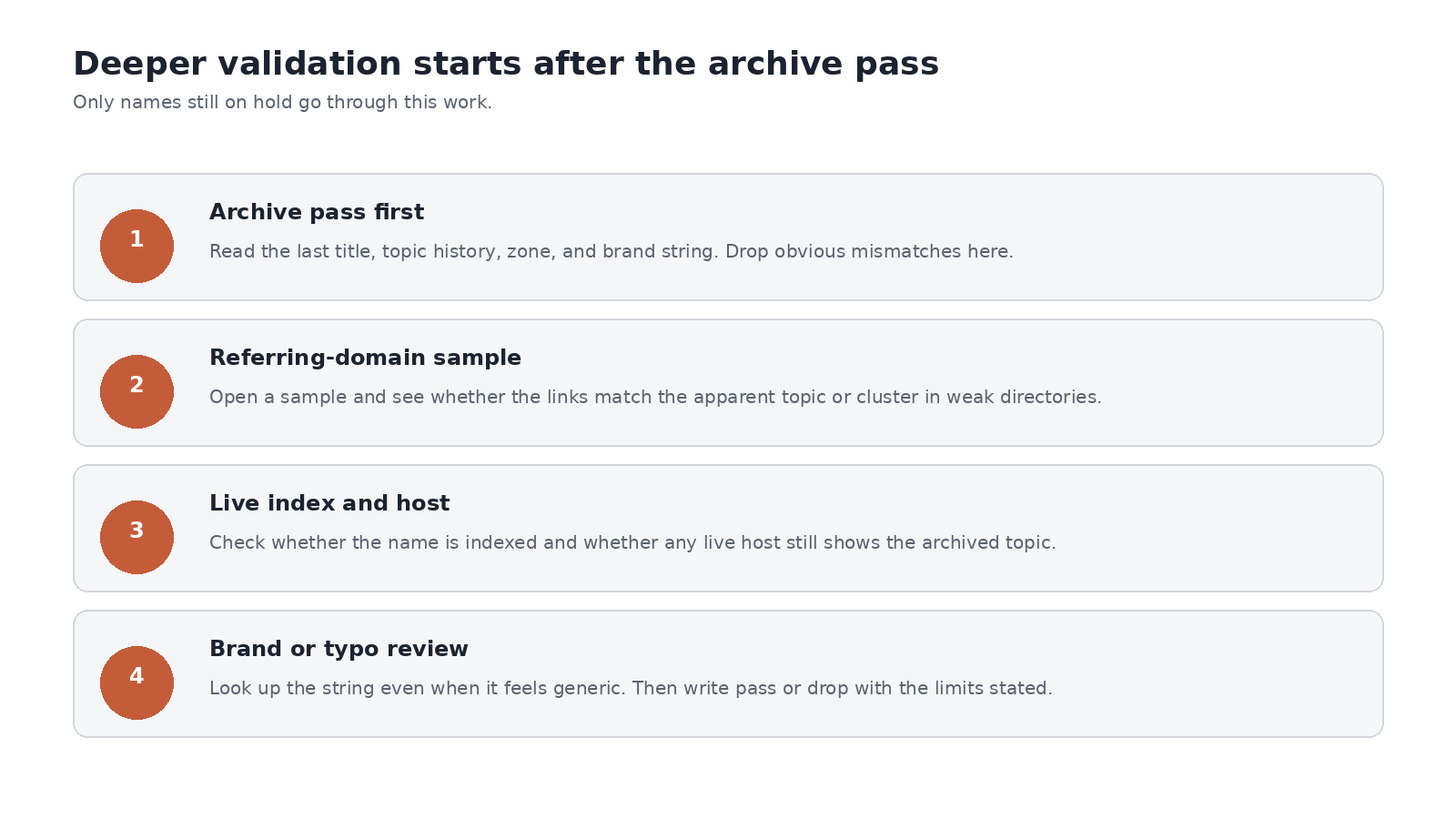
If the backlink sample or the brand check fails, the name moves to drop, and I record why. If both are acceptable, I will write a pass with the limits stated: what was checked, on which date, and that transfer of links, indexation, and rankings are not part of the claim.
What I tell the client when the shortlist is thin
A first-pass screen can return thousands of rows and still produce a short recommendation list. After the 16 November run, I would not have recommended the names at the top of the DR sort. That is a normal outcome.
I would rather send a client three names I can defend, or a note that the current brief did not produce one, than a table of high DR values with unexamined titles.
If the brief is too loose (any "com" zone, any topic, DR above a round number), I tighten it with the client before I run another screen: the actual TLD they want, the topics they will not accept, and whether a brand-adjacent string is automatically out. Those constraints shrink the net and make the later human review cheaper.
This workflow will not catch every bad history. Archive coverage is uneven, and a quiet snapshot record can still hide a link profile you will only see later. The point of the first pass is to stop the obvious mismatches, including the ones a category filter misses, before they appear in a proposal.
When a name does survive, the proposal should say what was checked, on what date, and what was not. I used to leave that last part out. Writing it down stops the DR figure from standing in for work I have not done.
Latest posts
View all posts →
Why Small Business Re-Engagement Emails Fail (And the 3 Fixes That Actually Work)
You put together a re-engagement campaign. The subject line is solid. The offer is genuine. You send it to 800 subscribers who've gone quiet over the past few…


What 10,000 Daily Support Conversations Teach About Writing Copy in the Words Customers Actually Use
Every SaaS team I know tests its copy the same way: a marketer writes two versions of a headline, the team argues about which one sounds better, and an A/B tes…


AI Chatbots + SEO: A Practical Guide for Growing Businesses (2026)
Most growing businesses treat their chatbot and their SEO as two separate jobs. The chatbot answers customers. The SEO brings visitors. They sit in different t…