
For many years, social media was viewed primarily as a B2C playground: a place for brand awareness, viral moments, and consumer engagement.
In modern B2B marketing, that perception has fundamentally changed. Today, social media plays a strategic, measurable, and often indispensable role across the entire B2B marketing funnel.
From shaping early-stage brand perception to influencing purchasing committees and supporting long sales cycles, social platforms have become deeply embedded in how B2B buyers research, evaluate, and engage with solutions.
Decision-makers no longer rely solely on whitepapers, vendor websites, content marketing assets, or sales outreach. Instead, they turn to LinkedIn feeds, industry discussions, peer commentary, and thought leadership content to validate trust and expertise.
This article explores the strategic role of social media in modern B2B marketing, focusing on how it supports business objectives, aligns with buyer behavior, and integrates with broader marketing and revenue strategies.
Rather than treating social media as a standalone channel, we’ll examine how leading B2B organizations use it as a long-term growth asset, one that influences not just awareness, but measurable pipeline and revenue outcomes.
How B2B Buying Behavior Has Evolved
The Shift Toward Self-Directed Research
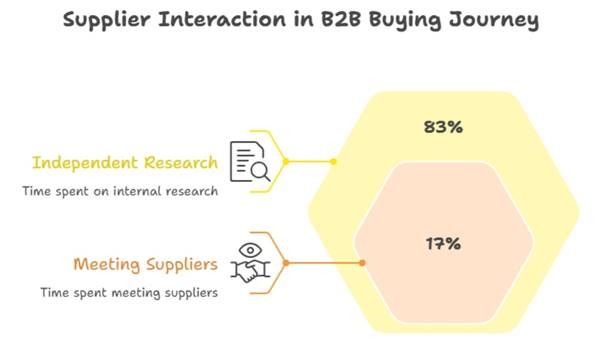
Modern B2B buyers are more informed and independent than ever before. According to research from Gartner, B2B buyers spend only 17% of the purchasing process meeting with potential suppliers, with most of their time spent conducting independent research across digital channels.
Source:
This shift toward self-directed research has fundamentally reshaped marketing strategy. Buyers now explore vendor credibility long before engaging with a sales representative.
They compare competitors, read industry commentary, evaluate case studies, and observe brand communication patterns.
Social media plays a significant role in this research phase. Buyers use platforms to:
• Follow industry experts and practitioners
• Observe how vendors communicate and respond publicly
• Validate credibility through consistency and engagement
• Discover real-world use cases shared by peers
Rather than asking vendors directly, buyers often “listen” first, watching conversations unfold before engaging.
In many cases, social media complements broader Content Marketing strategies by distributing educational materials, research findings, and expert commentary to the audiences already conducting independent research.
A well-structured content marketing ecosystem ensures that blog posts, research reports, and long-form insights are amplified through social channels where buyers are already spending time.
The result is a more informed buyer, and a more competitive environment where authority, consistency, and clarity matter more than aggressive promotion.
Multi-Stakeholder Decision Making
B2B purchases rarely involve a single decision-maker. Buying committees often include executives, technical evaluators, financial stakeholders, procurement officers, and operational end users.
Each of these stakeholders has distinct concerns, evaluation criteria, and risk tolerances.
Social media allows marketers to address these varied audiences simultaneously by publishing diverse content types:
• Strategic insights for leadership
• Technical breakdowns for specialists
• Practical tips for day-to-day users
This makes social platforms uniquely suited to supporting complex buying journeys, especially when aligned with blog content, gated resources, and Email marketing automation workflows that nurture different stakeholder groups over time.
For example, a CFO may engage with ROI-focused thought leadership on LinkedIn, while a technical lead may interact with product walkthrough videos on YouTube.
Social engagement data can then inform segmentation within Email marketing automation systems, ensuring that follow-up messaging remains relevant to each stakeholder’s priorities.
Social Media’s Role Across the B2B Marketing Funnel
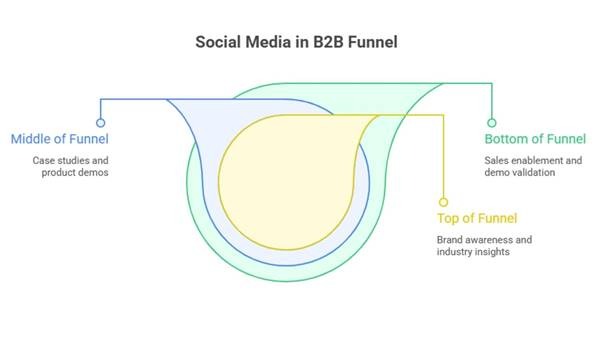
Top of Funnel: Brand Awareness and Positioning
At the awareness stage, social media helps B2B brands establish visibility and relevance within their niche. This is not about viral reach but about consistent presence in the right professional circles.
LinkedIn, in particular, has become central to B2B discovery. According to LinkedIn’s official marketing data, 80% of B2B social media leads come from LinkedIn.
Effective top-of-funnel B2B social content often includes:
• Industry trend analysis
• Educational threads or carousel posts
• Original research summaries
• Commentary on relevant news or regulatory changes
This content often originates from a broader content marketing engine, where long-form blog posts, reports, and whitepapers are repurposed into social-friendly formats.
Repurposing not only increases content lifespan but also ensures messaging consistency across channels.
The goal is not immediate conversion, but mental availability, being recognized as a knowledgeable and credible brand when a need arises.
Brand awareness in B2B is subtle but powerful. When a challenge emerges inside an organization, decision-makers tend to recall brands they have consistently seen providing value, not necessarily the ones that advertise most aggressively.
Middle of Funnel: Trust, Education, and Consideration
As buyers move into the consideration phase, social media becomes a channel for trust reinforcement and education.
B2B buyers want proof, not just claims. Social content can support this by showcasing:
• Case study highlights
• Customer quotes and short testimonials
• Product walkthrough clips
• Behind-the-scenes insights into teams and processes
At this stage, consistency matters more than frequency. Regular, high-quality content signals stability and reliability, two traits B2B buyers value highly.
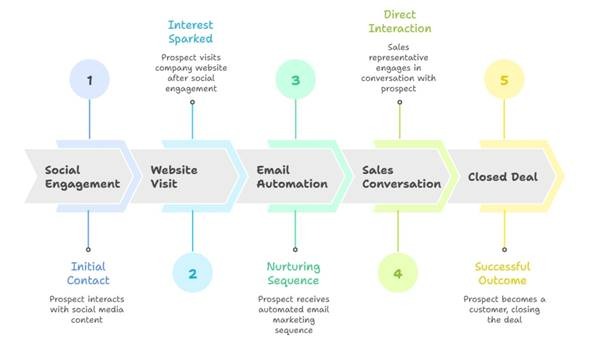
When combined with email marketing automation, social media engagement can trigger personalized follow-ups, targeted content delivery, and nurture sequences that guide prospects deeper into the funnel.
According to HubSpot’s State of Marketing report, segmented and automated emails significantly improve engagement and conversion performance.
This integration ensures that social interaction is not isolated. It becomes part of a coordinated buyer journey supported by Content Marketing, retargeting, and strategic follow-up communication.
Trust is rarely built in a single touchpoint. Instead, it develops gradually through repeated exposure to valuable, relevant content across channels.
Bottom of Funnel: Sales Enablement and Validation
While social media rarely closes B2B deals on its own, it strongly influences final decisions. Prospects often review a company’s social presence before:
• Booking a demo
• Responding to outreach
• Signing a contract
An inactive or poorly maintained social presence can create doubt, while an informative and professional one reinforces confidence.
Sales teams increasingly use social content as:
• Conversation starters
• Follow-up resources
• Objection-handling support
Here, integration becomes critical. Social media insights can inform Email marketing automation campaigns, ensuring that follow-up messaging aligns with what prospects have already seen or engaged with.
For example, if a prospect frequently interacts with thought leadership posts related to industry regulation, automated email sequences can deliver in-depth regulatory guides or compliance-focused case studies.
This alignment shortens the trust-building cycle and creates a seamless experience between marketing and sales.
Platform-Specific Strategies in B2B Social Media
LinkedIn: The Foundation of B2B Social Strategy
LinkedIn remains the most strategically important platform for B2B marketing. Its professional context, targeting capabilities, and content formats make it ideal for reaching decision-makers.
According to the Edelman Trust Barometer, business leaders are among the most trusted spokespeople, making executive-led social content particularly powerful in B2B environments.
Effective LinkedIn B2B strategies often focus on:
• Personal brand building by executives and subject-matter experts
• Long-form posts that share experience-based insights
• Data-backed thought leadership
• Employee advocacy programs
Executive visibility humanizes the brand. When leaders share authentic insights, lessons learned, and industry commentary, it reinforces credibility far more effectively than corporate messaging alone.
This approach works best when LinkedIn activity is aligned with a broader Content Marketing roadmap, ensuring that social conversations reinforce the same strategic themes presented across blogs, webinars, and email campaigns.
YouTube and Video-First Platforms
Video consumption continues to grow in B2B contexts. According to Wyzowl’s video marketing statistics report, 91% of businesses use video as a marketing tool, and a majority say it improves product understanding.
YouTube is particularly effective for:
• Product demos
• Educational explainers
• Webinar recordings
• Customer interviews
Video content often supports both social distribution and Email marketing automation workflows, where recorded webinars or demo clips are delivered as follow-up educational assets.
Video increases comprehension, reduces friction in complex explanations, and accelerates decision-making.
In technical industries, video can bridge the gap between marketing messaging and product functionality.
Social Media as a Relationship-Building Channel
Unlike many traditional marketing channels, social media enables direct, two-way interaction between brands and their audiences.
Rather than broadcasting messages in a one-sided format, organizations can participate in conversations, respond in real time, and demonstrate attentiveness to their community.
This ongoing dialogue strengthens relationships, encourages meaningful engagement, and builds transparency (an essential factor in B2B decision-making).
B2B relationships are rarely transactional; they are built on trust, expertise, and long-term reliability.
When companies consistently respond to comments, contribute to industry discussions, and acknowledge feedback, they signal that they are accessible and invested in their audience’s success.
Even small interactions, such as answering a question thoughtfully or sharing a relevant resource, can significantly shape perception.
Over time, these interactions compound in value. Casual followers may evolve into engaged advocates who amplify content within their networks.
Satisfied customers can become vocal ambassadors, reinforcing credibility through peer influence. Prospects who repeatedly engage with insightful content are more likely to subscribe to updates or download resources.
From there, structured email marketing automation journeys can nurture those relationships further, delivering personalized insights that align with demonstrated interests. In this way, social media becomes not just a visibility tool, but a long-term relationship engine.
Measuring the Strategic Impact of B2B Social Media
Moving Beyond Vanity Metrics
Follower counts and likes offer limited insight in B2B contexts. Strategic measurement focuses on metrics tied to business outcomes, such as:
• Engagement rate from relevant audiences
• Website traffic quality
• Content saves and shares
• Assisted conversions
• Sales pipeline influence
When social media is integrated with CRM systems and email marketing automation tools, marketers gain clearer visibility into how early engagement translates into long-term revenue impact.
Multi-touch attribution models are particularly important in B2B environments where buying cycles span months.
Social media may serve as the first touchpoint, while conversion occurs much later through direct outreach or email follow-up.
Understanding this interconnected influence helps leadership view social media as a strategic investment.
Common Challenges in B2B Social Media Strategy
Despite its growing importance, many B2B organizations struggle to implement social media strategies effectively. The challenge is rarely about recognizing value. More often, it’s about operationalizing it in a structured and sustainable way.
One of the most common obstacles is limited internal resources. B2B marketing teams are often lean, managing multiple channels simultaneously.
Without dedicated personnel or clearly defined processes, social media can become reactive rather than strategic. Inconsistent posting, limited engagement, and a lack of content planning reduce long-term impact.
Another frequent challenge is inconsistent executive participation. In B2B environments, leadership voices significantly enhance credibility and trust. However, executives may lack time, clarity on messaging, or confidence in personal branding.
Without their involvement, organizations miss valuable opportunities to humanize their expertise and influence decision-makers directly.
Measuring ROI also presents complexity. B2B sales cycles are long, and social media rarely drives immediate conversions. This makes it difficult to attribute revenue directly to social activity. Without proper tracking, CRM integration, and multi-touch attribution models, social efforts may appear less effective than they truly are.
Finally, many organizations overemphasize short-term metrics such as likes or follower growth instead of focusing on pipeline influence, engagement quality, and brand authority.
Addressing these challenges requires clear governance, defined KPIs, cross-functional collaboration, and executive alignment.
When leadership understands how social media supports pipeline growth, employer branding, and long-term market authority, investment becomes not only justified but strategic.
The Future of Social Media in B2B Marketing
Several trends are shaping the next phase of B2B social strategy:
• Increased emphasis on executive personal branding
• Greater integration between social analytics and CRM systems
• Expanded use of AI-assisted content marketing workflows
• Deeper personalization within Email marketing automation systems
As technology advances, integration between platforms will become more seamless. Behavioral signals from social engagement will increasingly inform automated nurture sequences, predictive lead scoring, and personalized content delivery.
Organizations that invest early in integration and strategic alignment will gain a sustainable competitive advantage.
Social Media as a Strategic B2B Asset
Social media is no longer optional in B2B marketing. In a marketplace where buyers conduct extensive independent research before ever speaking to sales, a brand’s social presence often becomes its first impression.
When approached strategically, social media does far more than generate engagement metrics. It supports brand awareness, builds credibility, strengthens professional relationships, and influences complex purchasing decisions that unfold over weeks or even months.
Modern B2B organizations recognize that social platforms are not simply distribution channels; they are trust-building ecosystems.
Consistent thought leadership, educational insights, and meaningful engagement signal expertise and reliability. Over time, this consistency shapes perception.
Buyers begin to associate the brand with authority in its field, making it more likely to be considered when a need arises.
Rather than chasing fleeting trends or vanity metrics, successful B2B marketers treat social media as a long-term investment in reputation and relevance.
Strategic alignment is critical. Social initiatives should complement broader content marketing efforts, ensuring that messaging is cohesive across blogs, reports, webinars, and executive commentary.
Engagement insights from social platforms can further enhance email marketing automation strategies, enabling personalized follow-ups that reflect a prospect’s demonstrated interests and behaviors.
Measurement must also evolve beyond surface-level metrics. Instead of focusing solely on impressions or likes, organizations should evaluate how social engagement contributes to pipeline growth, brand authority, and customer retention.
In today’s digital-first buying environment, visibility builds familiarity. Familiarity builds trust. And trust, consistently reinforced across channels, ultimately drives sustainable revenue growth.