A few years ago, website templates were mostly used for landing pages, personal blogs, and one-off projects. Today, they’re a core part of web design, powering millions of sites across all industries.
Need one more reason to make the switch? Free website templates are just as visually appealing as many paid options.
Plus, they’re optimized for search engines and deliver a seamless user experience, making it easier to gain visibility online.
Still, not everyone is a fan. Critics argue that templates are killing creativity in web design, and to some extent, they’re right. Thousands of websites look nearly identical, with only slight variations in layout, color palette, or navigation.
Most times, the real issue isn’t the use of templates, but the lack of customization. A template should be a starting point, not a substitute for creative content. Here’s what you should know about it.
TL;DR
- Free website templates can cut costs by 50-70%, offering visually appealing designs that are SEO-optimized.
- Critics argue templates stifle creativity, but the real issue is a lack of customization; personalization is key to standing out.
- Over 91% of developers use AI in their coding processes, indicating templates are not replacing custom design but evolving with technology.
- Successful website creation involves defining brand identity, customizing templates, and focusing on user experience for improved performance metrics.
- Don’t just pick a template, transform it into a unique representation of your brand for greater impact.
Are Website Templates Limiting Creativity?
Free website templates are meant to fuel, not stall, creativity.
What makes them so popular is their accessibility and convenience, with average cost savings ranging from 50% to 70%. The problem is that they’re often misused through practices that prioritize speed over originality. Let’s see a few examples:
- Copy-pasting the default layout without adapting it to the brand’s identity
- Ignoring SEO fundamentals, such as alt text, structured headings, and meta tags
- Adding placeholder text instead of meaningful content
- Not customizing the fonts and colors
- Not updating the template settings
- Using generic stock images
- Failing to optimize for mobile
For instance, many entrepreneurs select a template, upload their logos, write content for the main pages, and then hit “Publish.” Their websites look good overall, except for one thing: they’re similar to hundreds of other sites and lack personality.
Suppose you sell women’s apparel and choose an eCommerce template from Wix. That’s a great choice, but if you leave the template untouched, your website may not resonate with your target audience or reflect your brand’s identity.
The solution? Personalize it with your own colors, images, banners, and other visual elements. Focus on what makes your brand unique, and ensure it shows in your website’s copy and design.
Free Website Templates Can Serve as Creative Tools
At its core, a website template is a pre-designed page or set of pages that can be customized to suit different needs. Basically, it lays the foundation for building a fully functional site, saving you time, money, and effort.
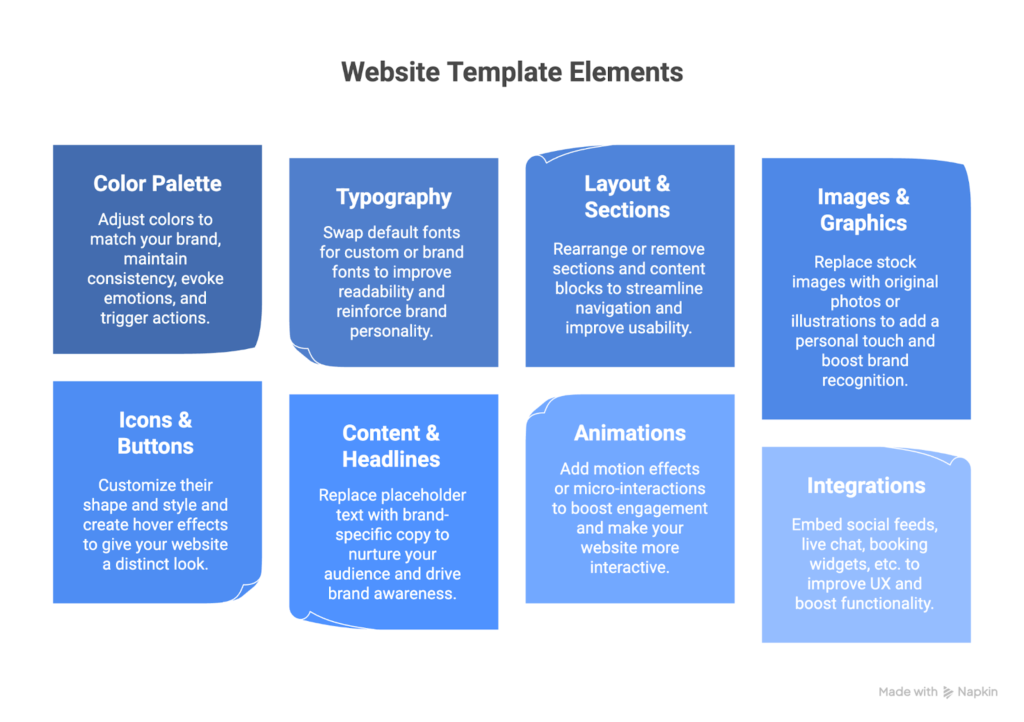
The outcome depends on how you use the template. Ideally, treat it as a creative tool and transform it into a unique website that speaks volumes about your brand. also added social proof, such as customer reviews, testimonials, and press mentions, to build trust and engagement. You can build a unique website with coding. Here are some simple ways to customize a template and how it benefits your brand.
Most templates also boast customizable SEO features that can help your site rank higher in search results. For example, you can edit meta titles and descriptions, add alt text to images, and adjust header tags (H1–H6).
These small changes enhance accessibility and usability, which in turn can boost the user experience. Over time, you may notice improvements in key performance metrics like bounce rate, page views, session duration, and engagement.
Does This Mean Custom Web Design Is Dead?
The rise of AI and website templates has lowered the demand for custom web design. After all, why pay thousands for a bespoke site when you can build one yourself for next to nothing?
No-code platforms offer flexibility and convenience, allowing small business owners, entrepreneurs, and creatives to get online fast. But custom web design is far from dead, it’s simply evolving.
For example, many web designers use Wix Studio or similar platforms as their creative starting point. Developers, on the other hand, deploy AI to generate code, find bugs, and work faster.
According to a recent survey, 91% of developers use AI for coding, and nearly 60% say it’s an integral part of their workflow. Most respondents also reported using AI coding assistants and image-generation tools such as DALL-E, Midjourney, and Flux.
Neither website templates nor the tools mentioned above are meant to replace web design and development. These technologies complement each other and have different use cases.
Say you want to launch an e-commerce site. A free template can handle hundreds of products and features like upselling, cross-selling, order management, and online payments.
But if you want to create a complex platform with custom subscription models, personalized product configurators, and multi-vendor functionality, you’ll likely need to hire a web designer or developer. The same goes for on-demand marketplaces, enterprise-level platforms, and other projects where templates simply won’t cut it.
Final Thoughts
Free website templates can help you take your business online or launch a brand in no time. They’re highly customizable and easy to use, but you have to put in some effort to maximize their value.
Simply put, you can’t just pick a template, replace placeholder text, and call it a website. Instead, define your brand image, set clear goals, and think about the message you want to convey. Then customize your template to reflect that vision and resonate with your ideal customers.
The keyword here is “creativity.” Why settle for a generic design when you can have a website like no other? So, mix and match colors, experiment with fonts, and play around with different design elements to create something truly memorable.
FAQs
Are free templates really effective for web design?
Yes, free templates can be very effective for web design. They are visually appealing, optimized for search engines, and can save you significant time and costs, often ranging between 50% to 70% less than custom designs. However, the effectiveness depends heavily on how you choose to customize them to fit your brand’s identity.
Do free website templates limit creativity?
While critics argue that free templates limit creativity, the real issue lies in their misuse. Many users copy the default designs without customization, leading to similar-looking websites. Templates can and should be viewed as a starting point to fuel creativity, encouraging users to personalize their sites with unique content, colors, and images to stand out.
How can I improve my website using a free template?
To improve your website using a free template, focus on personalization. Customize colors, fonts, images, and layout to reflect your brand’s identity. Utilize SEO features such as editing meta titles, descriptions, and alt text for images. This not only enhances your site’s uniqueness but also improves user experience and website performance metrics.
Is custom web design still relevant with the rise of templates?
Yes, custom web design remains relevant. While the demand may have shifted due to templates and no-code platforms like Wix, the need for custom solutions persists, especially for complex projects. Custom web design is evolving, with many designers now using templates as starting points and incorporating new technologies like AI for efficiency.
What should I consider when using a free website template?
When using a free website template, consider your brand image, target audience, and the message you want to convey. Don’t settle for generic designs; instead, aim to customize the template to reflect your unique vision. Define clear goals for your site and put in the necessary effort to personalize it beyond just changing placeholder text.