Influencer marketing has always been about following your gut, not following a plan.
You pay someone with a lot of followers to post, cross your fingers, and wait. If sales go up, you can thank the collaboration. If they don’t, you can say that “brand awareness” is to blame.
It has been a challenge for the growth team members who care about attribution, CAC, and ROAS to get influencer marketing to fit their mindset. It’s a lottery. That takes a long time. It is difficult to make bigger.
Things are changing quickly. AI influencer marketing is changing one of the least data-driven channels into one of the most. Your competitors probably know how to use it by now, even if your growth team doesn’t.
Here’s how it actually works, the practical version.
What “AI Influencer Marketing” Actually Means
The phrase is used to refer to two very different things, and confusing the two will cost you time and money.
Type 1: AI tools for optimizing human influencer campaigns. This is where most growth teams should begin. These are platforms and tools that leverage machine learning to find influencers, analyze audiences, detect fraud, predict content performance, and attribute ROI. The influencers are real humans. The AI is working behind the scenes to make your campaigns smarter.

Type 2: AI-generated virtual influencers. These are fully computer-generated characters — like Lil Miquela (22M+ Instagram followers) or Imma from Japan — that brands use as spokespersons. They never have a bad day, never go off-brand, and never post something that triggers a PR crisis at 2 am. They’re compelling for certain use cases, but they’re not where most growth teams should be spending their budget in 2025.
This article focuses heavily on Type 1, because that’s where the ROI signal is clearest. I’ll touch on virtual influencers too, because they’re increasingly relevant for specific growth plays.
Why Growth Teams Have a Complicated Relationship with Influencer Marketing
Let me be honest about something.
Most growth teams I’ve spoken with treat influencer marketing as a “brand thing” — something the social media team runs, with soft metrics that don’t connect to the funnel. And historically, that perception has been fair.
The core problems were:
- Discovery was manual and slow. Finding the right influencer meant hours of scrolling, cross-referencing follower counts with engagement rates, and praying the audience data you were given was real.
- Fraud was rampant. Industry surveys show that 59.8% of brands have experienced influencer fraud — and the number is climbing back up after a brief decline.
- Attribution was guesswork. Did that spike in traffic come from the influencer post or the email campaign you sent the same week? Without proper tagging and modeling, you had no idea.
- Scaling was impossible. Running 10 micro-influencer campaigns simultaneously with manual processes is a logistical nightmare.
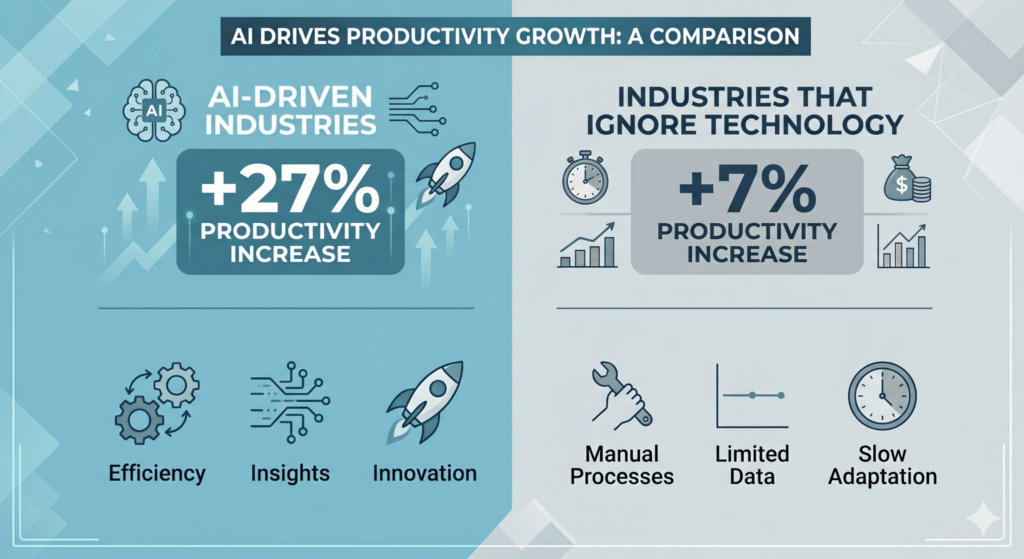
AI doesn’t magically solve all of these problems — but it makes each one significantly more tractable. According to the data from The Pivot Wave, productivity in AI-driven industries has increased by 27% compared to just 7% in those that ignore technology. So, for today’s growth teams, this is no longer just a “useful tool,” but a necessary skill for surviving in such a dynamic and highly competitive market.
How AI Is Actually Used Across the Influencer Marketing Workflow
1. Influencer Discovery and Vetting
This is where AI delivers the most immediate value for growth teams.
Today’s AI-powered influencer discovery tools extend far beyond simple searches by hashtag and follower count. They break down:
- Audience demographics at a granular level (age, gender, location, income bracket, purchasing behavior)
- Audience authenticity scores — detecting bot followers, purchased engagement, and suspicious follower growth patterns
- Content-brand fit — using NLP to analyze whether an influencer’s past content aligns with your brand values and product category
- Engagement quality — distinguishing between genuine comments and bot-generated noise
Platforms like Modash, Heepsy, and Upfluence have built ML models trained on millions of creator profiles. When you input your target audience persona, they surface influencers whose actual audiences match — not just influencers who claim to reach your demographic.
For a growth team, this is huge. Instead of spending 15 hours vetting 50 influencers manually, you get a ranked shortlist in minutes — with fraud probability scores attached.
2. Audience Overlap Analysis
The audience overlap detection is one of the most underused features in AI influencer platforms.
If you’re running five different campaigns with influencers at the same time, their audiences probably overlap quite a bit. You could be spending five times as much to reach that same 200,000 people.” AI tools can help you identify the overlap between creator audiences and develop a portfolio of influencers for maximum unique reach.
This is basic media planning logic – the kind of thinking that’s been standard practice in paid media for decades – finally applied to influencer marketing.
3. Content Performance Prediction
When a campaign launches, AI models can predict likely performance based on:
- Historical content performance of the influencer by content type (stories, reels, posts)
- Time-of-day and day-of-week patterns for that creator’s audience
- How similar past brand collaborations have performed
- Seasonal and trending topic signals
This doesn’t mean you can predict ROI to two decimal places. But that does mean you can make justified decisions about which influencer-format combinations are most likely to drive results — before you spend a dime.
4. Fraud Detection
Influencer fraud is still one of the biggest dangers in the channel. HypeAuditor’s State of Influencer Marketing 2025 has revealed that one in four influencers has bought fake followers and that fraudulent account activity has been increasing year on year, with AI-generated bot networks now accounting for the majority of detected fraud cases.
AI fraud detection works by flagging:
- Sudden spikes in follower growth (a sign of purchased followers)
- Engagement rates that are statistically inconsistent with follower count
- Comment patterns that suggest automation (generic phrases, identical comment structures)
- Follower quality scores based on account activity history
For growth teams managing significant influencer budgets, running fraud checks before contracting is non-negotiable.
5. Campaign Management and Briefing
AI tools help streamline campaign operations through various functions that include creative brief generation from brand guidelines, automated outreach sequence development, contract workflow management, and delivery status tracking of overdue or noncompliant items.
The most effective form of influencer marketing automation operates through its ability to relieve your team from routine tasks, which enables them to concentrate on developing business strategies while building professional relationships.
6. Attribution & ROI Measurement
The most critical area for growth teams receives its most substantial advancement through artificial intelligence research.
Standard UTM tracking, plus promo codes, only tracks last-click attribution, which results in a major underestimation of the actual impact that influencers have on the sales process.
AI-powered attribution models can:
- Use multi-touch attribution to accurately assign influencer touchpoints throughout the customer journey
- Use incrementality modeling to measure the true lift an influencer campaign delivers beyond your organic baseline
- Connect influencer content consumption to downstream conversion events through probabilistic matching
- Track brand search volume lifts that correlate with influencer campaign activity (a signal that AI overview and search data is increasingly capturing)
If you’re building the business case for influencer budget inside a growth team, this attribution infrastructure is what makes it possible.
Virtual Influencers: When Do They Actually Make Sense
I told you we’d come back to this.
Digital personalities created by AI, “virtual influencers,” are no longer a novelty. The average engagement rate for campaigns featuring virtual influencers is 5.9%, compared to 1.9% for those featuring human influencers – almost three times higher. Their campaigns include brands like Samsung, BMW, and Prada.
The case for virtual influencers in a growth context:
- No brand risk. They won’t say something controversial, get embroiled in a scandal, or insist on renegotiating halfway through a campaign.
- Always there. No scheduling conflicts. No delays in getting content. No sick days.
- Totally customizable. You own the look, the story, the brand integration right down to the pixel.
- Potentially scalable. Technically, one virtual persona can post in multiple markets at the same time.
The downside for most growth teams right now is:
- Expensive to create and maintain. Creating a captivating and entertaining virtual influencer takes a lot of work in 3D design, animation, and content creation.
- Audience trust remains a work in progress. Audiences are increasingly demanding transparency about the nature of AI, and the trust relationship between virtual influencers and their followers is still evolving.
The current case against virtual influencers operates under two main challenges that affect most growth teams:
- The process of building virtual influencers needs substantial resources because realistic virtual characters require extensive 3D modeling work, plus animation work and content development efforts.
- Audience trust is still developing. Audiences now require organizations to disclose their artificial intelligence systems, while virtual influencers need time to establish trust with their audience base.
- Most virtual influencer success stories function as brand awareness campaigns, which do not generate immediate customer reactions.
My honest assessment states that brands that lack virtual brand presence with dual business requirements should invest their resources into human influencer optimization tools for artificial intelligence purposes. The investment delivers more evident returns, which become accessible to users in a shorter duration.
A Practical Framework for Growth Teams Adopting AI Influencer Marketing
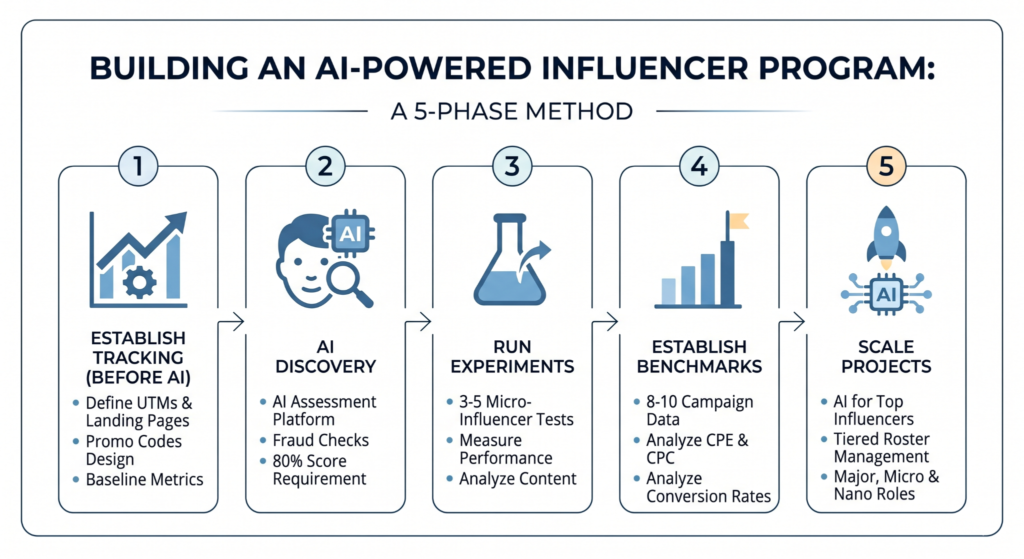
The following steps explain my preferred method for building an AI-powered influencer program from its initial stage:
The first phase of this project requires you to establish your tracking system before implementing AI technologies. Your organization needs to establish its entire tracking system before you start using artificial intelligence technologies. Your organization needs to establish UTM parameters, create unique landing pages, and design promotional codes, which will be used in all upcoming marketing initiatives. Your organization needs to establish organic conversion rate baseline metrics, which will enable you to assess actual incremental growth.
The second phase of this process requires you to use AI for discovery purposes. The platform uses artificial intelligence technology to assess potential influencers. All potential candidates must undergo a fraud detection assessment before we begin the outreach process. The minimum requirement for audience authenticity scores needs to be established, with 80% as the initial base requirement.
The third phase requires you to conduct small experiments while maintaining precise measurement processes. Begin your campaign by collaborating with 3 to 5 micro-influencers with a following of 10,000 to 100,000 users in your specific market. Micro-influencers achieve better engagement results because they develop stronger connections with their followers. The evaluation process involves assessing performance based on the content format, time of posting, and the way the message is presented.
The fourth phase requires you to establish your performance benchmarks. Your internal benchmarks will become established after you complete 8-10 campaigns, which will provide enough data to develop expected CPE (cost per engagement) and CPC from influencer traffic and conversion rates according to influencer tier and content format.
The fifth phase requires you to expand successful projects through implementation. Use AI-based tools to discover additional influencers who meet your requirements for top-performing individuals. Create an influencer roster that consists of three levels, which include major creators for brand awareness and additional micro and nano-influencers who handle conversion-based marketing activities.
The Metrics That Actually Matter
Stop optimizing for vanity metrics. The following metrics require tracking by a growth-oriented influencer program:
- Earned Media Value (EMV) represents the estimated advertising value of content that would require payment for its acquisition.
- Cost Per Acquisition (CPA) tracks all conversions that result from influencer marketing efforts.
- Incrementality lift — sales above your organic baseline during the campaign window
- Audience Authenticity Score — ongoing monitoring, not just pre-campaign vetting
- Share of Voice — in your category, across social platforms, tracked over time
- Brand search volume uplift is measurable via Google Search Console data and often correlates with influencer activity
AI tools surface most of these metrics automatically. The job of the growth team is to set up the right measurement framework before the campaign runs — not scramble to piece it together afterward.
The Honest Limitations
AI enhances the effectiveness of influencer marketing, yet it remains a complex process.
The artificial intelligence technology currently fails to resolve these particular issues:
- Relationship quality. The best influencer partnerships are built on genuine alignment between the creator and the brand. AI can identify candidates, but a human still needs to build the relationship.
- The ability to make creative decisions. AI can predict that video outperforms static for a given influencer, but it can’t tell you whether your product integration feels authentic or forced. Human creative oversight remains necessary for that particular task.
- Understanding cultural nuances. Influencer marketing requires a deep understanding of specific cultural contexts. The AI model trained mostly on English-language data will fail to detect vital market details that exist in non-English-speaking regions.
- The algorithm wildcard. Platform algorithm changes can tank the reach of even perfectly constructed campaigns overnight. AI attribution models struggle to account for these sudden shifts.
What’s Next: Putting This Into Practice
The present situation shows that you have reached two different points after reading the text. You want to create an influencer program from scratch, which requires you to avoid all manual procedures. You need to find out the reasons behind your influencer campaign results because you have operated these campaigns.
So, before you touch a single AI tool, answer these questions:
- Can you currently attribute a sale to a specific influencer post? You need to correct your UTM and landing page configuration before proceeding to any other tasks.
- Do you know the fraud score of the influencers you’re currently working with? You need to check their fraud score today by using the free version of HypeAuditor or Modash.
- Do you have internal benchmarks for what good influencer performance looks like in your category? The next step for you to follow involves executing 3 to 5 micro-influencer test campaigns, which I previously mentioned.
AI influencer marketing isn’t a silver bullet. But for growth teams willing to approach it with the same rigor they bring to paid search or lifecycle marketing, it’s one of the most underutilized leverage points in the current channel mix.
The brands that figure this out in the next 12 months are going to have a significant advantage. The window to build that advantage while the channel is still underpriced is closing.