Cold outreach has a reputation problem, and honestly, it earned it.
Most teams treat it like a numbers game: load a thousand names into a sequence, hit send, and wait for the 2% to bite.
That playbook is still everywhere. And so are the consequences: ignored inboxes, declining reply rates, and reps who have quietly stopped believing their own message will ever land.
Something is shifting though. A different kind of outreach is gaining ground, one that feels less like a broadcast and more like a well-timed, well-researched conversation.
It runs on AI, but not in the way that makes people roll their eyes. Used right, it changes what is actually possible when you are trying to turn a stranger into a conversation.
If you have been stuck in the old playbook and want a way out, here is how to build something better.
Why Most Cold Outreach Falls Flat
The problem is rarely the channel. It is the lack of any real reason for that specific person to care.
A message that could have been sent to ten thousand people reads exactly like one. The recipient clocks it within a sentence or two. You clearly do not know them, do not understand their situation, and have no idea whether your offer actually applies. At that point, the email is already gone.
What actually converts is specificity. When someone reads a message and thinks, this person did their homework, or this is weirdly relevant to what I am dealing with right now, that is when reply rates move.
The issue is that building that kind of relevance for hundreds of prospects at once has always been brutally time-consuming. Most teams skip it because they cannot afford not to.
That is the gap AI is starting to close, and platforms like Magic Pitch are built specifically to close it faster than anything else on the market.
How AI Shifts the Equation
AI does not just help you draft emails more quickly. When it is set up well, it makes the entire research and personalization layer something you can actually run at scale.
A few places where it makes the biggest difference:
• Prospect research in the background. AI tools can pull from company websites, LinkedIn activity, recent news, job postings, and hiring trends to build a working picture of a prospect before you ever write a word. What used to eat 20 minutes per person can now happen automatically, across hundreds of contacts at once.
• Personalization that goes beyond the obvious. “I see you are the VP of Sales” is not personalization, it is a LinkedIn lookup. AI can surface things that actually matter: a pain point buried in their job listings, a product launch that creates a new need, a team expansion that signals a shift in priorities.
• Smarter prioritization. Not everyone on your list is ready to hear from you at the same time. AI can score and sort based on signals that suggest a prospect is in-market right now, whether that is a trigger event, a recent funding announcement, or a role change.
• Learning from what works. The real advantage compounds over time. AI tools that track reply rates, subject line performance, and message patterns give you something to actually iterate on, rather than running the same sequence and hoping for different results.
What the Stack Actually Looks Like
You do not need ten tools. You need a few that cover the right stages and talk to each other: identify, research, write, sequence, and learn.
Identification starts with a sharp ICP. Not just a job title filter, but a real profile of who is likely to buy, when, and why. AI-powered prospecting tools help you find people who actually match that profile, including the behavioral signals that suggest they are worth prioritizing.
Research and personalization is where most teams still underinvest. It is also the step that separates a reply from silence. Good AI research tools do the legwork automatically, pulling together enough context to make your message feel like it came from someone paying attention.
For writing, the goal is not to hand everything off to AI and call it done. The goal is to use it for strong, already-personalized first drafts, then bring in your own voice and judgment. The message should still sound like a person wrote it, because one did. AI just gave you better material to start from.
Sequencing and timing is where Magic Pitch does the heavy lifting. The platform manages outreach across channels, tracks engagement signals, and makes sure your message lands at the moment it is most likely to get read, not just whenever the queue fires. At this stage of outreach, intelligent sequencing handles the logistics layer so your reps can stay focused on actual conversations.
What a Good AI-Assisted Message Actually Looks Like
Here is the same prospect, two different approaches.
The generic version:
“Hi [Name], I noticed you are the Head of Growth at [Company]. We help companies like yours increase pipeline. Would you have 15 minutes this week?”
The AI-assisted version:
“Hey Sarah, saw that Acme just moved into the mid-market last quarter and you have been building out the outbound team pretty fast. Most teams at this stage hit the same wall: reps burning time on research and not enough time actually talking to prospects. Happy to show you how a few similar teams fixed it. Worth 15 minutes?”
Same ask. Same channel. A completely different feeling. The second one shows evidence of actual thought. That is what AI-assisted outreach makes possible, and that is exactly the kind of output Magic Pitch is designed to generate, at scale, without it taking three hours per prospect.
Why Magic Pitch Belongs at the Center of This Stack
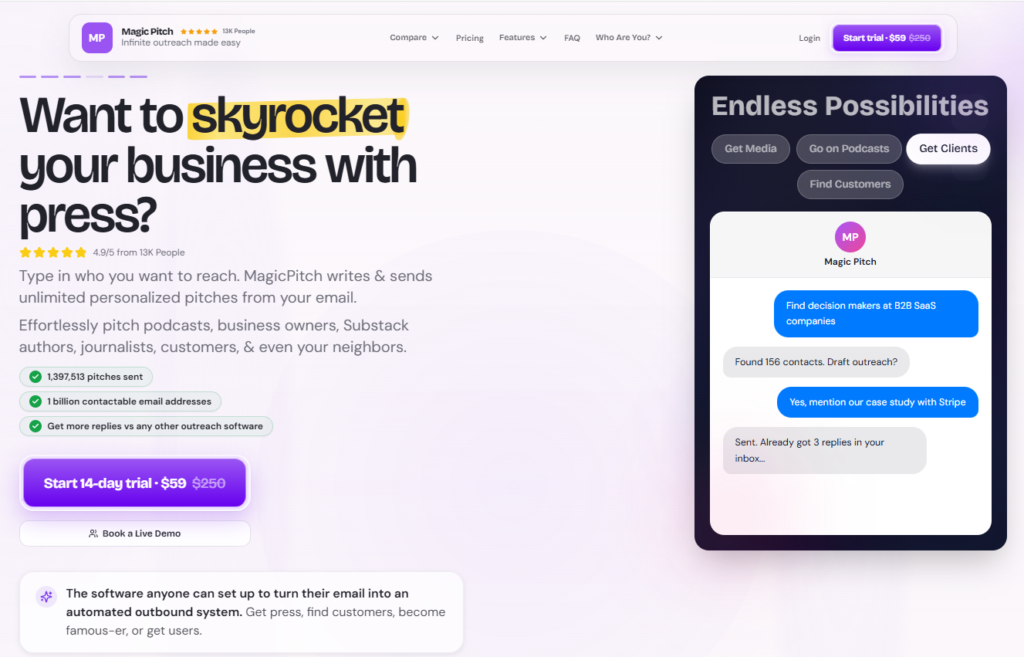
Most AI outreach tools help with one piece of the puzzle. They draft better subject lines, or they find verified emails, or they score leads by intent. Those are useful capabilities. But they leave you stitching together four or five platforms to cover the full cycle.
Magic Pitch is different because it was built to handle the whole outreach motion, not just one slice of it.
• A database built for earned media and outreach at scale. With access to millions of verified contacts including podcast hosts, journalists, and decision-makers, it removes the prospecting bottleneck that kills most outreach programs before they ever find a rhythm.
• AI personalization grounded in real data. Magic Pitch does not merge fields into a template. It pulls from each contact’s actual content activity, recent work, and professional context to write outreach that reads like someone did the research, because the platform did.
• Deliverability infrastructure that protects your sender reputation. Dedicated sending infrastructure per client means your campaigns do not share IP reputation with other users. That matters more than most teams realize. It is the difference between landing in inboxes and disappearing into spam.
• Campaign tracking that closes the feedback loop. Open rates, reply rates, and booking conversions in a single view means you are always improving, not just running the same sequence and hoping this batch performs better than the last one.
The result is a platform that compresses what used to be a week of manual outreach work into under 30 minutes.
For marketing teams running thought leadership campaigns, PR agencies managing podcast outreach for clients, and founders building brand presence without a dedicated PR function, that time difference is enormous.
A Few Things That Go Wrong
AI outreach done poorly is just bad outreach that arrives faster. Worth watching for:
• Over-automating at the cost of quality. If the messages feel canned, AI is working against you. The bar for what people will tolerate in their inbox keeps rising. Match it.
• Chasing volume before the fundamentals are right. AI lets you scale, but scaling a broken strategy just means more of the same disappointing numbers. Get the ICP sharp and the messaging tight before you pour fuel on it.
• Treating AI as a one-time setup. The teams getting the most out of this are the ones feeding reply data back into the system, testing, and iterating. It is a process, not a launch.
Start With One Segment
You do not need to tear down your current setup to start seeing results. Pick one segment.
Take 50 prospects who actually fit your best-customer profile. Run real research on them. Write messages that use what you find. Track what happens.
Then do more of what worked and cut what did not.
The teams consistently winning at outreach are not the ones with the biggest lists. They are the ones who decided that relevance was worth investing in and built systems around it.
Magic Pitch gives you the infrastructure to do exactly that without starting from scratch.
One Last Thing
Cold outreach is not going away. But the version that treats every prospect like a name on a spreadsheet is losing ground fast.
The kind that shows up with actual context, at a moment that makes sense, with a message worth reading? That version is growing. And AI is what makes it repeatable rather than a manual one-off.
If you are ready to build that kind of system, Magic Pitch gives you the infrastructure to make it run consistently, not just when a rep happens to do exceptional research on a good day.
That is the real difference between cold and converted.