
Quick answer: Before signing with an SEO agency, get a written scope tied to specific deliverables (not “ongoing SEO”), a clear contract exit process with an asset-transfer exhibit, monthly reporting that connects to booked consultations rather than raw traffic, and evidence (not a promise) that the agency can get your firm cited in AI-generated answers as well as ranked on Google. Score every proposal against the same written requirements document, and don’t sign until legal counsel in your jurisdiction has reviewed the agreement.
Editor’s Note: While tailored to legal practices, this procurement framework offers growth leads and agency buyers an actionable blueprint for vetting search partners in high-LTV service verticals.
The best-looking proposal on your desk is rarely the best offer. A presentation can hide vague deliverables, an exit clause that quietly costs five figures, and monthly reports that never once connect marketing spend to a retained matter.
Choosing an SEO agency in 2026 means reading documents more carefully than slides.
That distinction matters more this year than it did two years ago. A small firm now has to judge conventional search work and, separately, whether an agency can keep the firm visible inside AI-generated answers. Treat every promise as a claim that needs a document behind it.
Start Choosing an SEO Agency With Your Firm’s Requirements
Every agency you contact has a proposal template, and that template will define your firm’s needs unless you define them first. Write a short requirements document before the first call and send an identical copy to everyone you’re considering.
It doesn’t need to be long. It needs to be the same document each time, so that six proposals answer the same questions and you can lay them side by side without translating between them.
Define the matters and markets that justify the investment
List the practice areas you want to grow and the offices you want them to grow in. Then convert the goal into something countable: twelve qualified consultations a month in family law, rather than “more visibility.” An agency can’t be held to a wish.
Most people start their legal search in a search box. RevenueMemo reports that 96% of people seeking legal advice begin their research with a search engine, making that initial visibility an essential driver for new consultations.
Record the baseline before an agency can claim improvement
Capture what you already have. Pull organic sessions and qualified calls for the trailing twelve months. Note form submissions and booked consultations, then record retained matters and the map positions you hold in your primary practice area.
Check whether any AI-generated answer already names your firm.
A baseline protects both sides. It gives the agency credit for what it actually changes, and it stops month-six reporting from presenting your existing referral calls as new growth. Export the dashboards and date the file.
Set a budget against expected matter economics
Budget belongs in the same sentence as your average matter value and your intake capacity. A firm that can’t answer the phone at 6 p.m. doesn’t need more calls yet.
Decide how many months you can fund the work before it has to pay for itself, because a twelve-month program abandoned in month four is unlikely to produce a return.
Law firms typically direct roughly 2–10% of revenue toward marketing, with about 45% of that marketing budget going to SEO, proving organic search remains a competitive priority. Rather than relying on generic benchmarks to guide your spending, ask exactly what the retainer buys in hours and named people.
Build a Shortlist Before You Invite Proposals
Peer referrals from firms in adjacent practice areas carry the most value, because the person answering has already paid for the mistakes. Bar association vendor programs and legal-industry publications add names. So do agency case studies and comparison pages, as long as you know who wrote them.
You’re not picking a winner yet. Five names you can test under one process beat a favorite you found first.
Treat published rankings as lead sources, not verdicts
Agency-published comparisons serve as practical benchmarking tools because they compile vendor data into a single resource. For example, reviewing an industry roundup of law firm SEO providers allows you to compare price ranges and contract terms across fifteen different agencies in one place before scheduling sales calls.
Then verify what you took. A published price range is a useful baseline until a provider repeats it in a proposal with your firm’s name on it, and the contract language behind that range decides whether the price means anything at all.
Give every candidate the same request
Send the requirements document you already wrote, unchanged, along with your baseline numbers and your budget parameters. Ask for a proposal that separates setup work from recurring work, with optional services and third-party costs on their own lines. Include the tasks you’re assigning to your own staff, because unbilled work still costs the firm time.
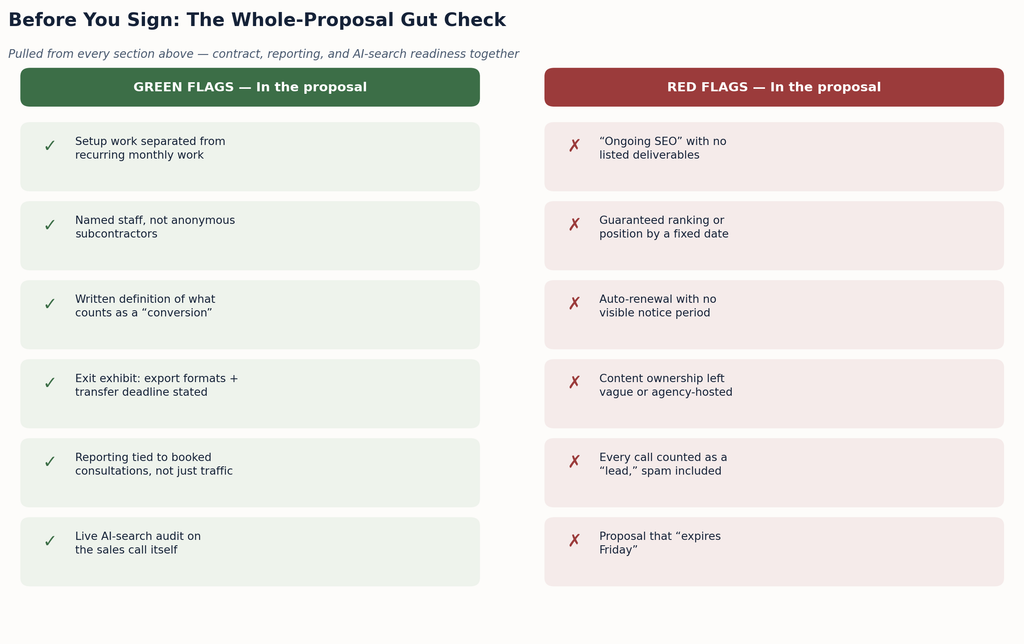
Reject artificial urgency while you’re at it. A proposal that expires Friday may be designed to expire before your contract review finishes.
Read the Contract as Closely as the Strategy
What follows is commercial vetting, not legal advice, and whether a particular clause is enforceable depends on where you practice.
The contract red flags that cost small firms real money are rarely dramatic. They’re ordinary sentences about renewal windows and account ownership that nobody read aloud.
Match every promised service to a written deliverable
“Ongoing SEO” isn’t a deliverable. Convert each promise into work you could observe, or refuse to pay for. Your statement of work should name:
- Technical audits, and who implements the fixes.
- Content volume, and whose name appears on each piece.
- Local-search management, including who administers the Google Business Profile and coordinates Map Pack visibility with Google Local Services Ads (LSAs).
- Link acquisition or digital PR, and the methods used.
- Conversion tracking setup and ongoing maintenance.
- Reporting format and meeting cadence.
Then ask who does the work. A senior strategist on the sales call and an anonymous vendor on the file are two different purchases, so establish which tasks go to employees and which go to subcontractors the agency would rather not name.
Examine the term and what it costs to leave
Read the initial term first, then the automatic renewal. Find the notice period and count backward from your renewal date so the deadline sits in your calendar, not the agency’s. Ask what work is owed after notice is given, and what happens to scheduled content the day you cancel.
A twelve-month term isn’t automatically a trap. Real setup work such as a migration or an initial content library takes months to earn back, and an agency fronting that cost has a defensible reason to ask for time. Make them state the reason, though, and get it into the agreement rather than an email thread.
Put SEO asset ownership in writing
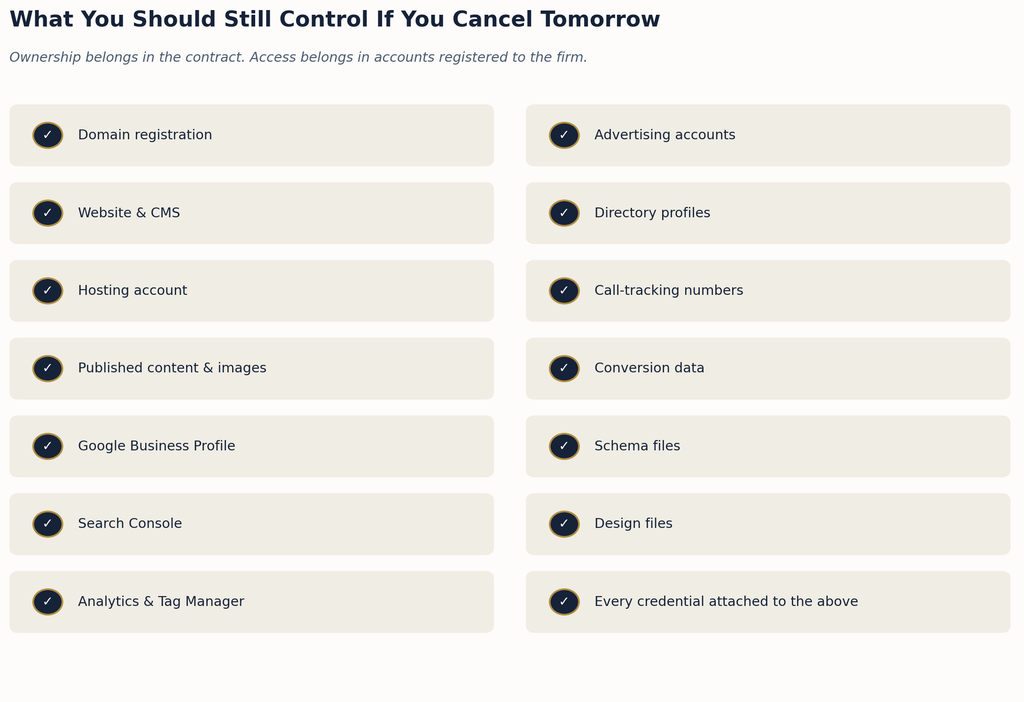
Ownership comes down to one test. If you canceled tomorrow, you should still control the domain registration, the website and CMS, the hosting account, published content and images, the Google Business Profile, Search Console, Analytics, Tag Manager, advertising accounts, directory profiles, call-tracking numbers, conversion data, schema files, design files and every credential attached to them. Ownership belongs in the contract. Access belongs in accounts registered to the firm.
The website carries the most sunk cost on that list, representing a foundational digital asset for any practice. Retaining control of this asset is far more practical than rebuilding it.
Ask for an exit exhibit naming the export formats and the transfer deadline, plus any fee attached to transition assistance.
Check data handling and market conflicts
Ask what client and intake data the agency can see and where it’s stored. Then ask how access gets revoked when a staffer leaves. Call recordings and intake forms may contain sensitive or confidential details. Treat them accordingly.
Then ask about the firm across town. Find out whether the agency already represents another practice chasing the same matters in your market, and what is walled off between those accounts. Any exclusivity promise belongs in the agreement, not the pitch, and professional-conduct rules vary by jurisdiction.
Make Legal Experience and References Verifiable
A logo strip proves someone paid an invoice once. References and case studies only mean something when they’re specific enough to compare with your situation, which means asking for the details the anonymized version leaves out.
Test whether the case study matches your firm
Ask what the starting number was and how long the campaign ran. Then ask for the budget range and how the agency defined the outcome it’s claiming. A 400% traffic increase from a base of nineteen visitors is arithmetic, not evidence.
Be skeptical of modeled returns too. Commercial estimates of three-year ROI on legal SEO circulate widely, and they rest on undisclosed assumptions about matter value and attribution, which puts them closer to a sales aid than a budget input. Insist the example resembles your firm in practice area and market size.
Interview references instead of collecting testimonials
Ask for two current clients and, where the agency allows it, one former client of similar size. Then hold a real conversation. Find out how quickly the agency responded in month seven and whether the early forecasts held up.
Ask how many account managers the client has had, and whether anything on an invoice arrived as a surprise. For the former client, ask how the asset transfer actually went.
A testimonial is a sentence the agency approved. Ask for the call.
Require Reporting That Reaches the Intake Pipeline
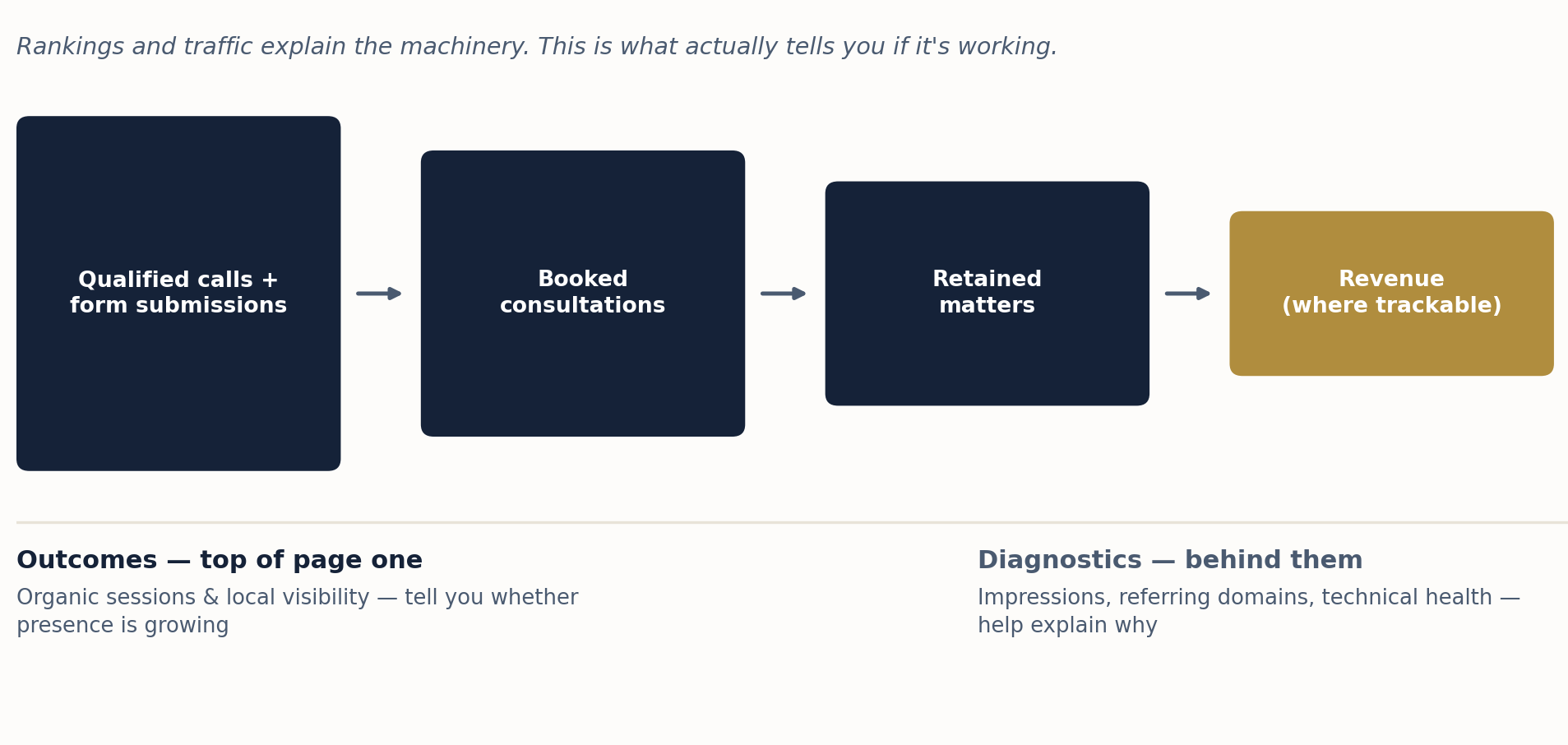
The reporting metrics that matter to a law firm are the ones that reach intake. A monthly report should connect qualified calls and form submissions to booked consultations, then carry those consultations forward to retained matters.
Add estimated revenue where your systems can track it lawfully. Rankings and traffic explain the machinery underneath. They don’t tell you whether the phone rang with someone you can help.
Separate business outcomes from diagnostic metrics
Outcomes go at the top of page one and diagnostics behind them. Organic sessions and local visibility tell you whether your presence is growing; impressions and referring domains help explain why. Technical health tells you what’s blocking the rest.
Require legal CRM integration capabilities
Confirm whether the agency can integrate conversion tracking directly with legal CRMs (e.g., Clio, MyCase, or Salesforce). Passing intake status and signed case data back to tracking systems ensures monthly reports reflect actual revenue, not unverified lead counts.
Require written tracking definitions and direct data access
Demand written conversion definitions before signing. Calls carry unusual weight in legal marketing, and “call conversion” means different things in different tracking systems; a report that counts every ring as a lead is counting spam and job seekers. Your internal intake log and unedited reporting data (not static PDF screenshots) separate an unqualified caller from a booked consultation.
Ask what the report will look like before signing
Request a redacted sample and a live walkthrough with the person who will actually present it. A good analyst explains what changed and why, then tells you which assumption failed and what happens next month. A weak one narrates a line chart.
Set milestone reviews at roughly 90 days, then again at six and twelve months. Don’t accept a ranking timeline in exchange. Pacing depends on site history, the size of the competitive gap, and how fast your team can implement; any agency promising position one by a specific date is selling certainty it doesn’t own.
Put the AI Search Strategy Under Scrutiny
An AI search strategy starts with query-level diagnosis during the sales process, not generic optimizations. Have the agency run a live audit on the call using five target practice area queries.
Evaluate visibility across Google AI Overviews, ChatGPT, and Perplexity, and require them to explain how they intend to turn your firm into a cited source across each platform.
Reject any proposal that renames ordinary SEO tactics without direct engine evidence. This isn’t a niche concern: 28.1% of legal consumers used ChatGPT to research a lawyer in 2025, up from 20.5% the year before.
Verify Bar advertising compliance expertise
Require the agency to state how they review content for state Bar advertising rules. Legal SEO strategies that use automated content generation or aggressive lead-capture language can trigger disciplinary reviews or legal ethics violations if non-compliant.
Require tactics and honest limits
A credible answer starts with unglamorous technical work: crawlable pages and markup that tells a machine who wrote what. Identity signals for each attorney matter as much as the firm’s own.
After that, it gets less settled. Content has to be sourced well enough that a model can quote it without hedging, and third-party citations have to corroborate the same facts. Ask which parts of the plan are established practice and which are experiments.
Then ask how they measure it. Citation tracking is imperfect, and referral data from AI interfaces is incomplete, and an honest agency volunteers both limitations before you raise them. Nobody can guarantee inclusion in an AI Overview. “We optimize for AI” isn’t a strategy until it names specific queries and the person doing the work.
Compare Final Proposals With a Weighted Scorecard
Normalize every proposal against a weighted scorecard before you look at price. Two retainers at $4,000 can include entirely different work and hand implementation to different parties, which makes a straight price comparison the least informative first step. Score the evidence instead.
Weighted agency proposal scorecard
| Evaluation criterion | Weight | Evidence required | Score |
|---|---|---|---|
| Scope and fit for the firm’s matters and market | 15 | Written deliverables, staffing, implementation responsibilities | 1 to 5 |
| Contract flexibility and exit process | 15 | Term, renewal, notice, fees, transition obligations | 1 to 5 |
| Asset and account ownership | 15 | Contract clauses, administrator access, export procedure | 1 to 5 |
| Reporting and outcome attribution | 20 | Sample report, definitions, intake integration, data access | 1 to 5 |
| Relevant experience | 15 | Comparable experience with proof and reference calls | 1 to 5 |
| AI-search readiness | 15 | Live audit, query examples, work plan, measurement method | 1 to 5 |
| Risk and controls | 5 | Evidence and delivery risk | 1 to 5 |
Score evidence rather than presentation quality
Use a five-point scale. A 1 means unsupported or materially risky. A 3 is adequate but incomplete, and a 5 means the claim is documented and confirmed by someone other than the agency. Multiply each rating by its weight, then write a one-line note under every score. After four sales calls, nobody remembers which agency agreed to hand over the Tag Manager container.
Establish minimum thresholds
Set a floor on ownership and reporting before you total anything, and treat contract risk the same way. A persuasive strategy presentation shouldn’t be able to offset a clause that leaves your content behind. There’s no universal passing score, because a firm already running its own WordPress installation with clean analytics carries far less risk than one starting from a vendor-hosted site.
Compare total cost on matching scopes
Add setup fees, monthly retainers, software charges, and production costs across the full initial term to calculate total cost. Keep advertising spend separate from management fees, as blending the two disguises true agency labor hours.
Where two scopes differ, send them back. A revised proposal written against identical requirements is worth more than your own attempt to reconcile the difference in a spreadsheet.
Score the non-answers
Silence is data, and it needs a number. When a finalist skips a question, put it in writing once more with a date attached. A second vague answer scores a 1 on the criterion it belongs to, and it stays a 1 no matter how well the strategy call went.
How Much Does This Actually Cost?
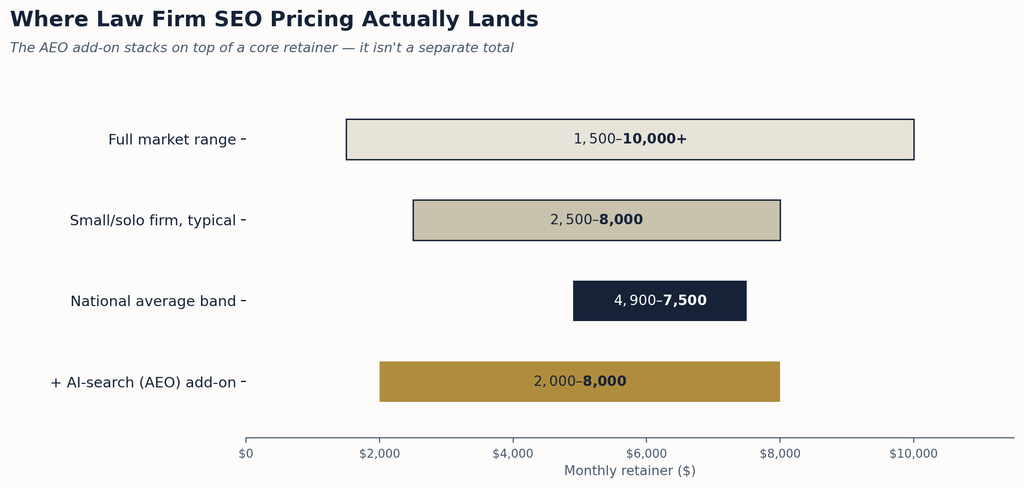
Published 2026 pricing guides converge on a wide but fairly consistent range: most law firm SEO retainers fall between $1,500 and $10,000+ a month, with the tightest clustering for solo and small multi-attorney practices sitting between roughly $2,500 and $8,000 a month.
National averages vary by source and firm-size mix, landing anywhere from about $4,900 to $7,500 a month. If you’re evaluating AI-search (AEO) work specifically, expect it to show up as its own line (often an additional $2,000–$8,000 a month on top of core SEO) rather than folded silently into the base retainer.
None of these numbers mean much without a written scope attached to them. A $3,000-a-month “local SEO and foundations” package (Google Business Profile management, citation cleanup, basic technical hygiene, a handful of properly built practice-area pages) is a real, viable program for a firm competing locally in a non-saturated practice area.
It is not the same purchase as a $3,000-a-month package promising to unseat an established competitor in a high-value metro market, and any agency pricing those two outcomes the same way is overselling one of them. Ask what tier your quote actually buys before you compare it to a number you saw in an industry roundup.
Sign When the File Matches the Pitch
The decision rests on paperwork, not persuasion. Nearly every expensive mistake in this process traces back to a term someone accepted on a call and never found in the agreement.
Finish the scorecard before the next sales call, and write down every unanswered question. Send the agreement to counsel in your jurisdiction before anything gets signed. Authorize the first payment after that, and not before.
Frequently Asked Questions
1. What should I ask an SEO agency before hiring them for my law firm?
Ask for a written scope that names specific deliverables (technical audits, content volume and byline, local-search management, link-building methods, and reporting cadence) rather than accepting “ongoing SEO.” Ask who on staff does the work, what the contract term and exit process look like, who owns your assets if you cancel, and how reporting connects to booked consultations rather than raw traffic. Also ask the agency to run a live AI-search audit using your firm’s actual target queries, since visibility in Google AI Overviews, ChatGPT, and Perplexity now requires separate evidence from traditional rankings.
2. How much does law firm SEO cost in 2026?
Most law firm SEO retainers run between $1,500 and $10,000+ a month, with $2,500–$8,000 the most common range for solo and small multi-attorney practices. National averages across firm sizes land roughly between $4,900 and $7,500 a month, depending on the source. AI-search (AEO) work is often quoted separately, typically adding $2,000–$8,000 a month on top of core SEO. The right number for your firm depends on practice-area competitiveness and market size more than any single benchmark.
3. How long should an SEO contract term be, and what counts as a red flag?
A twelve-month initial term isn’t automatically a problem if real setup work (a migration, an initial content library) justifies the time needed to earn it back, as long as that reasoning is written into the agreement. Red flags include auto-renewal with no visible notice period, guaranteed rankings by a specific date, content or platform ownership left vague or hosted on the agency’s proprietary system, and a proposal designed to expire before you can finish reviewing it.
4. What’s the difference between traditional SEO and AI-search (AEO) readiness?
Traditional SEO targets ranking position and clicks on a search results page. AEO (Answer Engine Optimization) targets being cited or quoted directly inside an AI-generated answer — in Google AI Overviews, ChatGPT, Perplexity, and similar tools — which often produces zero clicks even when it succeeds. The two overlap heavily (crawlable pages, clear authorship, and structured markup help both) but AEO adds specific requirements: content sourced precisely enough to quote without hedging, and third-party citations across directories and review platforms that corroborate what your own site claims.
5. Who should own our website and SEO assets if we switch agencies?
The firm should. At minimum, your law firm should hold the domain registration, hosting account, CMS access, published content and images, Google Business Profile, Search Console, Analytics, advertising accounts, and schema files, with every credential registered in the firm’s name. Before signing, get a written exit exhibit specifying export formats, a transfer deadline, and any transition-assistance fee, so a cancellation doesn’t turn into a full site rebuild.
Further watching