Growth marketers adopted every channel early: paid social before it was crowded, content before every company had a blog, community before it became a job title. AI search is now moving into that same category, but for agencies it has a sharper consequence than traffic alone.
When a founder, CMO, or growth lead asks an AI engine which agencies to consider, the answer can shape the shortlist before anyone reaches Google results, a directory page, or an agency website. That makes AI search a discovery channel, a trust channel, and a positioning test at the same time.
For agencies, the question is not only “Can we get traffic from ChatGPT, Perplexity, Gemini, Copilot, or AI Overviews?” The better question is: when buyers ask those systems who is credible for a specific problem, does your agency appear as a clear, trusted option?
Why AI Search Is a Channel, Not a Curiosity
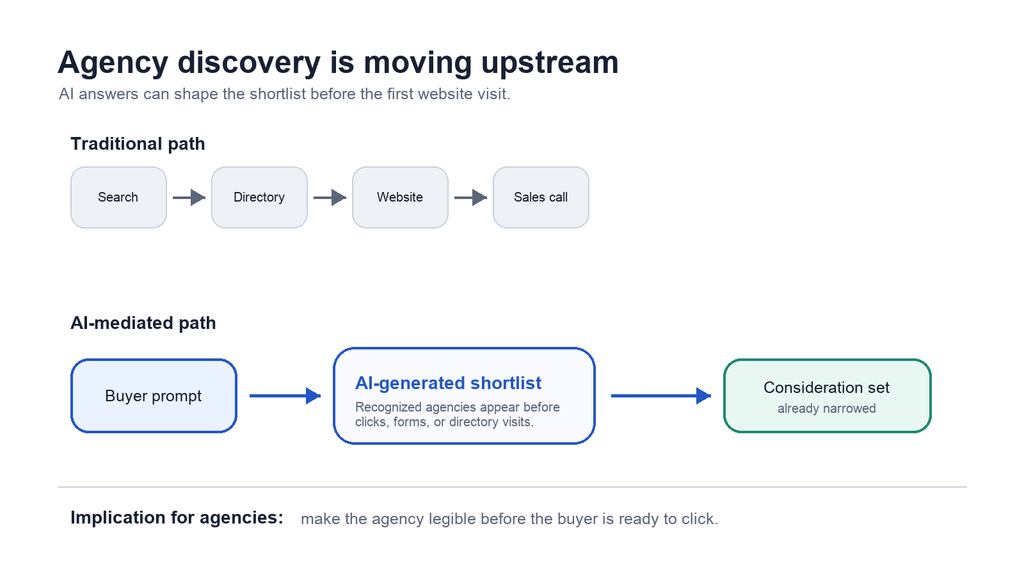
AI search can compress agency discovery into an upstream shortlist before the first website visit
The demand shift is already visible. Pew Research Center found that when Google users encountered an AI summary, they clicked a traditional search result in 8% of visits, compared with 15% of visits without an AI summary. Users clicked a source link inside the AI summary in just 1% of visits.
Bain’s research points in the same direction: about 80% of consumers now rely on zero-click results for at least 40% of their searches, reducing organic web traffic by an estimated 15% to 25%. Ahrefs has also found that Google AI Overviews can materially reduce click-through rates for top-ranking informational results by 58%.
That does not mean SEO is dead. Semrush found that AI traffic grew 66% in 2025, while still making up less than 0.15% of total visits. The signal is more specific: AI search is still small as a direct referral source, but it is becoming important as an upstream influence layer.
For agencies, that matters because buyers often research the market before they are ready to fill out a form. They ask comparison-shaped questions:
- “Which B2B SaaS SEO agencies should we consider?”
- “What agencies have experience reducing CAC for ecommerce brands?”
- “Who is credible for technical SEO after a migration?”
- “What are the best alternatives to hiring an in-house growth marketer?”
If your agency is absent from those answers, you may never see the lost demand. There is no missed form fill, no abandoned demo request, and no clean analytics trail. The buyer simply forms a shortlist without you.
The Agency Discovery Problem AI Search Makes More Urgent
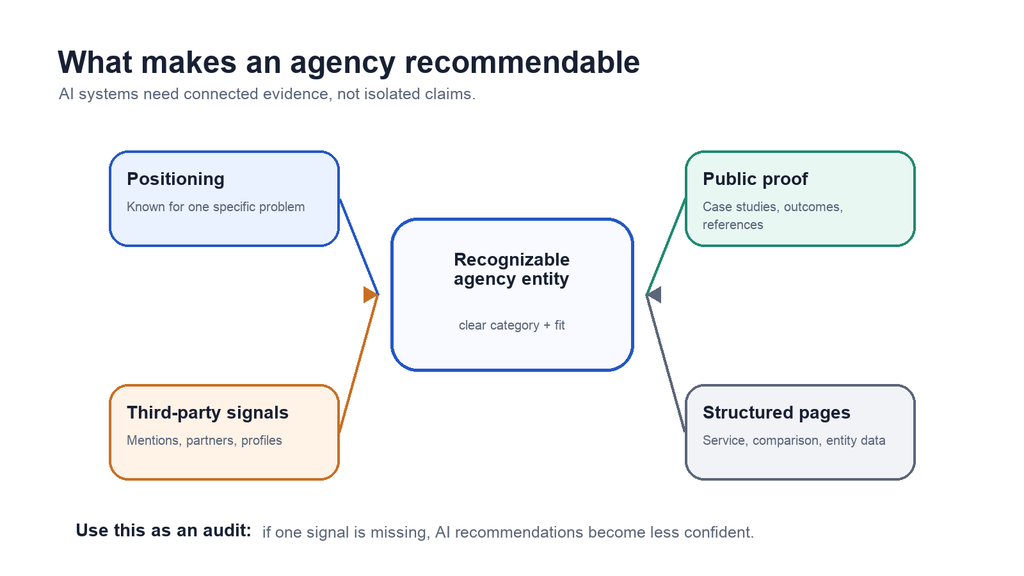
A recommendable agency entity is built from connected public evidence, not isolated claims.
Agency discovery has always had a trust problem. Buyers need to know which agencies are actually relevant, which proof is real, and which recommendations are shaped by paid visibility. Agencies need a fair way to be found for the work they are genuinely suited to win.
AI search does not remove that problem. It compresses it.
Instead of scanning ten agency websites, three directories, two LinkedIn threads, and a few referrals, a buyer may ask one AI engine to summarize the market. The engine then has to decide which entities are legible, which claims are repeated by credible sources, and which agencies can be connected to the buyer’s problem.
That is why agencies should treat AI visibility as a trust infrastructure problem, not a content-volume problem. A generic blog calendar will not make an agency recommendable. Clear positioning, verifiable outcomes, consistent entity signals, and third-party evidence will.
The Framework: Recognize, Produce, Measure, Compound
Four stages. Run them in order.
1. Recognize (be a legible entity)
AI engines name brands they recognize as distinct, credible entities. Before you produce a single new asset, make your brand legible:
One canonical hub page that clearly states who you are and what you are known for.
Consistent name, description, and core facts across your site, profiles, and directories.
Confirmed relationships: your company, your named frameworks, your credentials, the outlets that cite you.
Operators who do this well anchor their identity to a single clear position. Matthew Bertram, for instance, built his identity around named frameworks he created and references consistently, which is exactly what makes an entity easy for an engine to recognize and name. The principle scales down to any brand: stand for one distinct thing, everywhere.
2. Produce for the Questions Buyers Actually Ask
The engines do not all draw from the same source pool, and buyers do not ask them only generic category questions. A SaaS founder asking for “best B2B SaaS SEO agencies” is not looking for the same evidence as a marketing leader asking how to choose between paid search agencies after CAC has climbed.
That means the production plan should start with buyer questions, then map assets to the places AI systems can use them.
For agencies, the highest-value assets are usually:
A canonical positioning page that states category, niche, ICP, services, proof, geography if relevant, and the types of clients the agency is not built for.
Service pages that connect a specific buyer problem to a specific agency capability.
Case studies with named context, constraints, actions, and measurable outcomes.
Comparison and alternative pages that help buyers understand tradeoffs without pretending every agency is interchangeable.
Founder or operator POV content that explains how the agency thinks, not only what it sells.
Third-party mentions, interviews, podcasts, directories, communities, and partner pages that confirm the agency exists outside its own website.
This is where many agencies accidentally weaken themselves. They publish broad educational content, but their strongest proof sits in sales decks, private proposals, or vague case studies with the numbers removed. AI systems need public, crawlable, consistent evidence. Buyers do too.
The production question is not “How do we write more?” It is “What evidence would make an agency safe to recommend for this buyer’s problem?”
3. Measure Visibility Before Traffic
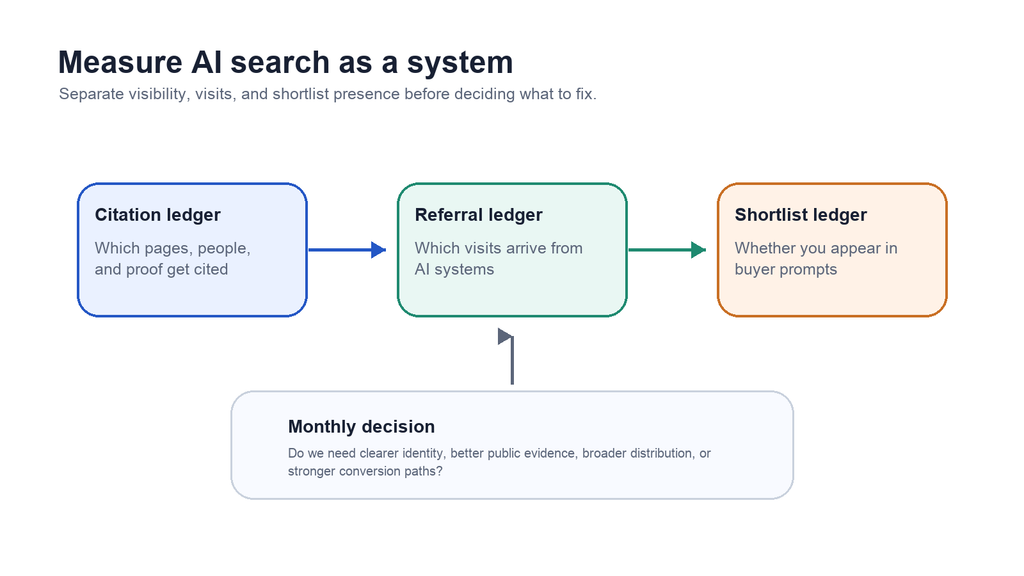
AI search measurement needs separate ledgers for citations, referrals, and shortlist presence.
The trap is measuring AI search as one number. The pages that get cited in AI answers and the pages that get clicks are often different. Discovery and evaluation content may earn the citation; the homepage, pricing page, or contact page may get the later branded visit.
Track three ledgers separately:
| Ledger | What it tracks | Why it matters |
| Citation ledger | Which URLs, people, case studies, or pages get named across AI engines | Shows whether your agency is being used as evidence |
| Referral ledger | Which URLs receive traffic from AI systems and AI-assisted search | Shows whether citations or recommendations turn into site visits |
| Shortlist ledger | Whether the agency appears for buyer prompts such as “best agency for X” or “alternatives to Y” | Shows whether you are present in the consideration set |
Run a monthly prompt sweep across the engines your buyers are most likely to use. Use prompts that match real buying moments, not vanity prompts about your brand name.
Examples:
- “Which agencies should a Series A SaaS company consider for demand generation?”
- “What are credible ecommerce CRO agencies with measurable case studies?”
- “Who are alternatives to [known competitor] for technical SEO?”
- “What should I look for when hiring a B2B content agency?”
Record whether your agency appears, which competitors appear, what sources are cited, and what evidence the engine uses. If you blend citations, referrals, and shortlist presence into one metric, you cannot tell whether the problem is recognition, evidence, content format, or conversion.
4. Compound Trust Signals
AI visibility compounds because recognition compounds. Every credible mention, consistent entity signal, cited case study, and clear relationship gives the next system more material to work with.
For agencies, compounding should not mean trying to flood the web with shallow mentions. It should mean reinforcing the same credible position everywhere buyers and AI systems look:
The same category and ICP language on the website, LinkedIn, directories, partner pages, and founder profiles.
Case studies that name the business problem and the measurable result.
Service pages that explain who the offer is for and when it is not a fit.
Thought leadership that shows how the agency makes decisions.
Reviews and references that support the same claims the agency makes about itself.
This is also where paid visibility can create a long-term trust problem. If a buyer cannot tell whether an agency was recommended because it is relevant or because it bought placement, the recommendation loses value. AI search will not automatically solve that incentive problem. The brands that benefit will be the ones with proof that survives outside a sponsored slot.
What Agencies Should Run This Quarter
You do not need a moonshot. Run one clean loop.
Audit your entity signals.
Search your agency name, founder name, key services, and niche terms. Check whether descriptions are consistent across your website, LinkedIn, directories, partner pages, podcast bios, and author profiles.
Build or rewrite the canonical hub.
Create one page that makes the agency easy to understand: who you serve, what you do, what you are known for, what proof supports it, and where a buyer should go next.
Test buyer prompts.
Run 15 to 20 prompts across ChatGPT, Perplexity, Gemini, Copilot, and Google AI Overviews. Focus on questions a buyer would ask before building a shortlist.
Turn private proof into public evidence.
Rewrite three case studies so they include the client context, problem, constraints, work performed, and measurable outcome. If client names cannot be used, be specific about the category and situation.
Map content to engines and surfaces.
If buyers use Perplexity, recent cited sources and expert quotes matter. If buyers use Google AI Overviews, structured pages and search visibility still matter. If buyers use LinkedIn and Copilot, founder/operator presence matters. Pick the two surfaces most relevant to your market first.
Review the ledger monthly.
Do not expect clean attribution immediately. Look for changes in citation presence, branded search, direct traffic, AI referrals, and sales calls where buyers mention they saw the agency in an AI answer.
The GrowthFolks View
AI search is not just another optimization surface. It is a preview of how agency discovery is changing.
Buyers want fewer distorted signals and better ways to understand fit. Agencies want to be discovered for the work they can actually win, not buried below whoever pays for more visibility. AI engines are now sitting in the middle of that discovery process, summarizing the market before the buyer has clicked through to anyone’s site.
That makes the next phase of agency marketing less about chasing every new traffic source and more about becoming recommendable: clear position, verified outcomes, consistent identity, and proof that travels.
The agencies that start now will not only earn more AI visibility. They will build the trust infrastructure buyers already need.
Sources
Bain & Company, “Goodbye Clicks, Hello AI: Zero-Click Search Redefines Marketing”
Ahrefs, “Update: AI Overviews Reduce Clicks by 58%”
Semrush, “We analyzed billions of web visits: How AI is reshaping traffic channels”