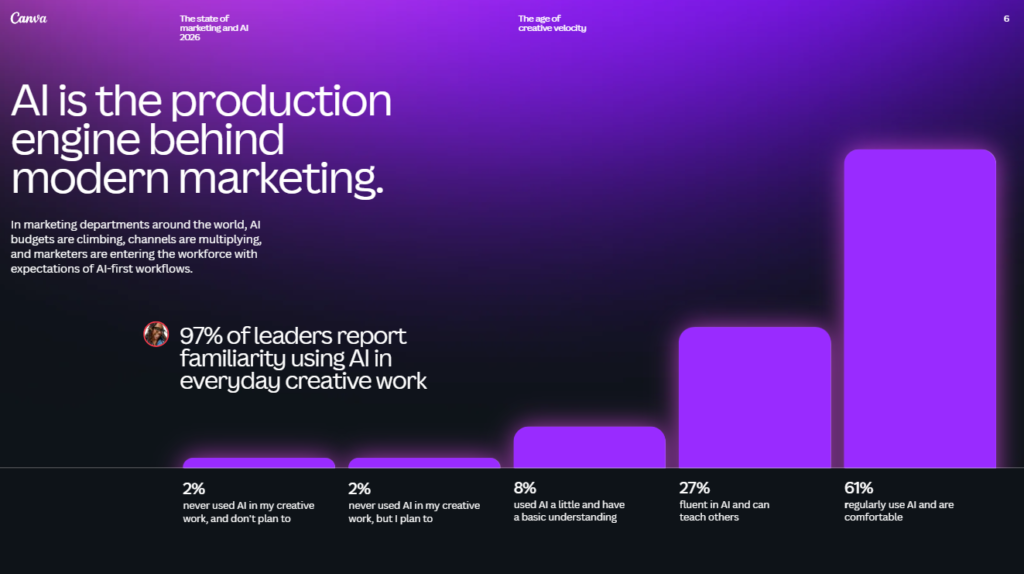
Canva’s 2026 State of Marketing and AI report found that 97% of marketing leaders now use AI in their daily creative work, including content creation. So the hard part of AI content is no longer production. You can draft a blog post in seconds or pull up new designs with a click.
Canva
The hard part is getting your readers to believe what you published is worth their time and their trust.
While AI can whip up thousands of sentences faster than any human could, without proper oversight, its output might contain hallucinated facts and incorrectly sourced claims. Moreover, AI content often sounds too refined, monotonous, or robotic.
That explains why 78% of consumers, in the same Canva report, say they would rather see content made by people, even if AI could produce something better.
To avoid getting your content sidelined without sacrificing AI use for faster workflow, you need to make it sound credible and human.
In this article, we’ll share a 7-pillar framework to achieve that.
What Credible AI Content Actually Means in 2026
Credible content is content a reader trusts enough to act on. It answers their question, is accurate, and conveys a clear sense that a person stood behind it.
Notice that the definition says nothing about how the content was produced. That is deliberate, and it matches how Google treats the question.
Google’s own guidance on people-first content is clear that AI-assisted content is fine. What its systems reward is helpfulness, expertise, and trust, and what they penalize is content mass-produced to game rankings rather than help anyone.
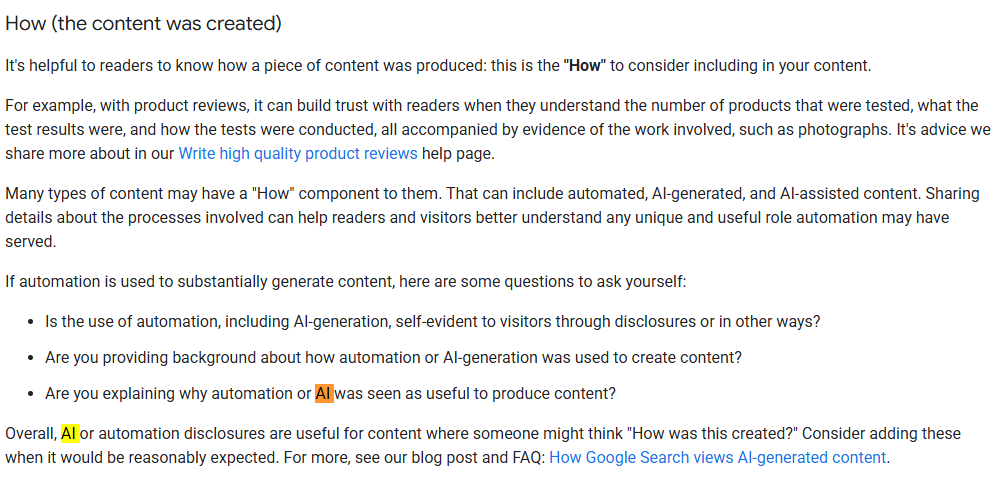
So the line is about content built with care versus content dumped onto a page, regardless of how it was created.
The 7 Pillars of Credible and Human AI Content
Each pillar below handles one part of the trust problem, and they are designed to work together as a single workflow.
1. Understand Your Real Audience
Good AI content starts the same way good human content does, with the people you are writing for.
Go Beyond Demographics
Most audience research stops at age, job title, and industry. That tells you who your reader is on paper, but it won’t tell you what they actually need.
Dig into the things that change what you write:
- The job your reader is trying to get done when they land on your page
- The doubts and objections that make them hesitate before they buy
- The questions they ask in their own words, pulled from on-site search logs, support tickets, sales calls, and social comments
You can find these insights in each department’s workflow engine. For instance, a support ticket shows you the exact phrasing of a problem, while a sales call recording shows you the objection that keeps coming up.
Repeated product fixes can highlight the point of consumer pain, which otherwise may be missed by solution-focused articles you create. These behavioral data enable credible content and, in turn, contribute to smoother B2B lead generation and qualification.
Feed That Context into Your AI System
Once you have the insight, turn it into instructions your AI tools can use.
Give it audience personas written from behavior rather than demographics, and specify which phrases your audience uses and which ones to avoid.
Hand the tool objections to address and the examples that land. AI does well with clustering and summarizing here, too, grouping hundreds of support questions into clear themes you can write toward.
The more genuine the audience context you feed your system, the less generic the output.
2. Engineer an Authentic Writing Voice
The default voice of most AI tools is fluent, refined, and forgettable. About 70% of consumers describe it as lacking a soul.
Credible content needs a voice with a little more personality than that.
Program Conversational Moves Into Your Prompts
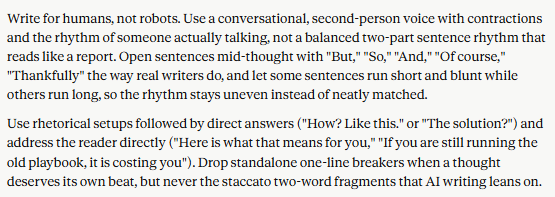
Tell your AI model to vary its sentence length and use plain, everyday verbs instead of corporate ones. Have it open some sentences with “but” or “so,” the way people actually talk.
Inform them to prefer a clear sentence over a clever one. See an example attached below:
Written by Author
Each instruction pulls the output a little further from robotic and a little closer to human.
For broader coverage and so you don’t repeat the rules every time, add all these tone and style instructions to the reference settings of whichever AI tool you’re using.
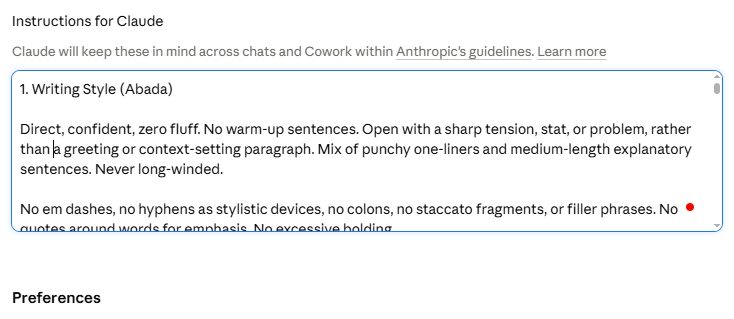
Claude
If you use the same tool for different content formats or brands, you can create multiple tone and style rules and add them all to the reference box under settings.
Teach Rhythm With Reference Samples
The fastest way to fix AI tone is to show the model what you want rather than describe it.
Before the model writes anything, give it two or three short paragraphs in the exact voice you want. It will pick up the cadence, the sentence length, and the level of formality far better than any adjective you could write into a prompt.
You can be more discreet by providing full blog samples or marketing copies that your human team worked on before. The more, the better.
Then ask the tool to extract what it has learned from those blogs so you can figure out whether the model is focusing on the right things.
3. Build Ethics and Transparency Into the Workflow
Credibility is not only about how your words read. It is also whether readers feel you have been straight with them.
Disclose AI Involvement Clearly
You do not need a banner at the top of every article announcing that a robot helped.
But where a reader might reasonably wonder how something was made, a short, honest note about your process and who reviewed it works.
The Canva research found that when consumers were asked what would make them more comfortable with AI in content, 52% pointed directly to disclosure of AI use.
Google’s guidance echoes the same idea, suggesting AI disclosures for content where someone might reasonably ask how it was created.
Global regulation is also moving in the same direction, with frameworks such as the FTC’s guidance on AI claims and the EU AI Act both pushing toward greater transparency.
Set Guardrails For Accuracy And Privacy
Disclosure handles honesty about the process. You also need guardrails for the content itself.
- Be careful about the data you feed your models, especially anything covering customers or proprietary information
- Keep every factual claim tied to a real, checkable source. Watch for bias, particularly on sensitive topics
- And when you get something wrong, correct it quickly and openly rather than hoping nobody noticed
Privacy stakes are higher in regulated industries, such as legal and finance. Take a finance firm that stores client contracts in a contract management software like ContractSafe. The temptation is to hand the AI direct access so it can pull figures, clauses, and client names into a case study or thought-leadership post.
Don’t. Pull the data manually, strip out anything client-identifiable, and feed the AI a sanitized version with the numbers and patterns intact but the identities gone.
4. Keep Humans in the Loop
AI can handle the heavy lifting of content production, but it cannot make judgments. That still belongs to you.
Know Where Human Judgment Beats Automation
Not every part of a piece needs the same level of human attention. Here’s how to know which sections demand it:
- Does it carry a fact a reader could act on, like a stat, a price, a date, or a claim about regulation? That needs a human check
- Does it make a judgment call about what the reader should do? Human. Does it carry brand voice, opinion, or a sensitive topic where tone matters? Human
- Is it formatting, summarizing what was already written, or generating variations of something a person already approved? AI is fine on its own
None of that happens if you solely rely on a generic AI grammar check.
Use The Relay Model
The most reliable way to keep humans in the loop is to think of your content workflow as a relay rather than a handoff.
- AI runs the first leg, producing a draft, variations, and a starting structure
- A human runs the critical middle leg, refining the argument, fixing the tone, checking every fact, and adding the insight only a person has
- Then AI can run the last leg again, helping with formatting, summaries, and repurposing the piece for other channels
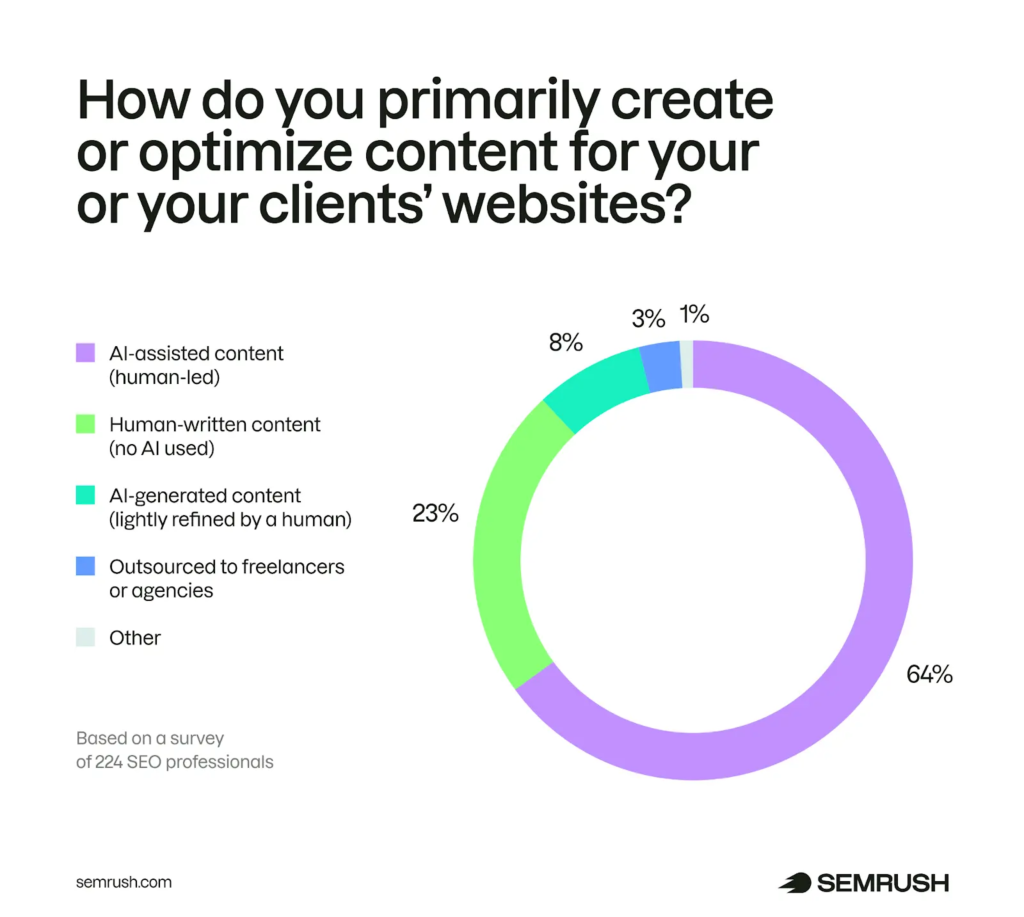
64% of SEO professionals now use this hybrid approach. So, integrate it into your content workflow as well.
5. Choose Tools That Fit Your Voice
The feature count of each tool matters, but how much each tool fits your brand voice and needs matters more.
Match The Stack To Your Goals
You might use a large language model like GPT for drafting, a research assistant like Perplexity to gather sources, an SEO tool to identify coverage gaps, and a separate layer, such as Claude, to keep the voice consistent.
There is no single correct stack. There is only the stack that serves the content you are trying to create.
Start from your authenticity goals and work backward. Do you need deep customization for a distinct brand voice? Strong multilingual output? Tight control over data and privacy? Clean integration with your CMS?
Let those answers pick your tools, rather than letting a feature list pick them for you.
- In terms of voice adoption, Claude does a great job
- But if you need something more tightly guarded when it comes to data privacy, ChatGPT might be the go-to LLM
Some ready-made content tools, such as SurferSEO, provide all-in-one services, including SEO research, drafting, and optimization. If you need a single solution, then that’s a good place to start.
Ask Vendors The Right Questions
Before you commit, get specific with any vendor.
Ask how their model can be steered toward a particular voice. Ask what they disclose about training data and how the tool handles corrections and factual accuracy.
Some of this information is available on their data disclosure page so that you can check it out. Or contact support for more specific queries.
Then run a real test using your own prompts and style guide rather than their polished demo. You will learn fast which tools bend to your needs and which ones force you into theirs.
6. Build Feedback Loops That Improve Output
Feedback loops help you refine your system to produce better output.
Collect Reader Signals And Test
Collect comments and the questions that come back to your support and sales teams.
Run quick A/B tests on the parts that carry the most weight, like headlines, intros, and calls to action. Watch where readers stop scrolling, and treat that drop-off point as a note for the next draft.
For instance, let’s say you sell custom t-shirts. You can test two completely different product-page descriptions, with different levels of AI involvement and rules. Then let the conversion data settle, which voice its buyers respond to.
Refresh Content And Retune Prompts
Set a schedule to revisit your high-performing evergreen posts to keep them accurate and current.
On the system side, retune your prompts and templates as you learn about new audience segments, seasonal changes, or product updates.
Retire the patterns that have stopped performing. A prompt that worked six months ago is not guaranteed to work today.
7. Measure Credibility Beyond Clicks
Clicks and likes only reflect attention. You need to track metrics that instead depict trust.
- Watch how many readers finish what they start, using Scroll Depth and Completion Rate on long pieces
- Watch whether they come back with the Return Visitor Rate
- Track sentiment from short on-page polls or surveys
- Pay attention to time-to-value, meaning how quickly a reader reaches the insight they came for
Other indicators, such as correction velocity and subscriber health, help you figure out your content’s credibility score.
- Correction velocity is how fast you fix a factual error once someone flags it, and a quick, visible fix protects trust rather than eroding it
- Subscriber health, like the unsubscribe rate after an AI-assisted send, tells you whether your audience still wants what you are producing
Use all of these signals the same way. Feed them back into your prompts, your editorial standards, and your topic choices.
FAQs
Does Google Penalize AI-Generated Content?
No. Google evaluates content on quality and helpfulness, not on whether a human or an AI produced it. What its systems penalize is mass-produced, low-value content created to manipulate rankings, and that applies to human-written content too.
Should I Disclose That I Used AI to Create Content?
In most cases, a light touch is enough. A short note about your process and who reviewed the piece works well, especially where a reader might reasonably wonder how it was made. Disclosure is also something audiences actively ask for, so it tends to build trust rather than cost it.
Can AI-Assisted Content Rank Well In Search?
Yes, when it is genuinely helpful, accurate, and shows real expertise. AI-assisted content with strong human editing and oversight performs in line with human-written content. On the other hand, drafts published without human input and with no added value fail.
How do I keep AI content from sounding generic?
Give the model real audience context and reference samples in your target voice. Instruct it to vary sentence length and use plain language. Most importantly, have a human edit the draft for tone, nuance, and specific examples that a model cannot invent.
Is It Okay To Use AI In Regulated Industries Like Finance, Healthcare, Or Legal?
Yes, with stricter guardrails. The risk is publishing a confident-sounding sentence that turns out to be wrong about a regulation, a dosage, or a figure. Route every factual claim through a subject-matter expert, and never connect sensitive client data directly to an AI tool.
How Often Should I Update My AI Prompts And Templates?
Review them at a minimum every quarter and whenever your audience, product, or positioning changes. If a piece of content has started underperforming, the prompt is usually the first thing to retune.
Wrapping Up
Credible AI content has nothing to do with hiding that you used AI. It is about building a process where AI speed and human judgment work together rather than in silo.
Start with audience understanding. You need to know who you’re writing for and their preferences before AI writes a line. Then condition your system to understand these preferences by feeding it your insights.
Tune the AI’s output by providing past, credible samples, including ones that properly demonstrate your brand voice nd style. Afterward, set data guardrails to keep consumer data safe and build a continuous feedback loop to maintain quality.