The development of text-to-video AI systems has reshaped digital content production by allowing written prompts to be converted into fully rendered video sequences. These platforms reduce reliance on traditional filming and editing pipelines, enabling creators to generate visual narratives through simple text descriptions. As the technology matures, different tools have emerged with distinct strengths in realism, speed, cinematic quality, and workflow integration.
This article reviews five notable text-to-video AI platforms currently used across creative industries. Each tool is evaluated based on its core capabilities, generation style, and practical use cases for content creation.
Pollo AI
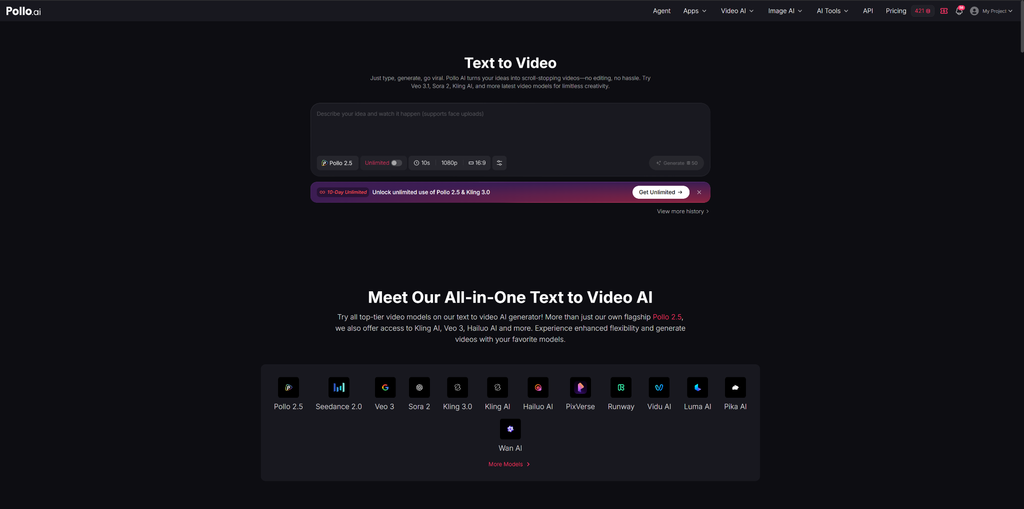
Pollo AI is positioned as an all-in-one platform for text to video AI that integrates multiple leading video models into a single unified system. Rather than relying on a single proprietary engine, it provides access to a wide ecosystem of supported models such as Pollo 2.5, Kling 3.0, Veo 3, Sora 2, Runway, Luma AI, and Pika AI. This multi-model structure allows users to generate videos from text prompts, images, or references while selecting different rendering styles depending on creative needs.
Beyond basic generation, Pollo AI extends its capabilities through a broad ecosystem of AI video applications. These include workflows for Ad Video, UGC Video Ads, Product Video, Clone Viral Video, Social Media content, Anime Video, Explainer Video, Story Video, News Video, and even Music Video generation. The platform also supports tools like Image to Video AI, Reference to Video, Video to Video AI, and AI Video Editor. This makes it a structured creative environment rather than a single-purpose generator, designed for scalable production across marketing, filmmaking, and social content.
Why Choose Pollo AI in Text to Video AI Workflows
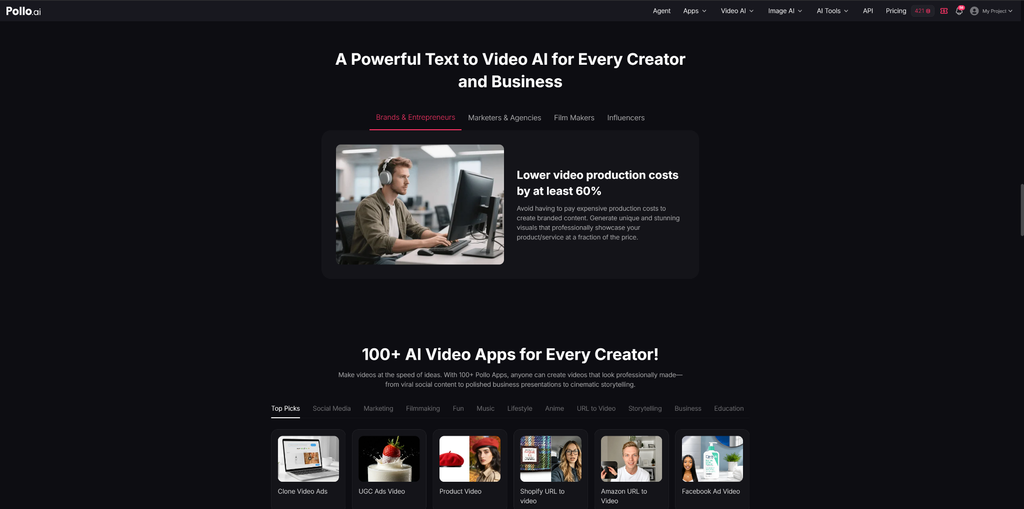
Pollo AI is often selected for its workflow flexibility and multi-use case coverage within the text-to-video AI landscape. It allows creators, marketers, and businesses to switch between models without leaving a single platform, which can improve production efficiency. Its support for applications such as Facebook Ad Video, Faceless Video, and Narrative Music Video makes it particularly relevant for users working across different content formats.
The main advantage lies in its integrated ecosystem of over 100 AI video tools — including the GoEnhance AI video generator for upgrading visual quality and refining generated footage — which supports bulk content generation and rapid iteration. It is also commonly used in marketing pipelines where consistency and scalability matter more than single-model precision. For teams producing frequent visual content, this centralized approach reduces operational friction and simplifies experimentation across multiple styles.
My tip: The wide model selection can be overwhelming, so consistent prompt structure is important to avoid unpredictable output variations.
Runway Gen-3
Runway Gen-3 is a widely recognized text to video AI system focused on high-fidelity motion generation and cinematic scene construction. It interprets natural language prompts and converts them into visually coherent video sequences with strong attention to lighting, object movement, and temporal consistency. The platform is often used in professional creative environments where visual quality and narrative coherence are essential.
In addition to generation, Runway includes advanced editing features that allow users to extend scenes, modify motion behavior, and refine outputs through iterative prompting. This positions it not only as a generator but also as a post-production enhancement tool within AI-assisted workflows. Its output style is generally aligned with film-like aesthetics, making it suitable for storytelling, advertising, and concept visualization.
Why Choose Runway Gen-3 in Text to Video AI Workflows
Runway Gen-3 is often preferred for its ability to produce stable and cinematic outputs within the text to video AI category. It excels in maintaining spatial consistency and realistic motion, which is critical for narrative-driven projects. Users working in film pre-visualization or commercial advertising benefit from its controlled generation structure.
Another advantage is its iterative refinement system, which allows creators to gradually adjust scenes without restarting the entire generation process. This makes it effective for professional workflows where precision matters more than speed. It is especially useful in environments that require polished, production-ready visuals.
My tip: It may require more detailed prompting than simpler tools, especially for achieving specific visual styles.
Kling AI 3.0
Kling AI 3.0 is a text to video AI platform known for its emphasis on realistic motion physics and environmental consistency. It is designed to interpret prompts with strong awareness of object interaction, spatial depth, and physical plausibility. This makes it particularly effective for scenes involving dynamic movement or multi-object interaction.
The system supports extended video generation, allowing for longer sequences that maintain continuity across frames. This makes it suitable for storytelling applications where sustained motion is required. Kling AI 3.0 is often used in simulation-style visuals, product demonstrations, and narrative sequences where realism is a priority.
Why Choose Kling AI 3.0 in Text to Video AI Workflows
Kling AI 3.0 stands out in the text to video AI space due to its focus on physics consistency and motion stability. It reduces common generative artifacts, especially in fast-moving scenes or complex environments. This makes it reliable for users who prioritize realism over stylization.
It is particularly effective for use cases involving natural environments, human motion, or structured product visualization. Its longer generation capacity also supports more continuous storytelling compared to shorter clip-focused tools.
My tip: It may trade off some stylistic flexibility in exchange for stronger realism and stability.
Pika 2.0
Pika 2.0 is a text to video AI tool designed for rapid generation and creative iteration. It converts prompts into short video clips quickly, making it suitable for social media content, ideation, and experimental storytelling. Its interface prioritizes simplicity, allowing users to generate outputs without complex configuration.
The platform supports both realistic and stylized outputs, enabling users to explore different visual directions from the same prompt. It is commonly used during early-stage creative development, where speed and flexibility are more important than final production quality. This makes it a practical tool for brainstorming and short-form content creation.
Why Choose Pika 2.0 in Text to Video AI Workflows
Pika 2.0 is valued in the text to video AI ecosystem for its speed and accessibility. It enables rapid testing of visual ideas, making it useful for creators who need multiple variations in a short time. Its lightweight workflow supports fast iteration cycles.
It is also effective for social media environments where short, engaging clips are required. The ability to quickly generate multiple versions of a concept makes it useful for content experimentation and audience testing.
My tip: Output quality can vary depending on prompt clarity, so concise descriptions tend to perform better.
Luma Dream Machine
Luma Dream Machine is a text to video AI platform focused on producing cinematic and visually expressive video outputs. It interprets prompts with an emphasis on composition, lighting, and atmospheric detail, aiming to generate scenes that resemble film sequences rather than simple animations.
The system is designed to maintain smooth motion and coherent scene transitions, making it suitable for narrative-driven content. It is often used for conceptual storytelling, artistic visualization, and mood-based video creation where emotional tone is important.
Why Choose Luma Dream Machine in Text to Video AI Workflows
Luma Dream Machine is often selected for its cinematic output style within the text to video AI category. It produces visually rich scenes that emphasize mood and atmosphere, making it suitable for creative and artistic applications. Its strength lies in transforming abstract prompts into visually structured sequences.
It is particularly effective for creators working on conceptual visuals, storyboarding, or experimental film ideas. The platform prioritizes aesthetic coherence, which can enhance storytelling depth even in short clips.
My tip: It may not always prioritize strict prompt accuracy, especially when dealing with highly detailed scene instructions.
Conclusion
The text to video AI ecosystem continues to evolve rapidly, offering a range of tools optimized for different creative needs. Pollo AI focuses on multi-model flexibility and workflow integration, Runway Gen-3 emphasizes cinematic precision, Kling AI 3.0 prioritizes physics realism, Pika 2.0 enables fast iteration, and Luma Dream Machine leans toward expressive storytelling.
As these platforms mature, they are increasingly integrated into professional content pipelines across marketing, media production, and digital storytelling. The choice of tool depends largely on whether the priority is speed, realism, creative flexibility, or cinematic quality.