
Choosing a startup name used to be treated like a branding exercise. Today, it is also a search visibility decision.
Your name affects how easily people remember you, how confidently they search for you, whether your homepage wins branded clicks, and how much confusion you create in Google before your company even gets traction.
That matters because Google still dominates search, holding about 90.04% of the worldwide search engine market in April 2026.
Industry search data also shows that a massive portion of Google activity now comes from branded intent, with Ahrefs estimating that 45.7% of searches are branded by volume, meaning users increasingly type exact companies, tools, and products they already recognize instead of browsing vague generic terms.
In plain English: a huge share of searches already involve people looking for a specific brand, product, or trusted tool such as a business name generator, not just a broad category.
That is why a smart startup naming strategy for SEO is not about stuffing a keyword into your company name and hoping Google rewards you.
In fact, Google explicitly says that keywords in a domain name or URL path have hardly any ranking effect on their own beyond how they appear in breadcrumbs.
So the real goal is not “exact-match keyword ranking from the name itself.” The real goal is to create a name that is searchable, memorable, ownable, and scalable.
This guide will show you exactly how to name a startup for SEO, how to develop startup name ideas for SEO without sounding generic, what makes an SEO-friendly business name, and how to turn your chosen name into a long-term organic growth asset.
Why Your Startup Name Matters for SEO
A startup name influences SEO in two very different ways.
First, it shapes brand demand. If your name is easy to remember, easy to spell, and distinct enough to own in search results, more people will search for you directly.
That matters because branded search is not a side issue anymore. Nearly half of Google searches are branded by volume, which means name recognition can directly translate into search behavior.
Ahrefs also notes that brand signals such as branded search volume, web mentions, and anchor text correlate with visibility in both traditional search and AI Overviews.
Second, your name affects search clarity. A vague or overloaded name can bury you under unrelated results.
A name that is too generic may make it harder for your homepage, social profiles, reviews, and PR mentions to dominate the first page.
And that first page matters: Backlinko’s analysis of roughly 4 million Google results found that the #1 organic result gets 27.6% of all clicks, while only 0.63% of searchers click something on page two. If your own brand name search does not clearly point to you, you are making growth harder than it needs to be.
This is why the best startup names are not just “creative.” They reduce friction. Stripe recommends thinking about how your name performs in search results and whether unrelated results will outrank your brand. SparkToro makes a similar point from a marketing angle: a strong name should be easy to say, hear, spell, and remember.
What Google Actually Cares About
A lot of founders still assume that putting a high-value keyword in the company name is a shortcut. It is not.
Google’s own documentation says you should choose the name that is best for your business, and that domain-name keywords alone have very limited ranking impact.
Google also warns against keyword stuffing and other manipulative tactics intended to game rankings. So an SEO-friendly business name is not one that sounds like a keyword pileup. It is one that helps users find, understand, trust, and remember you.
That distinction changes the entire naming process.
What Makes an SEO-Friendly Business Name?
An SEO-friendly business name usually scores well on five traits.
1. It Is Distinct Enough to Own
If your startup is called something like “Growth Labs,” “Data Solutions,” or “Cloud Systems,” you may sound professional, but you are also creating a search problem.
Generic names compete with thousands of unrelated businesses, articles, directories, and social profiles. Stripe specifically advises evaluating whether unrelated results will outperform your brand name in search.
Distinct names do not need to be bizarre. They just need to be identifiable.
“Notion,” “Zapier,” and “Canva” are easy to search because they are memorable and not overloaded with unrelated meanings. A name should be brandable before it is clever.
2. It Is Easy to Spell, Say, and Type
This is a hidden SEO factor because it affects whether people can successfully search for you after hearing about you in a podcast, at an event, or in a Slack conversation.
SparkToro’s practical test is excellent: show the word to one group and ask them to say it, then say it to another group and ask them to spell it.
If around 90%+ of people get it right, you are in a much safer zone. Names that fail the “heard it once” test often lose branded search demand before they ever build it.
3. It Hints at a Category Without Locking You In
A strong startup naming strategy for SEO often uses category relevance, not exact-match keyword stuffing.
For instance, a fintech startup might use words that suggest trust, speed, or clarity. An AI workflow startup might use words that suggest automation, orchestration, or intelligence.
This gives users context without sounding like “Best AI Automation Software Company.” This is the balance that founders miss: your name can be relevant without being too strict.
4. It Leaves Room for Expansion
GoDaddy warns against choosing names that limit future growth. That also matters for SEO. If your name is too narrow, you may have to go through painful rebranding later on, especially if you add more products, locations, or user groups.
Rebranding is not impossible, but it makes things more complicated when it comes to redirects, brand mentions, link equity, and search recognition.
5. It Can Be Supported by a Strong Search Footprint
Your name is just the beginning. To become SEO-friendly in practice, it must also work with:
- a clean domain
- strong homepage messaging
- descriptive title tags
- branded PR mentions
- consistent social handles
- relevant internal links
- supporting pages that explain what you do
Google’s documentation on internal links and anchor text reinforces this point: descriptive, natural, contextual links help users and Google understand your site more easily.
How to Name a Startup for SEO: An 8-Step Framework
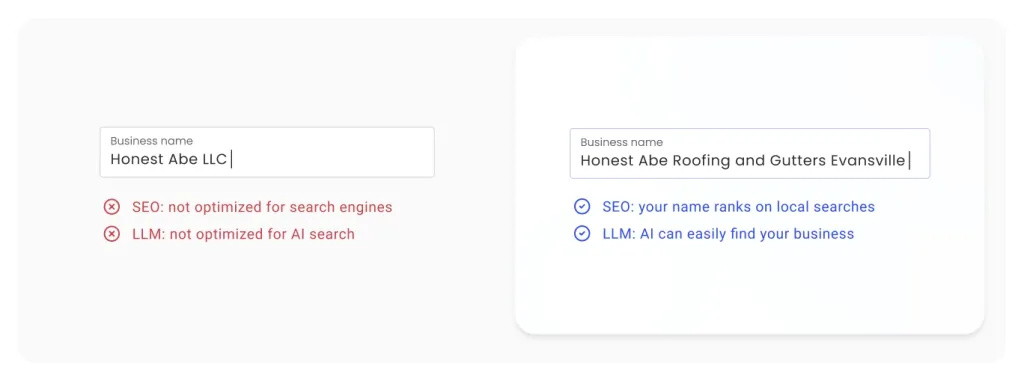
Here is a practical framework founders can use before buying a domain, filing paperwork, or designing a logo.
Step 1: Start With Search Intent, Not Wordplay
Before you brainstorm names, define the search intent around your business.
Ask:
- What does the customer think they need?
- What words do they already use?
- What problem are they trying to solve?
- What adjacent categories might they compare us with?
If you are building a budgeting app for freelancers, your audience may search terms like “invoice tracker,” “freelance expenses,” “cash flow app,” or “tax organizer for freelancers.”
Those phrases should inform your naming direction, even if none of them appear in the final name.
Step 2: Build a Keyword Bank Around Meaning, Not Just Volume
Use keyword tools, Google autocomplete, competitor titles, community language, and sales call notes to create a word bank. Then sort terms into four buckets:
- category terms
- outcome terms
- emotion/trust terms
- metaphor or movement terms
For example, a B2B workflow startup might collect:
workflow, sync, ops, flow, pulse, chain, bridge, stack, pilot, relay, orbit, merge, sprint, signal.
This gives you a better raw material pool than forcing exact phrases like “workflow automation platform” into the brand name.
Step 3: Choose a Naming Pattern
Most strong startup name ideas for SEO come from one of four patterns.
Descriptive
These names clearly signal what you do. They are easier to understand but often harder to own.
Examples: Payroll Pilot, Tax Relay, Invoice Orbit
Suggestive
These hint at the result or feeling without literally describing the product.
Examples: ClearPath, SignalForge, Northbeam
Compound/Hybrid
These combine a relevant word with a brandable element.
Examples: Flowmint, Hirecraft, Ledgerlane
Invented but Pronounceable
These can become highly ownable if they are easy to say and remember.
Examples: Tavro, Nureli, Velto
For most early-stage startups, the sweet spot is often the hybrid category: clear enough to understand, unique enough to rank.
Step 4: Run a SERP Competition Test
Now Google every serious name candidate and look at the first page.
You are checking for:
- existing companies with the same or similar names
- unrelated dominant meanings
- directory clutter
- trademarked products
- confusing acronyms
- famous brands in other categories
- social profile conflicts
This is one of the most overlooked parts of how to name a startup for SEO. A name may sound brilliant in a brainstorm and still be unusable in search.
If a candidate already produces pages of unrelated results, heavy brand competition, or confusion with a celebrity, movie, or common phrase, move on.
Step 5: Test Speech-to-Search and Spelling
Search does not only start on a keyboard anymore. People hear names in YouTube videos, podcasts, webinars, and conversations.
That means your name needs to survive:
- hearing it once
- spelling it from memory
- typing it on mobile
- understanding it without explanation
SparkToro’s “say it / spell it” test is still one of the best low-cost filters here. If a name regularly needs correction, it will create branded search leakage.
Step 6: Check Domain, Trademark, and Handle Availability
This is where naming stops being theoretical.
Check domain availability and compare alternative TLDs early. Before committing to a business name, use a trademark search tool to run a clearance search and help avoid potential trademark conflicts.
At a minimum, check:
- .com availability or realistic acquisition potential
- consistent social handles
- trademark conflicts in your class/category
- state or country business registry conflicts
- app store conflicts, if relevant
Do not fall in love with a name until this step is done.
Visual Suggestion 1
Create a simple “Name Validation Checklist” graphic with five columns: Search Results, Domain, Trademark, Social Handles, and Pronunciation Score.
Step 7: Compare Variations in Google Trends
Google Trends is useful when you are torn between close variants or want to compare how a term behaves over time or by region.
Google’s Trends interface lets you explore search interest and compare terms, which can help validate whether a naming direction aligns with how people already think and search.
This is especially useful when choosing between:
- US vs UK spelling
- singular vs plural naming
- “AI” vs “intelligence”
- “ops” vs “operations”
- “pay” vs “payroll”
Trends should inform the decision, not make it for you. Search behavior matters, but brand strength still wins long-term.
Step 8: Support the Name With SEO Assets From Day One
Even the best name needs search support.
Once you choose the name, create:
- a homepage title that clearly pairs the brand with the category
- a meta description that explains the offer
- an About page that reinforces brand meaning
- product/service pages targeting non-branded terms
- Organization schema
- social profiles with consistent descriptions
- launch PR and partner mentions using the exact brand spelling
This is how you turn a startup name into an actual SEO asset instead of just a logo.
Visual Suggestion 2
Add a screenshot-style visual showing the ideal branded SERP: homepage, About page, social profiles, knowledge panel, review site, and recent PR mention.
Startup Name Ideas for SEO: 30 Directions to Inspire Better Names
These are not cleared names. They are inspirational examples to show what good naming direction looks like.
For SaaS and B2B Tools
Flowmint
SignalNest
OpsPilot
RelayForge
Stacklane
TaskOrbit
Syncframe
Mergepath
SprintGrid
ClearStack
For AI and Automation Startups
Promptlane
ModelBridge
AgentNest
CortexFlow
LogicPilot
SignalMind
OrbitAI
TaskCortex
RelayIntelligence
LayerPilot
For Fintech and Accounting Startups
Ledgerlane
Paybridge
CashOrbit
TaxRelay
ClearLedger
Vaultpath
SpendPilot
BalanceForge
Credflow
MintLedger
For Marketing and Growth Startups
Rankforge
GrowthNest
SignalLift
AudiencePilot
Searchlane
BrandOrbit
FunnelCraft
ReachGrid
PulseRank
ClarityGrowth
Notice the pattern: these names are short, pronounceable, and category-aware without sounding stuffed.
Visual Suggestion 3
Design a “Bad / Better / Best” naming chart:
- Bad: BestSEOStartupNamePro
- Better: StartupRank Labs
- Best: SignalLift
That kind of visual is far more useful than a generic stock photo.
Common Mistakes That Hurt SEO Before You Launch
Mistake 1: Keyword Stuffing the Business Name
Google’s spam policies explicitly warn against keyword stuffing used to manipulate rankings. A startup name like “Best CRM Software for Small Business” is not clever SEO. It is a credibility problem.
It also ages badly. You may pivot, add new features, or expand categories, and the name becomes a cage.
Mistake 2: Choosing a Name That Is Too Generic
Generic names feel safe because they sound familiar. But in search, familiarity often creates competition. If your name looks like a directory category instead of a brand, you will spend more time and money forcing people to remember it.
Mistake 3: Ignoring Search Confusion
Many startups only check whether the domain is free. That is not enough. You also need to check whether your name is confused with:
- a dominant company in another market
- a popular app
- a common dictionary phrase
- a celebrity, song, or cultural reference
- an acronym with crowded results
Mistake 4: Using Needlessly Difficult Spelling
If people cannot spell your name, they cannot search for you reliably. That kills word-of-mouth compounding.
Mistake 5: Naming for Today Instead of Year Three
An SEO-friendly business name should survive your roadmap, not just your launch deck.
How to Use Generators Without Ending Up With a Terrible Name
Name generators are useful, but only if you treat them as idea expanders, not final decision-makers.
GoDaddy explicitly includes business-name generators, domain research tools, and Google Trends among the useful resources for naming. That is the right way to use them: for exploration, filtering, and validation.
A smart workflow looks like this:
Start with a Business Name Generator to create raw combinations from your keyword bank.
Then narrow the list and test variants with a company name generator to find shorter, cleaner, more brandable options.
After that, manually filter every option through:
- SERP competition
- pronunciation
- domain quality
- trademark risk
- category fit
- future expansion potential
Generators are helpful because they increase volume. Human judgment is what adds quality.
The Post-Launch SEO Checklist for Your New Brand Name
Naming is not where SEO ends. It is where the real work starts.
1. Pair the Brand With the Category in Key On-Page Elements
If your startup is called “SignalLift,” do not make the homepage title just “SignalLift.” Give Google and users more clarity:
SignalLift | SEO Reporting Software for Growth Teams
That is far more helpful for both branded and non-branded discovery.
2. Lock In Consistent Anchor Text and Brand Formatting
Google recommends descriptive, natural anchor text and says internal links help both users and search engines understand site structure. That means your brand should appear consistently across pages, press mentions, guest posts, and profile bios.
Do not use five different spellings of your startup across the web.
3. Build a Branded SERP You Control
Your goal is to own page one for your startup name with:
- homepage
- About page
- pricing/product page
- LinkedIn profile
- X profile or other relevant social channel
- Crunchbase or founder profile
- PR announcements
- review profiles, if applicable
Given the click concentration on the top results, controlling the branded SERP is one of the highest-leverage SEO plays for a young company.
4. Publish Supporting Content Around the Category
Your name helps people find you once they know you. Your content helps strangers discover you before they do.
That means building pages and posts around:
- category keywords
- pain-point keywords
- comparison keywords
- use-case keywords
- integration or workflow queries
This is where an SEO-friendly business name and a content strategy finally work together.
5. Track Branded Search Growth Over Time
As awareness grows, branded search should grow too. Ahrefs’ work on share of search and branded visibility is useful here because it frames brand demand as a measurable signal, not just a “nice to have.”
If branded search is flat after months of shipping, PR, partnerships, and social distribution, your problem may not be only SEO. It may be positioning, memorability, or naming clarity.
Final Rule: Name for Findability, Not Just Creativity
The best startup names do not win because they contain the perfect keyword.
They win because they are easier to remember, easier to search, easier to own, and easier to build authority around.
So if you are looking for startup name ideas for SEO, do not ask only, “Can this keyword rank?” Ask:
- Will people remember it?
- Will they spell it right?
- Will Google understand what we do once they land?
- Can we own the branded SERP?
- Will this still make sense after we grow?
That is the real foundation of a strong startup naming strategy for SEO.
A great name will not replace technical SEO, content, or backlinks. But a bad name can make all of them harder. Choose a name that gives your startup leverage, not friction.
FAQ
Does a keyword in the startup name help rankings?
Only in a limited way. Google says keywords in the domain name or URL path alone have hardly any ranking effect, so you should not rely on them as an SEO shortcut.
What is the best type of SEO-friendly business name?
Usually a name that is distinct, pronounceable, easy to spell, lightly category-relevant, and flexible enough for future growth. Hybrid names often work especially well for startups.
Should I choose a .com domain?
There is no magic TLD for SEO, but .com is still the most familiar and trusted option for many users. What matters most is clarity, consistency, and brand ownership across the web. GoDaddy notes that .com remains the most familiar default for users.
Are startup name generators worth using?
Yes, for brainstorming. No, as your final decision-maker. Use them to widen the option pool, then apply SERP, domain, trademark, and memorability filters before choosing.