Healthcare has changed a lot in the last few years. Clinics and hospitals no longer depend only on traditional systems to manage patient care.
From AI-powered diagnostics to virtual consultations and connected medical devices, technology is becoming part of almost every healthcare process.
Patients now expect easier communication, faster services, and more personalized care, which is pushing healthcare providers to modernize their operations.
According to Statista, the digital health market across the globe is on the rise since healthcare organizations are making further investments in connected technology and intelligent healthcare systems.
Apart from enhancing the experience of the patients, such developments have also enabled healthcare organizations to operate effectively.
Digital Transformation in Healthcare
The healthcare sector deals with huge amounts of data every day, and managing that information manually is no longer practical.
Healthcare providers are adopting digital tools to automate repetitive work, improve patient care, and reduce operational delays. In many cases, even small upgrades like online appointment systems or remote consultations can significantly improve the patient experience.
Today, many healthcare organizations are investing in healthcare automation solutions to simplify workflows and improve coordination between departments.
These technologies help reduce administrative pressure while allowing medical staff to spend extra time focusing on patient care.
Why Digital Transformation Matters in Healthcare
Healthcare systems struggle with long waiting times, rising operational costs, and disconnected patient records.
Digital transformation helps solve many such challenges by speeding up decision-making, improving communication, and making healthcare services more accessible for patients.
Healthcare professionals are using digital systems to:
- Automate routine tasks
- Reduce manual paperwork
- Improve patient engagement
- Support faster diagnoses
- Improve treatment coordination
As patient expectations continue growing, healthcare providers are under pressure to deliver services that feel smoother, faster, and more connected.
The Shift Toward Connected Care
Healthcare is slowly moving toward connected care models where patients, medical devices, and healthcare providers and medical devices stay linked through digital platforms.
Wearable devices and remote monitoring tools now allow doctors to track patient health outside hospital settings, which is especially useful for chronic disease management.
Most organizations are also combining telehealth services with AI in healthcare tools to personalize treatment recommendations and improve diagnostics.
This connected approach helps providers respond faster while providing patients with more convenient access to healthcare services.
Healthcare Digital Transformation: Market Overview
Investments in healthcare technology solutions have been accelerating due to the involvement of pharmaceutical companies and healthcare startups in investing in healthcare technologies.
AI, telehealth services, and health care devices are becoming an integral part of healthcare operations in today’s world.
McKinsey & Company has highlighted that health-care companies across the globe are making greater investments in analytics, cybersecurity, AI, and telehealth technologies.
Global Market Growth and Investment Trends
Investment in digital healthcare technologies continues to increase around the world. Healthcare providers are emphasizing technologies that improve patient care while helping reduce operational costs.
Venture capital firms are also funding startups focused on AI diagnostics, wearable health devices, telemedicine, and predictive healthcare systems.
Some major investments in this field are as follows:
- Remote Patient Monitoring
- Telemedicine Services
- Predictive Analytics Systems
- Smart Wearable Devices
- Healthcare CRM Systems
Such rapid adoption by healthcare providers reflects their fast adaptation to digital realities.
Major Drivers Accelerating Adoption
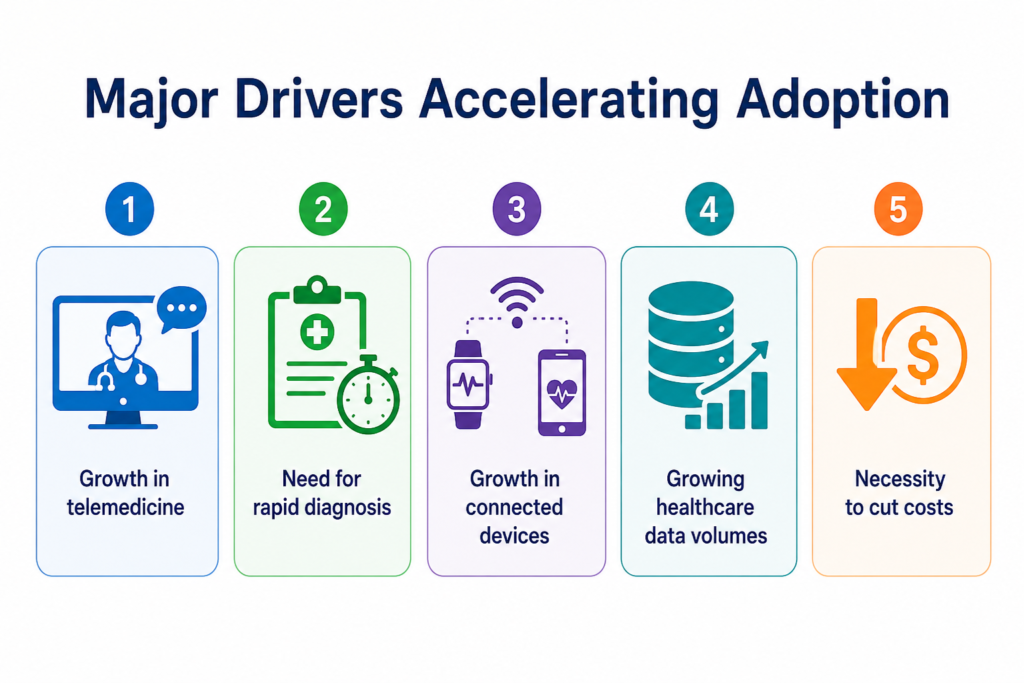
Many factors are pushing healthcare businesses toward faster digital adoption. Rising patient expectations, staff shortages, growing healthcare data, and demand for personalized care are all driving healthcare providers to modernize their systems.
Healthcare organizations are also closely watching emerging healthcare technology trends as connected healthcare systems become more common across hospitals and clinics worldwide.
The main drivers of adoption are:
- Growth in telemedicine
- Need for rapid diagnosis
- Growth in connected devices
- Growing healthcare data volumes
- Necessity to cut costs
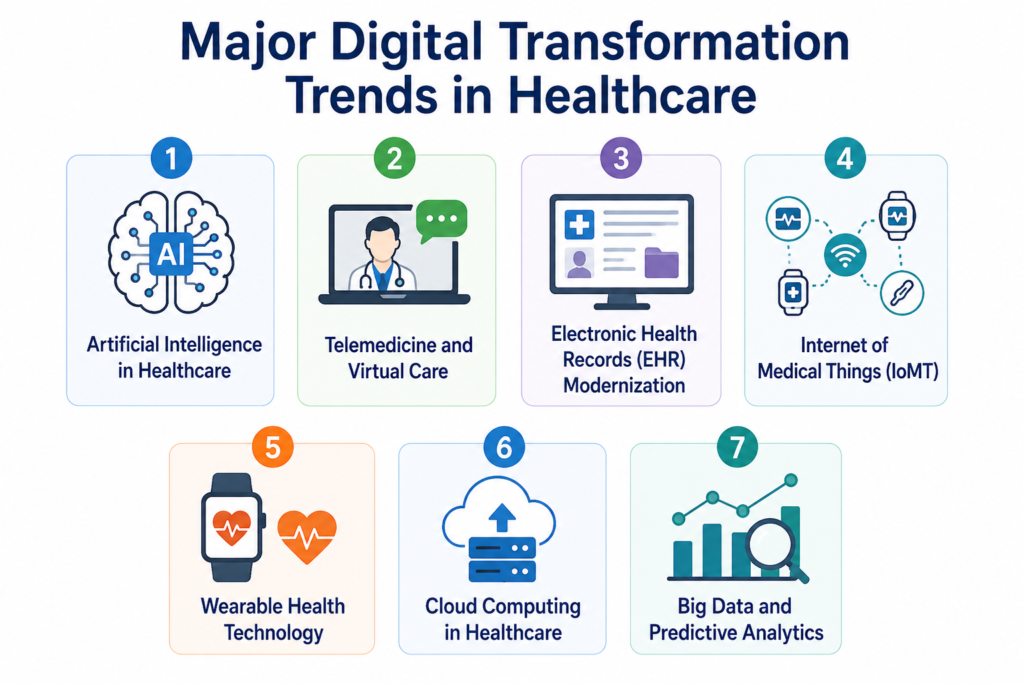
Major Digital Transformation Trends in Healthcare
Several technologies are currently shaping the future of healthcare. Some are improving diagnostics, while others are helping hospitals automate workflows and improve patient communication.
Artificial Intelligence in Healthcare
Artificial intelligence(AI) is helping healthcare professionals analyze sensitive data faster and improve diagnostic accuracy. Hospitals now use AI systems for predictive diagnostics, imaging analysis, virtual assistants, and workflow automation.
These technologies support doctors by helping them process large amounts of patient data more efficiently.
Common AI applications include:
- Predictive diagnostics
- Clinical workflow analysis
- Virtual health assistants
- Medical imaging analysis
Telemedicine and Virtual Care
One of the most rapidly expanding healthcare facilities today is telemedicine. Telemedicine involves consultations with a doctor remotely using video applications, making healthcare much more accessible while minimizing hospital visits in remote areas.
Benefits of telemedicine include:
- Faster specialist access
- Reduced hospital visits
- Better chronic disease management
- Improved patient convenience
Electronic Health Records (EHR) Modernization
EHR modernization becomes even more valuable when patient records are connected with front-office and communication systems.
With proper EHR and CRM integration, healthcare providers can improve patient data flow, reduce duplicate work, and support better coordination between clinical and administrative teams.
Improved EHR systems also support:
- Faster patient record access
- Better treatment coordination
- Reduced administrative delays
- Improved data sharing
Internet of Medical Things (IoMT)
The IoMT connects medical devices and healthcare systems through the internet, allowing healthcare providers to monitor patients continuously in real time. These connected systems improve patient monitoring and support faster medical responses when needed.
Common IoMT devices include:
- Smart glucose monitors
- Connected ECG systems
- Wireless blood pressure monitors
- Remote patient monitoring tools
Wearable Health Technology
Wearable devices are becoming more common in healthcare because they help patients track important health metrics outside clinical settings. Smartwatches and biosensors can monitor heart rate, oxygen levels, sleep patterns, and physical activity throughout the day.
Wearable technology supports:
- Preventive healthcare
- Chronic disease management
- Fitness tracking
- Remote patient monitoring
Cloud Computing in Healthcare
Healthcare businesses are moving toward cloud-based systems to improve accessibility, support remote collaboration, and help healthcare providers scale their operations more easily.
Cloud-based healthcare applications aid in:
- Remote record access
- Collaboration in real time
- Scalability of the system
- Data security
Many healthcare software applications have begun to rely on cloud technology to enable connected healthcare environments.
Big Data and Predictive Analytics
Healthcare providers collect huge amounts of patient data every day. Predictive analytics helps businesses find health risks, improve treatment planning, and optimize hospital operations by analyzing large datasets more efficiently.
Predictive analytics is mostly used for:
- Patient risk prediction
- Disease trend analysis
- Hospital resource planning
- Readmission prevention
Robotic Process Automation (RPA)
RPA helps healthcare organizations automate repetitive administrative tasks such as billing, appointment scheduling, and insurance verification. This reduces manual workload and allows healthcare staff to focus more on patient care.
RPA benefits include:
- Faster administrative processing
- Reduced manual errors
- Improved operational efficiency
- Better workflow management
Blockchain for Healthcare Data Security
Healthcare providers handle sensitive patient information, making cybersecurity a major concern. Blockchain technology helps improve data security by making transparent and secure systems for sharing and storing healthcare records.
Blockchain supports:
- Secure patient record sharing
- Better access control
- Improved data integrity
- Reduced cybersecurity risks
Digital Twins in Healthcare
Digital twins refer to virtual replicas created from real-time data generated in the healthcare sector. The following applications have been proposed for digital twin technology in the healthcare industry:
Digital twin technology is being explored for:
- Surgical planning
- Treatment simulations
- Hospital workflow optimization
- Personalized patient care
Future of Digital Healthcare
The pace of technology in healthcare is increasing fast, and the coming few years will most definitely see an increase in the transformation that healthcare will go through in hospitals, clinics, and patient care systems.
There have been massive investments in healthcare facilities, which use technological devices that make work more efficient while at the same time providing patients with a quality service experience.
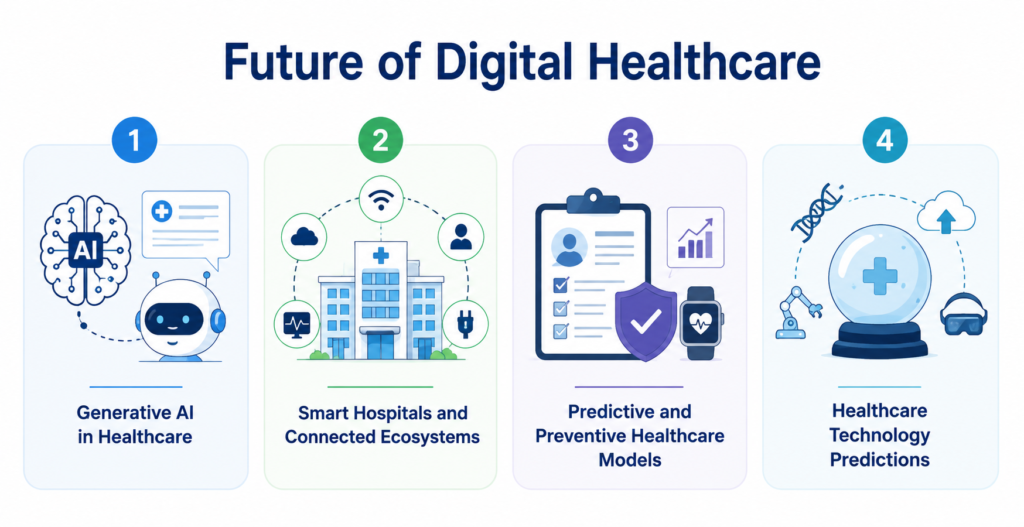
Generative AI in Healthcare
Generative AI is becoming one of the most talked-about technologies in modern healthcare because of its ability to simplify complex workflows and process large amounts of medical information quickly.
Healthcare providers are beginning to use generative AI for clinical documentation, patient communication, medical research support, and treatment recommendations.
These tools can help reduce administrative workload while giving healthcare professionals faster access to insights that support better decision-making.
Smart Hospitals and Connected Ecosystems
Intelligent hospitals are revolutionizing the conventional settings within healthcare institutions through the use of systems that enhance communication, monitoring, and efficiency within the hospital environment.
Hospitals have started adopting technologies such as connected devices for the automation of processes within and outside the hospital environment.
Through this integration of connected devices, health professionals are able to monitor patient conditions and coordinate effectively within departments.
Predictive and Preventive Healthcare Models
The current trend among healthcare organizations is to concentrate on preventive measures rather than dealing with ailments when they reach critical stages.
Predictive analytics platforms have the ability to examine the patients’ background information and make predictions based on the collected data.
This would help the doctors suggest preventive methods for their patients’ illnesses.
Healthcare Technology Predictions
The future trends in healthcare will most probably revolve around innovations that enable personalization, automation, and accessibility.
AI-powered diagnosis systems, wearable tech solutions, robotic treatment methods, and intelligent analytics platforms will definitely find their place in the practice of global health service providers.
With technological advancements continuously taking place, the healthcare sector will gain the capability to provide better and smarter services for patients, as well as enhance efficiency in the industry.
Conclusion
Digital healthcare is not just an upcoming trend but is currently revolutionizing the way hospitals function, the way people engage with the health industry, and even how doctors diagnose diseases.
Innovations such as AI, predictive analytics, telemedicine, and connected medical devices are assisting health providers in optimizing patient care.
As healthcare demands continue growing, Digital Transformation in Healthcare will remain one of the biggest priorities for healthcare organizations looking to improve efficiency, accessibility, and long-term patient outcomes.